
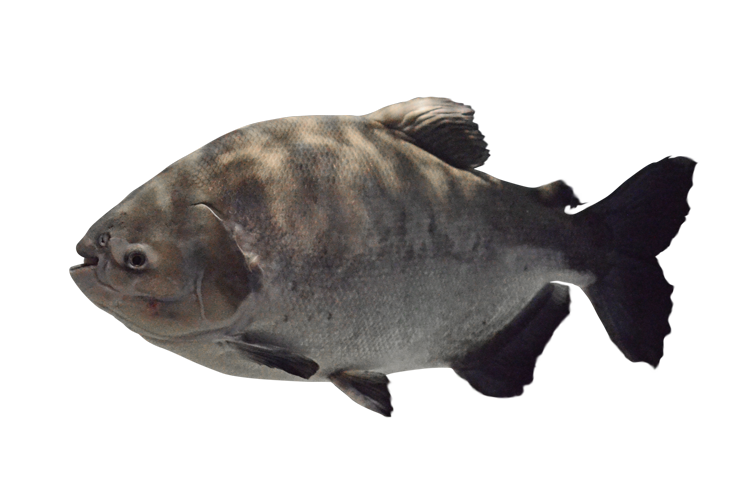
Colossoma macropomum (Cuvier, 1816)
ピラニアに紛れて身を守る幼魚
Young Fish Protecting Themselves by Resembling Piranhas
南米アマゾン川およびオリノコ川水系に生息する大型の淡水魚で、通常は体長50〜70cmほど、最大では1m近くに達します。体は強く側扁し、背側は灰褐色、腹部は黒みを帯びた独特の体色をしています。やや垂れた目つきと丸みのある体形から、どこか穏やかな印象を与える魚です。分類上はピラニア類に近縁ですが、鋭い肉食魚とは異なり、植物質を多く食べる雑食性として知られています。
幼魚は赤い腹部と銀色の光沢を持ち、レッドピラニアによく似た外見をしています。この特徴は、大型ピラニアによる捕食を避けるための保護的擬態である可能性が指摘されています。成長すると性質は比較的温和になり、主に川へ落下した果実や種子、水生植物などを食べます。そのため臼歯状に発達した歯を持ち、硬い木の実を砕くことができます。アマゾンの熱帯雨林では、果実の種子を運ぶ「種子散布者」として、生態系の維持にも重要な役割を果たしています。
食用魚としての価値も高く、南米では重要な水産資源です。成長が早く味も良いことから養殖が盛んに行われ、アメリカ合衆国、プエルトリコ、タイ、インドネシアなどへも導入されました。一部地域では野生化して定着しており、旺盛な食欲から釣りの対象魚としても人気があります。
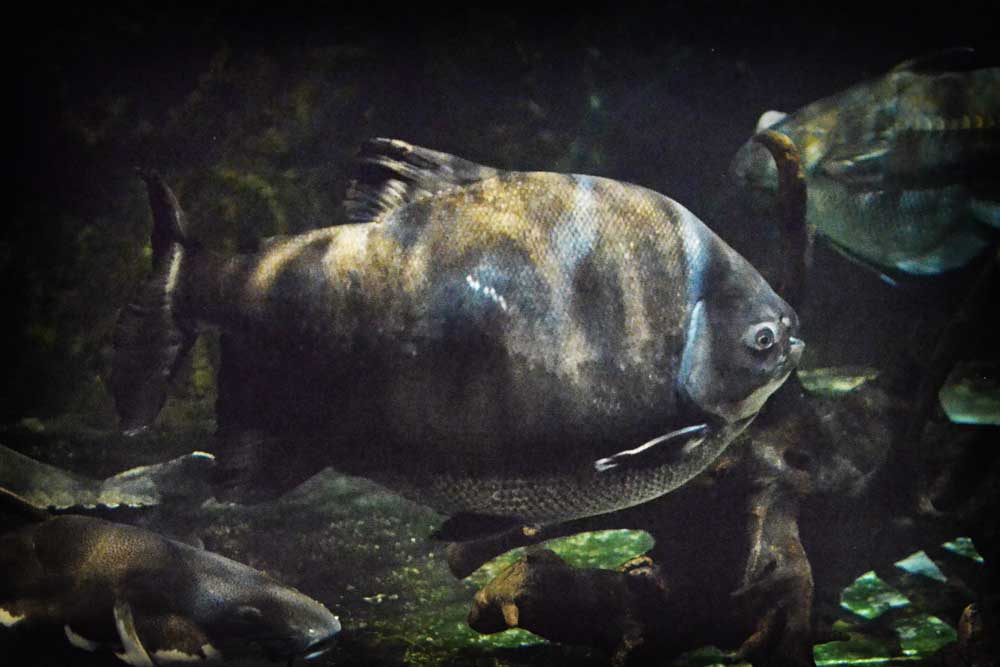
The tambaqui is a large freshwater fish inhabiting the Amazon and Orinoco River basins of South America. It usually grows to 50–70 cm in length, but can reach nearly 1 m at maximum size. Its body is strongly laterally compressed, with a grayish-brown back and a dark underside. Its drooping eyes and rounded body give it a somewhat gentle appearance. Although closely related to piranhas, the tambaqui is not a fierce predator, but an omnivorous fish that feeds mainly on plant material.
Juveniles have reddish bellies and silvery markings, closely resembling red-bellied piranhas. This appearance is thought to function as protective mimicry that helps deter attacks from larger piranhas. As they mature, tambaqui become relatively peaceful and feed mainly on fallen fruits, seeds, and aquatic plants. Their molar-like teeth are highly developed, allowing them to crush hard nuts and seeds. In the Amazon rainforest, they also play an important ecological role as seed dispersers, helping maintain the forest ecosystem.
Because of its good flavor and rapid growth, the tambaqui is highly valued as a food fish and is widely farmed in South America. It has also been introduced to regions such as the United States, Puerto Rico, Thailand, and Indonesia. In some areas, escaped individuals have established wild populations. Owing to its strong appetite and powerful fight, it is also popular among sport fishers.
参考文献
BE-PAL | 南米でもっともうまい淡水魚! 種子を運ぶコロソマの炭火焼きは寒ブリ級の絶品だ | (2024年11月7日) 2025年5月4日閲覧
釣りに行ってきます。 | コロソマという魚について | (2021年8月15日) 2025年5月4日閲覧
Brejão, G.L. 2024. Colossoma macropomum. The IUCN Red List of Threatened Species 2024: e.T49830760A85567354. 2025年5月4日閲覧