
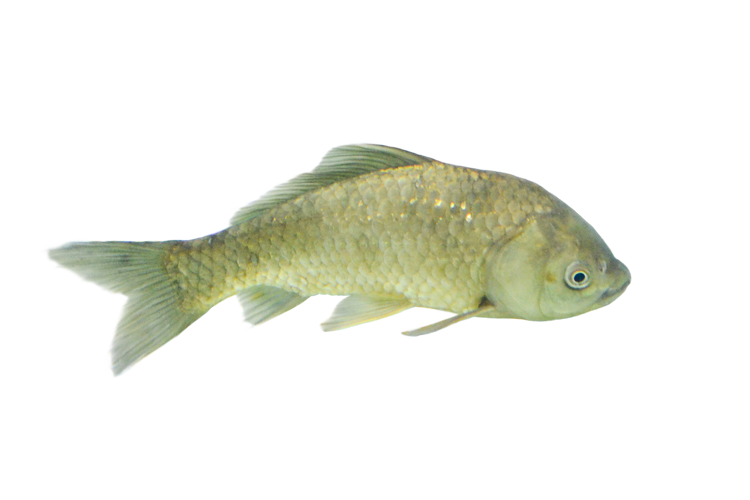
Carassius buergeri subsp. 1
分類が難しいフナの仲間
A Crucian Carp with a Complex Taxonomic History
体高が低く、細長い体形をしたフナの仲間です。全長は25cmほどになり、頭部と目がやや大きく、口も大きく斜め上を向きます。北陸や山陰地方のほか、福井県の三方五湖、長野県の諏訪湖などに分布が知られています。諏訪湖では「アカブナ」と呼ばれることもあり、地域に根付いた身近な魚の一つです。細長い体形が「ナガブナ」という名前の由来と考えられています。
しかし、ナガブナは分類上、単純に一つの種として整理できる魚ではありません。日本のフナ類は形態がよく似ているうえ、倍数性にも大きな違いがあります。国立科学博物館ではナガブナを Carassius auratus の亜種として扱っていますが、資料によって学名や分類上の位置づけには違いがあります。遺伝子と形態を比較した研究では、日本の主要な2倍体フナが、東北のキンブナ、中部のナガブナ・ニゴロブナ、南日本のオオキンブナという地域集団に分かれることが示されています。
ナガブナの興味深い特徴は、染色体にも表れています。1973年の研究では、諏訪湖産のナガブナは染色体数2n=100の2倍体でした。一方、北海道産では調査した5個体がすべて雌で、2n=156の3倍体でした。このような3倍体の雌がどのように生じたのかについて、研究者らはギンブナで知られている雌性発生との関係を指摘しています。その後の遺伝学的研究からも、日本のフナ類には地域によって遺伝的背景や倍数性の異なる集団が存在することが分かっています。
つまりナガブナは、細長い体形という外見上の特徴だけでは捉えきれない魚です。地域によって遺伝的背景や染色体数が異なり、近縁なフナ類との境界も複雑です。そのため、ナガブナは日本のフナ類に見られる分類と生殖の多様性を理解するうえでも、興味深い存在といえます。
The Slender Crucian Carp is a crucian carp characterized by its low, elongated body. It grows to about 25 cm in length and has a relatively large head and eyes, with a large mouth that opens obliquely upward. It is known from the Hokuriku and San’in regions, as well as Lake Mikata in Fukui Prefecture and Lake Suwa in Nagano Prefecture. At Lake Suwa, it is also known locally as “Akabuna,” or “red crucian carp,” and has long been a familiar fish in the region. Its Japanese name, Nagabuna, is thought to refer to its elongated body shape.
Taxonomically, however, the Slender Crucian Carp is not a fish that can be easily classified as a single distinct species. Japanese crucian carps are difficult to distinguish morphologically, while also showing considerable variation in ploidy. The National Museum of Nature and Science currently treats the Slender Crucian Carp as a subspecies of Carassius auratus, although its scientific name and taxonomic position have been treated differently in different sources. A study comparing genetic and morphological characteristics found that the major diploid crucian carp populations in Japan could be divided into regional groups: Kinbuna in the Tohoku region, Nagabuna and Nigrobuna in central Japan, and Okikinbuna in southern Japan.
An intriguing feature of the Slender Crucian Carp is its variation in chromosome number. A 1973 study found that specimens from Lake Suwa were diploid, with 2n = 100 chromosomes. In contrast, all five specimens examined from Hokkaido were females and were triploid, with 2n = 156 chromosomes. The researchers suggested that the occurrence of such triploid females might be related to gynogenesis, a reproductive process known in the Ginbuna, or Silver Crucian Carp. Later genetic studies have also shown that Japanese crucian carp include regional populations with different genetic backgrounds and ploidy levels.
Thus, the Slender Crucian Carp cannot be fully understood simply from its distinctive elongated body. Its genetic background and chromosome number vary among regional populations, while its boundaries with closely related crucian carps remain complex. It is therefore an intriguing fish for understanding the diversity of classification and reproduction found among Japan’s crucian carps.
参考文献
小林 弘・越智 尚子・竹内 直政(1973)「フナ属魚類の染色体の比較研究(続報):特にニゴロブナ,ナガブナ,ギンブナについて」『魚類学雑誌』20(1): 7–12. 2026年10月24日閲覧
小林 弘・川島 康代・竹内 直政(1970)「フナ属魚類の染色体の比較研究,特にギンブナに現われた倍数性について」『魚類学雑誌』17(4): 153–160. 2026年10月24日閲覧
小林 弘ほか(2007年前後)/科学研究費補助金 基盤研究(B)「フナの遺伝子および行動の解析によるキンギョのルーツ解明」KAKENHI-PROJECT-17405035. 2026年10月24日閲覧
『散歩しながら諏訪湖に学ぶ』諏訪湖クラブ (2020年10月) 2026年10月24日閲覧