
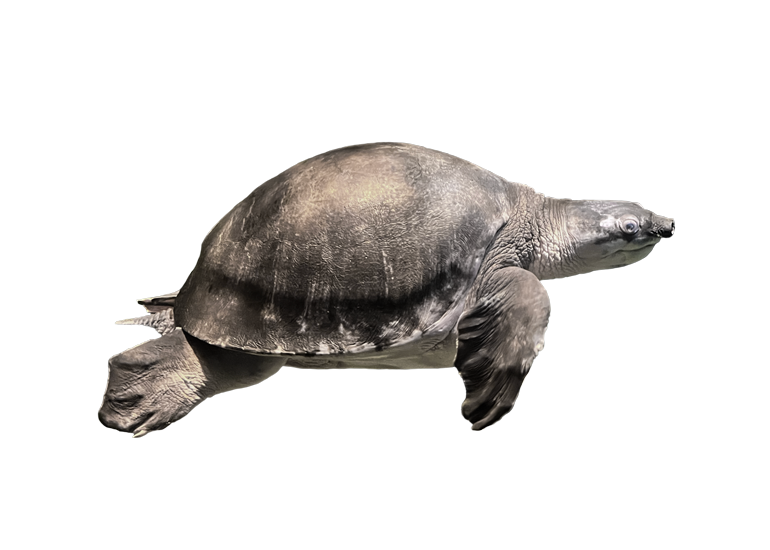
Carettochelys insculpta (Ramsay, 1886)
水中で匂いを感じ取る特異な鼻
A Unique Nose That Senses Odors Underwater
ニューギニア島南部とオーストラリア北部の河川や河口域に生息する、スッポンモドキ科唯一の現生種です。甲長は最大57cm、体重は22kgに達します。甲羅は硬い角質の甲板に覆われず、その表面を連続した皮膚が覆っています。前肢は水をかくのに適したひれ状で、第1、第2指だけに爪があり、残りの指は先端まで強く水かきでつながっています。後肢もひれ状で、前肢ほどではないものの遊泳に適した形をしています。こうした特徴から、水中生活に高度に適応したカメといえます。
なかでも目を引くのが、名前の由来にもなったブタのような鼻です。鼻先は肉質で幅広く、前方から下向きに突き出し、その先端に鼻孔があります。この特徴は、単なる外見上の奇妙さだけではありません。2023年の研究では、鼻腔の上部と下部の両方が嗅覚上皮で覆われ、そこには嗅覚受容ニューロンが広く分布していることが明らかになりました。一般的なカメでは空気中と水中の匂いを受け取る嗅覚器官が異なるのに対し、スッポンモドキでは一つの嗅覚系として構成され、水中の匂いを感知することに特化したものと考えられています。
さらに2024年には、マイクロCTを用いて頭蓋骨や脳、神経などを詳しく調べた研究が発表されました。頭蓋内の構造を再現したところ、嗅葉に対応する領域は、比較された現生カメ類の中でも大きく見えることが示されました。また、嗅覚神経は鼻腔から前方へ伸び、鼻先の後方につながる多数の枝に分かれることも確認されています。ただし、こうした特徴だけから嗅覚能力の高さや、特徴的な鼻の形が嗅覚のために進化したと断定することはできません。
スッポンモドキは、葉や果実、種子、水生植物などを食べる一方、軟体動物や甲殻類、昆虫、魚類なども利用する雑食性です。季節によって利用する餌が変わり、河川だけでなく氾濫によって水域が広がる環境も利用します。ひれ状の四肢、皮膚で覆われた甲羅、そして水中の匂いを感じ取る特殊な嗅覚系。ブタのように見える鼻もまた、水の中で暮らすこのカメの興味深い特徴の一つなのです。

The Pig-nosed Turtle is the only living species in the family Carettochelyidae. It inhabits rivers and estuarine areas in southern New Guinea and northern Australia. Its carapace can reach 57 cm in length, and it may weigh up to 22 kg. Unlike most turtles, its shell is not covered with hard scutes but with continuous skin. Its forelimbs are modified into flippers for swimming; only the first and second digits bear claws, while the remaining digits are joined by extensive webbing. The hindlimbs are also flipper-like and adapted for swimming, although less specialized than the forelimbs. These features reflect its highly aquatic lifestyle.
One of its most striking features is its broad, fleshy, pig-like snout, which gives the turtle its common name. The snout projects forward and downward, with the nostrils located at its tip. This unusual feature is more than just a curious appearance. A 2023 study found that both the upper and lower regions of the nasal cavity are lined with olfactory epithelium, with olfactory receptor neurons widely distributed throughout them. Unlike most turtles, in which different olfactory structures are involved in detecting odors in air and water, the Pig-nosed Turtle appears to possess a single olfactory system specialized for detecting odors underwater.
In 2024, a detailed study using micro-computed tomography examined the skull, brain, nerves, and other structures of the Pig-nosed Turtle. The reconstructed intracranial anatomy showed that the region corresponding to the olfactory lobes appears relatively large compared with those of other living turtles examined in the study. The olfactory nerves also extend forward from the nasal cavity and divide into numerous branches toward the rear of the snout. However, these features alone do not demonstrate that the turtle has an exceptionally strong sense of smell, nor can they establish that the distinctive shape of its snout evolved specifically for olfaction.
The Pig-nosed Turtle is an omnivore. It feeds on leaves, fruits, seeds, and aquatic plants, while also consuming mollusks, crustaceans, insects, fish, and other animal matter. Its diet changes with the seasons, and it uses not only rivers but also habitats that expand during seasonal flooding. Flipper-like limbs, a skin-covered shell, and a specialized olfactory system capable of detecting odors underwater are all fascinating features of this highly aquatic turtle. Its pig-like nose is yet another remarkable adaptation to life in the water.
参考文献