
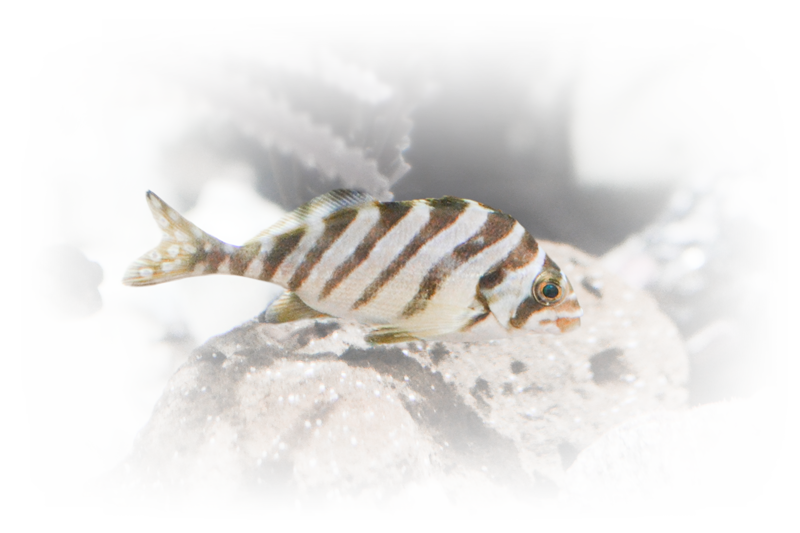
Goniistius zonatus (Cuvier, 1830)
斜めに走る独特の縞模様
Distinctive Stripes Running Obliquely
日本沿岸の岩礁や藻場に生息する、タカノハダイ科の魚です。体長は最大で約45cmになり、体側には茶褐色の斜めの帯が並びます。尾鰭も茶褐色で、白い円形の斑点が多数散らばるのが特徴です。胸鰭の下部の軟条は太く長く、岩場で休む際などに体を支えることもあります。
比較的浅い海の岩礁や海藻の生える場所を好み、幼魚は潮だまりでも見られます。底生の小動物を中心に食べ、甲殻類や多毛類などを捕食します。一方、藻類も食べることが知られており、季節によって食性が変化する可能性があります。幼魚は成魚とは異なる一様な銀色に近い体色を示し、成長するにつれて特徴的な斜帯が現れます。
「タカノハダイ」という和名は、体側に並ぶ斜めの模様が鷹の羽を思わせることに由来すると考えられています。地方名には「ヒダリマキ」などがあり、同じタカノハダイ科のミギマキと対になる呼び名としても知られています。ミギマキとは体の模様がよく似ていますが、タカノハダイは尾鰭全体が茶褐色で白い斑点が散らばるため、比較的容易に見分けられます。
食用にもなる魚ですが、磯臭さが強いとして評価されないこともあります。ただし、その臭いは季節や生息場所、個体によって異なり、冬に漁獲された新鮮な個体は美味しいとする報告もあります。身近な岩礁魚でありながら、独特の縞模様と白斑のある尾鰭、長く伸びた胸鰭という特徴的な姿をもつ魚です。
The Spottedtail Morwong is a member of the family Latridae and inhabits rocky reefs and seaweed beds along the coast of Japan. It can grow to about 45 cm in length and is characterized by a series of oblique, brownish bands across the body. The caudal fin is also brownish and scattered with numerous white, round spots. The lower rays of the pectoral fins are thick and elongated, and may help support the fish when it rests among rocks.
It prefers relatively shallow rocky areas and places where seaweeds grow, and juveniles can sometimes be found in tide pools. It feeds mainly on small benthic animals, including crustaceans and polychaete worms. It is also known to consume algae, suggesting that its diet may vary depending on the season. Juveniles have a rather uniform, silvery coloration that differs from that of adults, with the characteristic oblique bands developing as they grow.
The Japanese name Takanohadai is thought to refer to the oblique markings on its body, which resemble the pattern of a hawk’s feathers. One of its regional names is Hidarimaki, a name that is also known in contrast to Migimaki, a similarly patterned species in the same family. Although the two species can look quite similar, the Spottedtail Morwong can be distinguished relatively easily by its brownish caudal fin covered with white spots.
The species is also used as a food fish, although it is sometimes considered undesirable because of its strong, fishy odor. The odor can vary depending on the season, habitat, and individual fish, and freshly caught specimens taken in winter are reported to be good to eat. Despite being a familiar inhabitant of rocky shores, its distinctive combination of oblique bands, a white-spotted caudal fin, and elongated pectoral-fin rays gives it a particularly recognizable appearance.
参考文献
Fricke, R., Eschmeyer, W. N. & Van der Laan, R. (eds.). Eschmeyer’s Catalog of Fishes: Goniistius zonatus (Cuvier, 1830). 2026年10月12日閲覧
京都府農林水産技術センター海洋センター | 丹後の海の生き物(タカノハダイ) 2026年10月12日閲覧
海遊館 | ブログ | 地方名はおもしろい!!| (2013年11月8日) 2026年10月12日閲覧