
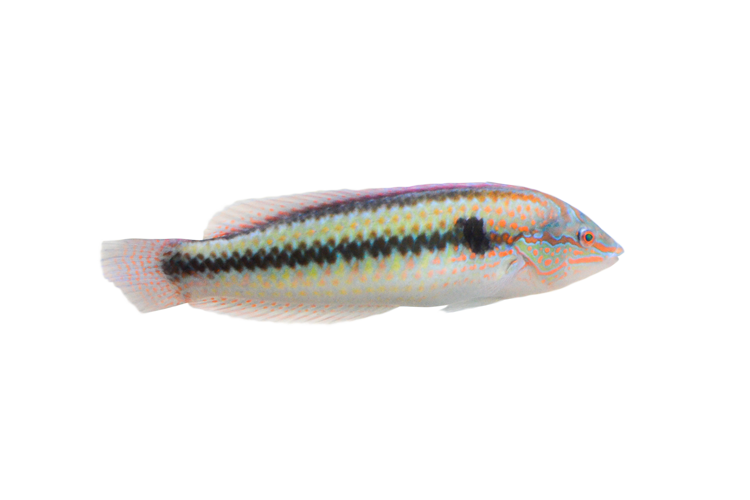
Parajulis poecilopterus (Temminck et Schlegel, 1845)
「九線」を持つ魚
The Fish with Nine Lines
日本沿岸の岩礁や砂地でよく見られるベラ科の魚です。北海道南部以南の日本各地から朝鮮半島、台湾、中国沿岸などに分布し、岩礁の周囲や海藻の生える砂底などに生息します。全長は30cmほどになり、雌より雄の方が大型になります。昼間は海底を泳ぎながら、甲殻類や多毛類などの小さな底生動物を探して食べます。
「キュウセン」という名前は、雌の体側に見られる約9本の縦の線に由来し、「九線」と書きます。雌は赤褐色を帯びた体に暗色の縦帯が並び、雄は黄緑色から青緑色を帯びて胸鰭の後方に黒い斑紋が現れます。地方では雌を「アカベラ」、雄を「アオベラ」と呼ぶこともあり、雌雄でまるで別の魚のように姿が異なります。
その理由は、キュウセンが成長にともなって性転換する魚だからです。多くの個体は雌として成長し、一定の大きさになると雄へ変わります。このような雄は「二次雄」と呼ばれます。一方、生まれたときから雄として繁殖する「一次雄」も存在し、こちらは雌に似た体色をしているため、外見だけでは雌との区別が難しいことがあります。
夜になると砂の中へ潜って休み、危険を感じたときにも砂中へ身を隠します。冬には低水温を避けるため活動を抑え、砂中で過ごすこともあります。身近な沿岸魚ですが、「九線」という名前の由来となった雌の縞模様、成長にともなう性転換、そして砂に潜る習性など、興味深い特徴をいくつも備えた魚です。
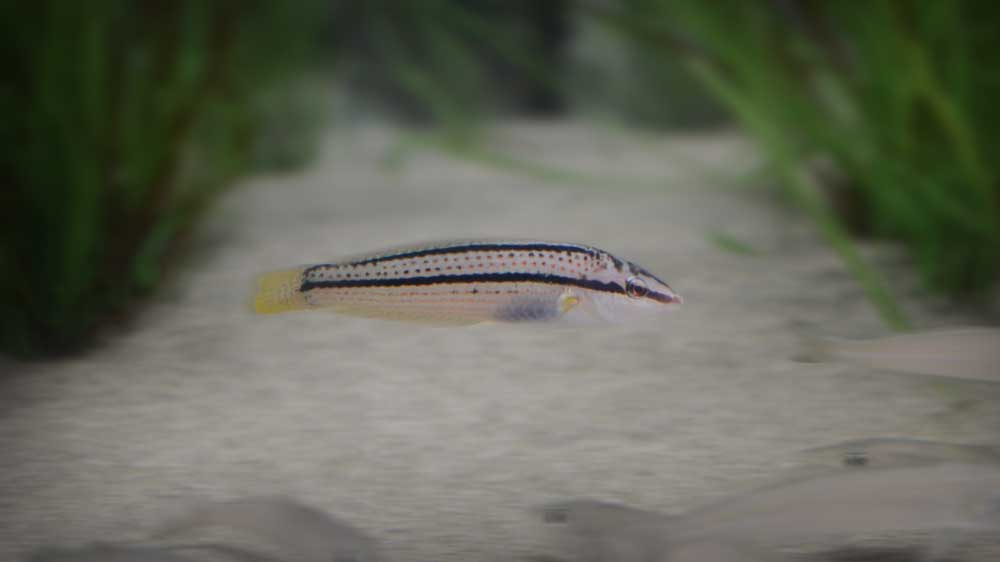
Female Multicolorfin Rainbowfish
The Multicolorfin Rainbowfish is a wrasse commonly found along the rocky shores and sandy bottoms of Japan. It is distributed from southern Hokkaido southward throughout Japan, as well as around the Korean Peninsula, Taiwan, and coastal China. It inhabits areas around rocky reefs and sandy bottoms with seaweed. It grows to about 30 cm in length, with males becoming larger than females. During the day, it searches the seafloor for small bottom-dwelling animals such as crustaceans and polychaete worms.
The Japanese name “Kyusen” literally means “nine lines” and refers to the approximately nine vertical lines visible along the body of females. Females have reddish-brown bodies marked with dark vertical bands, whereas males are yellowish-green to blue-green and develop a black blotch behind the pectoral fin. In some regions, females are called “Akabera” and males “Aobera.” Their strikingly different appearances can make them look like entirely different fish.
This difference is related to the species’ ability to change sex as it grows. Most individuals mature first as females and later change into males after reaching a certain size. Such males are known as secondary males. There are also primary males, which are male from birth and have coloration resembling that of females, making them difficult to distinguish from females by appearance alone.
At night, the fish buries itself in sand to rest and also dives into the sand when threatened. During winter, it may reduce its activity and remain buried in the sand to avoid low water temperatures. Although it is a familiar fish of Japanese coastal waters, the Multicolorfin Rainbowfish has several remarkable characteristics, including the female body markings that gave rise to its Japanese name, sex change as it grows, and its habit of burying itself in sand.
参考文献
Froese, R. & Pauly, D. (eds.). FishBase: Parajulis poecilepterus (Temminck & Schlegel, 1845). 2026年10月3日閲覧
ぼうずコンニャクの市場魚介類図鑑 | キュウセン 2026年10月3日閲覧
新潟水族館マリンピア日本海 | キュウセン 2026年10月3日閲覧
鶴岡市立加茂水族館 | 庄内動物図鑑 | キュウセン 2026年10月3日閲覧