
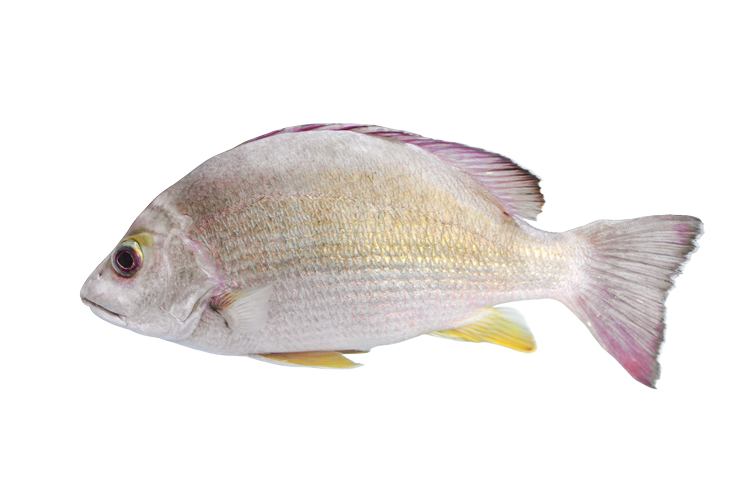
Lutjanus fulvus (Forster, 1801)
黒い尾びれのスナッパー
The Snapper with a Black Tail
インド洋から西・中部太平洋にかけて広く分布するフエダイ科の魚で、日本では南日本から琉球列島、小笠原諸島などに生息します。全長は最大40cmほど。体は黄褐色から灰褐色で、体側には鱗に沿って細い黄色から黄褐色の線が並びます。胸鰭、腹鰭、臀鰭は黄色く、背鰭と尾鰭は赤褐色から黒っぽい色をしています。なかでも黒っぽい尾鰭と、その後縁を縁取る細い白色部が特徴です。
この特徴から英名はBlacktail snapperと呼ばれます。「Blacktail」は黒っぽい尾鰭にちなみ、「snapper」はフエダイ科の魚に広く使われる呼び名です。強い顎と鋭い歯をもち、口を素早く閉じて獲物を捕らえることから、「snap(パチンと閉じる)」に由来すると説明されています。幼魚では体側の黄色い縦線がより鮮明で、成長すると次第に目立たなくなります。
成魚はラグーンや波の穏やかなサンゴ礁、礁の斜面などに生息し、深い穴や大きな岩の周辺を好みます。夜になると活動が活発になり、小魚、甲殻類、頭足類、ナマコ類などを捕食します。一方、幼魚は浅いマングローブや河口、河川下流部などを利用することがあり、成長に伴って生息環境を変えていきます。
本来の分布域とは別に、1950年代には食用魚としてハワイへ移入されました。フランス領ポリネシアのモーレア島からオアフ島へ運ばれて放流され、その後、繁殖して定着しました。やがてハワイ諸島の各地へ分布を広げましたが、現在も個体数は多くないとされています。
日本では沖縄などで食用魚として利用され、地域によって異なる地方名でも呼ばれています。沖縄本島では「スピイナクー」、八重山では「ヤマトゥピー」や「ビタロー」などの名があります。なお、本種を含む大型のフエダイ類は、地域によってシガテラ食中毒の原因となることがあるため、食用には注意が必要です。
Widely distributed from the Indian Ocean across the western and central Pacific, the Blacktail Snapper is a member of the snapper family, Lutjanidae. In Japan, it occurs from southern Honshu southward, including the Ryukyu Islands and the Ogasawara Islands. It can reach about 40 cm in total length. The body is yellowish brown to grayish brown, with fine yellow to yellowish-brown lines following the scales along the sides. The pectoral, pelvic, and anal fins are yellow, while the dorsal and caudal fins range from reddish brown to dark in color. Its most distinctive features are the dark caudal fin and the narrow white margin along its rear edge.
These features give the species its English name, Blacktail Snapper. “Blacktail” refers to the dark caudal fin, while “snapper” is a common name used for fishes of the family Lutjanidae. The term is explained as referring to their strong jaws and sharp teeth and their ability to snap their mouths shut quickly when seizing prey. Juveniles have more prominent yellow vertical lines along the body, which become less conspicuous as they grow.
Adults inhabit lagoons, sheltered coral reefs, and reef slopes, often favoring deep crevices and areas around large rocks. They become more active at night, feeding on small fishes, crustaceans, cephalopods, sea cucumbers, and other prey. Juveniles may inhabit shallow mangroves, estuaries, and lower reaches of rivers, changing their habitats as they grow.
Outside its native range, the species was introduced to Hawaii in the 1950s as a food fish. Individuals were transported from Moorea in French Polynesia to Oahu and released, where they subsequently reproduced and became established. The population later spread to other Hawaiian Islands, although it is still considered relatively uncommon there.
In Japan, the Blacktail Snapper is used as a food fish, particularly in Okinawa, where it is known by various local names. On Okinawa Island, it is called “Supiinaku,” while in the Yaeyama Islands, names such as “Yamatupii” and “Bitarō” are used. Like other large snappers, it can cause ciguatera poisoning in some regions, so caution is required when consuming it.
参考文献
Koskey, Jennifer “This is the Lutjanus fulvus or Blacktail Snapper” Ocean Project Maui. 2026年10月31日閲覧
“Lutjanus fulvus (Forster, 1801) Blacktail Snapper” Fishes of Andaman Sea, National Museum of Nature and Science. 2026年10月31日閲覧