
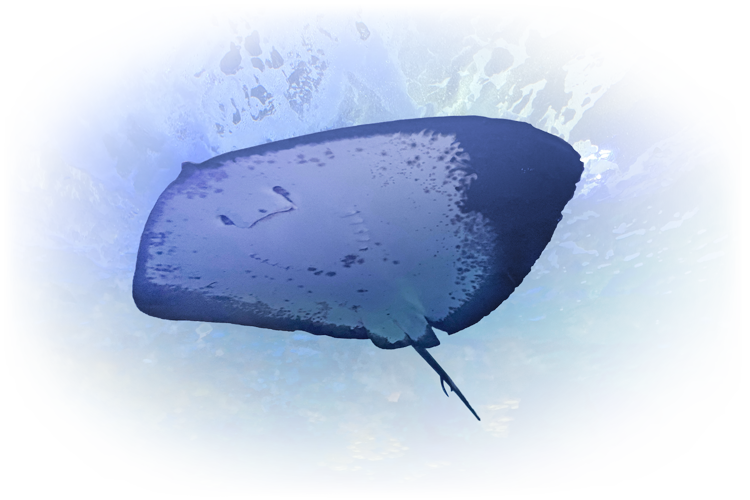
Bathytoshia brevicaudata Hutton, 1875
海で見つかる尾のない巨大エイ
Giant Rays Found Without Their Tails
日本沿岸からロシア極東にかけての北半球と、オーストラリア、ニュージーランド、南部アフリカなどの南半球に生息する大型のエイです。日本では北海道以南の各地で見られます。体盤は幅広い菱形で、背面は暗褐色から灰褐色。体盤には小さな白い斑点が散らばり、星を散りばめたように見えることが「ホシエイ」の名の由来とされています。英名のShort-tail Stingrayは、体盤に比べて尾が短いことに由来します。
大型になることも特徴で、体盤幅は1.8mほど、全長では4mを超える記録があります。尾は体盤より短く、基部から先にかけて細くなり、その途中には鋭い毒棘があります。海底近くを泳ぎながら、魚類や甲殻類、貝類などを捕食します。砂泥底に潜む獲物を探す際には、視覚だけでなく、海底から伝わる刺激や獲物が発する微弱な電気信号なども利用すると考えられています。
繁殖は体内受精で、母体内で胚を育てて子どもを産む胎生です。生まれた幼魚はすでに親とよく似た姿をしており、比較的大きな体で生まれます。大型の体をもつ一方、海底でゆったりと過ごす姿からは想像しにくいほど、遊泳能力にも優れています。
漁業では沿岸トロールや地引き網、延縄、巻き網などで混獲されることがあります。利用されない個体は放流・廃棄されますが、尾を切断される場合があります。実際に尾のないホシエイがダイバーによって観察されており、捕獲・放流された後も生き残る個体が少なくないことが示唆されています。
The Short-tail Stingray is a large ray found in both the Northern and Southern Hemispheres, ranging from the waters of Japan to the Russian Far East in the north, and from Australia and New Zealand to southern Africa in the south. In Japan, it occurs from Hokkaido southward along the coast. Its broad, diamond-shaped disc is dark brown to grayish brown on the upper surface. Numerous small white spots are scattered across the disc, giving it a star-studded appearance and inspiring its Japanese name, Hoshiei, meaning “star ray.” Its English name, Short-tail Stingray, refers to its relatively short tail compared with the width of its disc.
The species is notable for its large size. The disc can reach about 1.8 meters across, while individuals exceeding 4 meters in total length have been recorded. The tail is shorter than the disc and tapers toward the tip, with a sharp venomous spine along its length. It generally swims close to the seafloor, feeding on fishes, crustaceans, mollusks, and other prey. When searching for prey hidden in sandy or muddy bottoms, it is thought to use not only vision but also sensory cues from the seafloor and the weak electrical signals produced by its prey.
Reproduction occurs through internal fertilization, and the species is viviparous, with embryos developing inside the mother before birth. The young are already similar in form to adults when they are born and are relatively large. Despite its massive body, the Short-tail Stingray is also an capable swimmer, although its slow movements along the seafloor can make this less apparent.
The species is sometimes caught as bycatch in coastal trawls, seine nets, longlines, and purse seines. Individuals that are not retained may be discarded or released, and some have their tails removed. Divers have observed Short-tail Stingrays without tails, suggesting that at least some individuals survive after being captured and released.
参考文献
Florida Museum of Natural History, University of Florida. Short-tail Stingray (Bathytoshia brevicaudata). 2026年11月7日閲覧
Froese, R. & Pauly, D. (eds.). FishBase. Bathytoshia brevicaudata (Hutton, 1875) – Short-tail Stingray. 2026年11月7日閲覧