
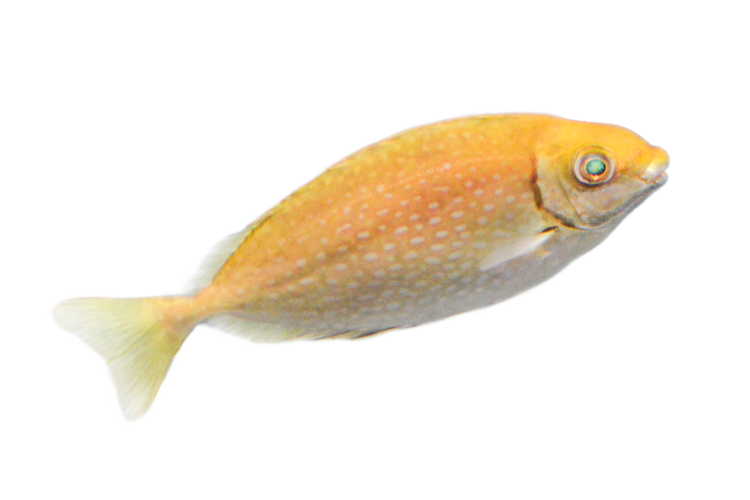
Siganus fuscescens (Houttuyn, 1782)
アイゴのゼンマイとは?
The Coiled Intestine of a Rabbitfish
東アジアからオーストラリアまでの西太平洋に広く分布するアイゴ科の魚です。日本では本州中部以南を中心に、浅い沿岸域や藻場、岩礁、内湾などに生息し、汽水域に入ることもあります。全長は最大約40cm、一般的には25cmほどです。体は左右に平たく、体色は黄褐色から褐色、オリーブ色など個体差があり、体側には細かな白色点が見られます。警戒すると体色が変化し、まだら模様が強く現れることがあります。
アイゴの特徴は、背びれ、腹びれ、尻びれに並ぶ鋭い毒棘です。背びれには13本、尻びれには7本の棘があり、刺されると強い痛みを生じます。毒は魚が死んだ後も棘に残るため、釣り上げた個体や調理の際にも注意が必要です。「アイゴ」という名前は、触れると肌を刺すイラクサの古称「アイ」に由来し、棘を持つ魚を意味するものとする説があります。
主に昼間に活動し、群れをつくって海藻や海草などを食べます。幼魚は糸状の藻類を、成魚は葉状の大型藻類や海草を利用します。植物質を主食とするアイゴは長い腸を持ち、その腸は腹腔内できれいな渦巻き状に巻かれています。この形から、地域によって「ゼンマイ」や「うずまき」と呼ばれ、食用にもされます。
瀬戸内海沿岸や四国の一部では、この腸を珍味として食べる食文化があります。身は上品な白身で、噛むほどに旨味が増すとされます。毒棘と独特の臭いから敬遠されることもありますが、適切に下処理すれば、カワハギを思わせる濃厚な旨味と脂の甘味を楽しめる魚です。
The Mottled Spinefoot is a member of the rabbitfish family, Siganidae, and is widely distributed across the western Pacific, from East Asia to Australia. In Japan, it occurs mainly south of central Honshu, inhabiting shallow coastal waters, seaweed beds, rocky reefs, and bays, and it may also enter brackish waters. It can reach about 40 cm in length, although individuals around 25 cm are more common. Its laterally compressed body varies in color from yellowish brown to brown and olive, with individual variation. Numerous small white spots can be seen along the sides, and when the fish is alarmed, its body coloration changes and a mottled pattern becomes more pronounced.
One of its most distinctive features is the series of sharp venomous spines on the dorsal, pelvic, and anal fins. The dorsal fin has 13 spines and the anal fin has 7. A puncture causes intense pain, and the venom remains associated with the spines even after the fish has died, so care is necessary when handling freshly caught fish or preparing them for cooking. One theory holds that the Japanese name aigo comes from an old word, ai, referring to stinging nettles, and go, meaning fish, alluding to its sharp spines.
The Mottled Spinefoot is mainly active during the day and often forms schools while feeding on seaweeds and seagrasses. Juveniles feed on filamentous algae, while adults consume larger algae and seagrasses. As an adaptation to its plant-based diet, it has a long intestine that is tightly coiled within the abdominal cavity. Because of this distinctive shape, the intestine is locally called zenmai or uzumaki, meaning “fiddlehead fern” or “spiral,” respectively, and is also eaten as a delicacy in some regions.
Along the Seto Inland Sea and in parts of Shikoku, eating the intestine as a delicacy is part of the local food culture. The flesh is a delicate white meat that is said to develop more flavor the more it is chewed. Although the fish is sometimes avoided because of its venomous spines and distinctive odor, when properly cleaned and prepared, it can offer rich umami and a subtle sweetness of fat reminiscent of filefish.
参考文献
『アイゴ』(2016), 徳島県立農林水産総合技術支援センター 水産研究課. 2026年9月22日閲覧
TSURINEWS | 西日本で食される海の『ゼンマイ』はアイゴの内臓 | (2022年7月18日) 2026年9月22日閲覧
小枝圭太. 畑晴陵, 山田守彦, 本村浩之(編), 2018.『黒潮あたる鹿児島の海 内之浦漁港に水揚げされる魚たち』鹿児島大学総合研究博物館,鹿児島市,520 pp. 2026年9月22日閲覧