
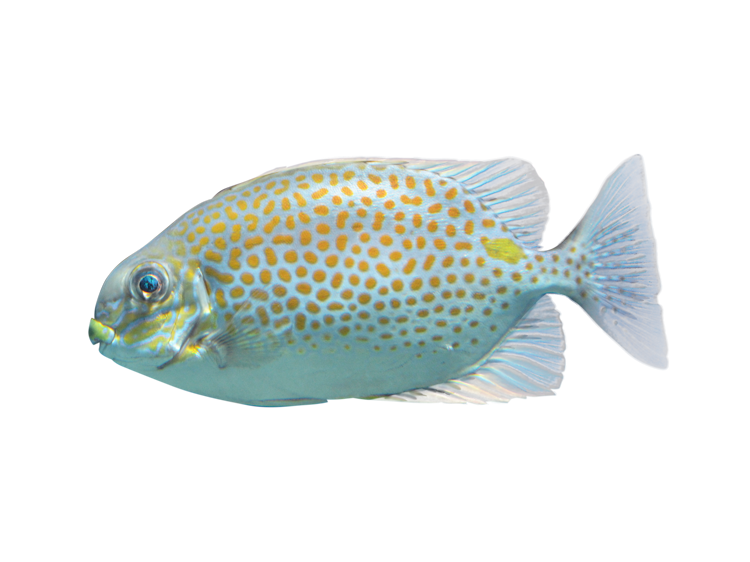
Siganus guttatus (Bloch, 1787)
毒棘に注意!美味しいものには棘がある
Beware the Venomous Spines — Delicious Fish Come with Sharp Defenses
ゴマアイゴは、スズキ目アイゴ科に属する魚で、東インド洋から西太平洋にかけての熱帯・亜熱帯海域に広く分布しています。日本では主に琉球列島周辺に生息し、沿岸の岩礁域やサンゴ礁、汽水域などで見られます。全長は35〜50cmほどになり、体側には細かな胡麻状の斑点や金色の縞模様が入ります。英名 “Goldlined spinefoot” は、この金色の線模様と、鋭い棘を持つことに由来します。
背びれや腹びれ、尻びれの棘には毒腺があり、刺されると激しい痛みを伴います。命に関わることはほとんどありませんが、痛みが数時間続くこともあるため、釣りや素手での取り扱いには注意が必要です。なお、「アイゴ」という名前は、アイヌ語でイラクサを意味する「あい」と、魚を表す「ご」に由来するとされ、棘を持つ魚という特徴をよく表しています。
主に海藻類を食べる植食性の魚で、群れを作って浅海を泳ぐ姿が見られます。一方で、海藻を食べ尽くしてしまうことで「磯焼け」の一因になる場合もあります。沖縄では「カーエー」と呼ばれ、古くから親しまれてきた重要な水産資源です。刺身や煮付け、塩焼きなどで食べられ、独特の風味を持つ魚として地域の食文化に根付いています。
The goldlined spinefoot is a rabbitfish distributed widely from the eastern Indian Ocean to the western Pacific. In Japan, it occurs mainly around the Ryukyu Islands, inhabiting rocky coasts, coral reefs, and brackish waters in subtropical seas. It grows to about 35–50 cm in total length, and its body is marked with small sesame-like spots and golden stripes. The English name “Goldlined spinefoot” refers to these golden lines and the sharp spines on its fins.
The dorsal, pelvic, and anal fin spines contain venom glands. Although the sting is rarely life-threatening, it can cause intense pain lasting for several hours, so caution is necessary when handling the fish or removing it from fishing gear. The Japanese name “Aigo” is said to derive from the Ainu words “ai,” meaning nettle, and “go,” meaning fish, together referring to a fish with painful spines.
This species mainly feeds on seaweeds and often forms schools in shallow coastal waters. In some regions, heavy grazing by rabbitfish is considered one of the causes of “isoyake,” a phenomenon in which seaweed beds disappear. In Okinawa, the species is called “Kāē” and has long been an important local fishery resource. It is commonly eaten as sashimi, simmered dishes, or grilled fish, and remains deeply connected to the food culture of the islands.
参考文献
ぼうずコンニャクの市場魚貝類図鑑 | ゴマアイゴ 2024年9月1日閲覧
Siganus lineatus (Valenciennes, 1835) Golden-lined spinefoot. Fishbase. 2024年9月1日閲覧
三賢社 | 高級魚事典後記 | 第11回 アイゴ科唯一の高級魚、ゴマアイゴ | (2025年5月10日) 2026年5月31日閲覧
Dianne J. Bray, Siganus lineatus in Fishes of Australia. 2026年5月31日閲覧