
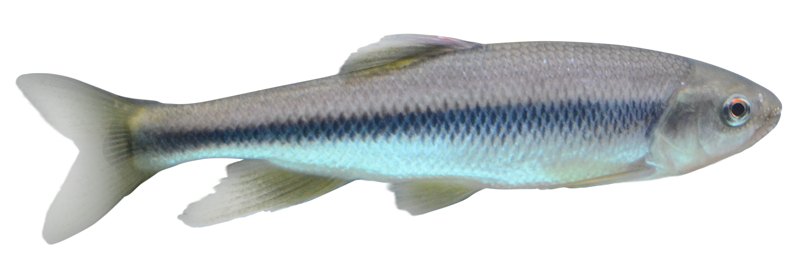
Nipponocypris temminckii (Temminck et Schlegel, 1846)
見極めが難しい日本産淡水魚
A Difficult-to-Identify Native Freshwater Fish of Japan
体長10〜15cm。西日本を中心に東アジアへ広く分布するコイ科の淡水魚で、流れの緩やかな河川中流域や湖沼、用水路などに生息します。オイカワやウグイと並び、日本の河川でごく普通に見られる身近な種です。近年では人為的な移入により、本来分布していなかった関東地方でも確認されており、地域によっては定着が進んでいます。
本種はかつて、形態や生態の違いから「A型(湖沼型)」と「B型(河川型)」に区分されていました。特に臀鰭不分岐軟条数や体形の差異が指標とされていましたが、2003年に分子系統解析の結果が反映され、B型がカワムツ、A型がヌマムツとしてそれぞれ独立種とする見解が提唱されました。決定的な根拠となったのはミトコンドリアDNAの解析による遺伝的差異です。
しかし、これら近縁種は外見が非常によく似ているうえ、生息域が重複する地域も多く、さらに交雑も可能であることから、野外での識別は容易ではありません。体側の模様や体高、各鰭の形状など複数の特徴を総合的に観察する必要があります。こうした事情から、本種は日本産淡水魚の中でも識別が難しいグループの一つとして知られています。
Reaching 10–15 cm in length, this cyprinid fish is widely distributed across western Japan and East Asia. It inhabits slow-flowing middle reaches of rivers, as well as lakes and irrigation channels. Alongside species such as the pale chub and dace, it is a familiar and commonly encountered fish in Japanese freshwater environments. In recent years, due to human-mediated introductions, it has also been recorded in the Kanto region, where it was not originally native, and in some areas it has become established.
This species was once divided into two forms based on morphological and ecological differences: the “A-type” (lacustrine form) and the “B-type” (riverine form). Distinctions such as the number of unbranched anal fin rays and body shape were used as key identifiers. However, in 2003, molecular phylogenetic analyses led to a taxonomic revision in which the B-type was designated as Nipponocypris temminckii (kawamutsu), and the A-type as Nipponocypris sieboldii (numamutsu), recognizing them as separate species. The decisive evidence came from genetic differences revealed through mitochondrial DNA analysis.
Despite this reclassification, these closely related species remain very similar in appearance. Their overlapping distributions and the ability to hybridize further complicate identification in the wild. Accurate distinction requires careful observation of multiple characteristics, including body markings, body depth, and fin morphology. For these reasons, this group is regarded as one of the more difficult freshwater fish taxa to identify in Japan.
参考文献
日本淡水魚類愛護会 | タナゴ類 | ヌマムツ or カワムツ 2025年4月26日閲覧
加藤 文男「福井県におけるオイカワ属魚類の分布と雑種の記録」福井市自然史博物館研究報告 第51号:15-24(2004) 2025年4月26日閲覧
TSURINEWS | 『カワムツ』が関東の河川で近年増加中 地域の生態系を乱す恐れもある「国内外来魚」とは? | (2024年12月1日) 2025年4月26日閲覧
日本淡水魚愛護会 | 同定 | ヌマムツ or カワムツ 2026年4月29日閲覧