
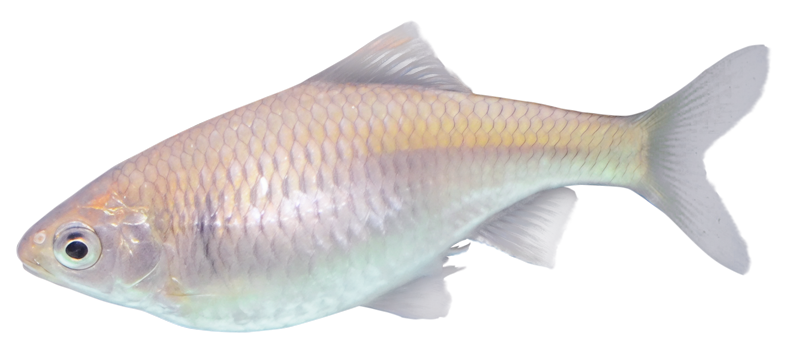
Rhodeus ocellatus (Kner, 1866)
二枚貝に託す小さな命
A Small Life Entrusted to a Freshwater Mussel
体長5〜8cm。中国大陸を原産とするバラタナゴの一種で、日本には1940年代に食用魚の移植に伴って持ち込まれました。現在では全国各地に定着しており、在来のニッポンバラタナゴとの交雑による遺伝的な影響も問題となっています。
湖沼や河川の中下流域など、水流が緩やかで水草が生える環境を好みます。体は側扁して体高が高く、春から秋の繁殖期(主に3〜9月)になると、オスは青紫色を基調とした鮮やかな婚姻色を現します。
本種を含むタナゴ類の大きな特徴は、二枚貝を利用した特殊な産卵方法です。メスは産卵管を伸ばし、ドブガイ類などのイシガイ科二枚貝のえらの内部に卵を産み込み、オスが放精することで受精します。卵は貝の中で守られ、外敵から身を守りながら成長することができます。
魚類が生きた二枚貝を産卵場所として利用する例は珍しく、タナゴ類のほか、一部のヒガイ類にも見られます。一方で、二枚貝にとっては必ずしも利益があるとは限らず、卵や仔魚の存在がえらの活動を妨げる可能性も指摘されています。そのため、この関係は片利共生、あるいは寄生的な関係に近いものとして議論されています。
身近な観賞魚として知られる一方、外来種として在来生態系にも影響を与えており、本種の存在は、人為的な生物移動がもたらす変化を考える上でも重要な例となっています。
The rosy bitterling (Rhodeus ocellatus ocellatus) measures 5–8 cm in length. Native to mainland China, it is one of the bitterling fishes introduced to Japan in the 1940s. It has since become established in many regions, and hybridization with the native subspecies, the Japanese bitterling (Rhodeus ocellatus kurumeus), has raised concerns about genetic impacts.
It inhabits lakes, ponds, and the middle to lower reaches of rivers, preferring calm waters with aquatic vegetation. Its body is deep and strongly compressed laterally. During the breeding season, mainly from March to September, males develop striking iridescent nuptial coloration with shades of blue and purple.
The most remarkable feature of this species is its unusual breeding strategy using freshwater mussels. Females extend a long ovipositor to deposit eggs inside the gills of unionid mussels, such as duck mussels, where the eggs are fertilized when males release sperm nearby. Protected within the mussel, the eggs can develop safely away from many predators.
Using living freshwater mussels as a spawning site is a rare behavior among fishes and is also observed in some gudgeons. For bitterlings, mussels serve as a nursery that protects their offspring. However, the relationship is not always beneficial for the mussels themselves, as eggs and larvae may interfere with their gill function. Therefore, this interaction has been discussed as ranging from commensalism to a relationship with parasitic characteristics.
Although familiar as an ornamental fish, the rosy bitterling is also an example of how human-mediated species introductions can influence native ecosystems.
参考文献
Honda 釣り倶楽部 | タイリクバラタナゴの特徴 2025年5月4日閲覧
京都府 | 京都府レッドデータブック2015 | ニッポンバラタナゴ 2025年5月4日閲覧
国立環境研究所 | 侵入生物データベース | タイリクバラタナゴ 2025年5月4日閲覧
たなごGo! | 二枚貝を使ったタナゴの繁殖方法!貝の飼育が産卵のポイントです! | (2024年4月12日) 2025年5月4日閲覧
橋口 康之「二枚貝に産卵する魚:タナゴ類の多様性と進化」日本の科学者 Vol.53 No.6 June 2018. 2025年5月4日閲覧