
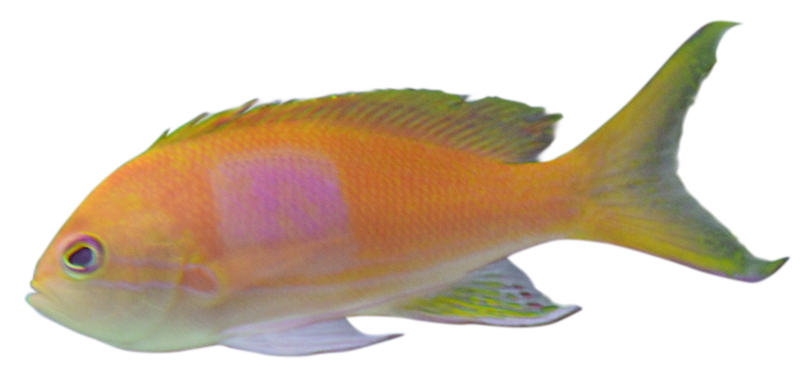
Pseudanthias pleurotaenia (Bleeker, 1857)
サンゴ礁に浮かぶ四角い紋
A Square Mark Drifting Above the Reef
体長約15cm。インド洋から西太平洋にかけて広く分布し、水深10~180mほどのサンゴ礁やその周辺の斜面に生息しています。特に外洋に面した潮通しの良い場所を好み、群れを作って中層を泳ぎながら動物プランクトンを捕食します。比較的浅い場所でも見られますが、多くはやや深い礁斜面に生息するため、ダイバーにとっては憧れの魚の一つです。
オスは鮮やかなピンクからオレンジ色の体色をもち、体側中央に大きな四角形の淡紫色斑が入るのが特徴です。この斑紋は湿布を貼ったようにも見え、印象的です。またオーストラリアでは、その姿が鏡を身につけているように見えることから「Mirror Anthias」と呼ばれることもあります。一方、メスは淡いピンクがかったオレンジ色で、オスのような四角い斑紋は見られず、全体的に落ち着いた色合いです。
本種はハナダイ類に共通する社会構造をもち、1匹のオスと複数のメスからなる群れを形成します。また、雌として成熟した後に雄へと性転換する「雌性先熟」の魚として知られています。群れのオスがいなくなると、優位なメスが性転換して新たなオスとなり、群れを維持します。反対に、最初はオスとして成熟し、その後メスへと変化する「雄性先熟」の代表例としてはクマノミの仲間が知られています。
オスの四角い紫色の斑紋の役割は詳しく解明されていませんが、繁殖期には特に目立つことから、ライバルへの誇示やメスへのアピールに用いられる性的シグナルである可能性が高いと考えられています。鮮やかな体色と独特な斑紋をもつスミレナガハナダイは、サンゴ礁の魚たちの中でもひときわ目を引く存在であり、その美しい姿だけでなく、性転換によって群れの秩序を保つ巧みな生態もまた、本種の大きな魅力です。
Reaching about 15 cm in length, the Squarespot Anthias is widely distributed from the Indian Ocean to the western Pacific Ocean. It inhabits coral reefs and adjacent reef slopes at depths of 10–180 meters. The species prefers areas exposed to oceanic currents, where it forms schools and feeds on zooplankton in the water column. Although it can sometimes be found in relatively shallow waters, it is more commonly encountered along deeper reef slopes, making it a highly sought-after sight among divers.
Males are distinguished by their vivid pink to orange coloration and a large square-shaped lavender patch on the side of the body. This marking resembles a medicinal patch affixed to the fish’s flank, giving it a particularly striking appearance. In Australia, the species is sometimes known as the “Mirror Anthias” because the patch looks as though the fish is carrying a small mirror. Females, in contrast, are colored a subdued pinkish orange and lack the conspicuous square marking.
Like many anthias species, the Squarespot Anthias lives in social groups consisting of a single dominant male and multiple females. It is a protogynous hermaphrodite, meaning individuals mature first as females and may later change sex to become males. When the dominant male disappears, the highest-ranking female undergoes sex change and assumes his role within the group. The reverse strategy, known as protandry—where individuals mature first as males and later become females—is famously seen in clownfishes.
The precise function of the male’s square lavender patch remains unclear. However, because it becomes especially conspicuous during the breeding season, it is thought to serve as a sexual signal used to attract females and display dominance toward rival males. With its brilliant coloration and unique markings, the Squarespot Anthias is one of the most eye-catching fishes on coral reefs. Its beauty, combined with its remarkable social structure and ability to change sex, is among the species’ greatest attractions.
参考文献
名古屋港水族館 | スタッフコラム | へ〜ん し〜ん | (2022年6月23日) 2024年8月3日閲覧
Crew, Bec. (2020, November 23). The squarespot anthias is the ocean’s pocket mirror. Australian Geographic. 2024年8月3日閲覧
“Squarespot” Monterey Bay Aquarium. 2026年8月1日閲覧
“Mirror Basslet, Pseudanthias pleurotaenia (Bleeker, 1857)” Australian Museum. 2026年8月1日閲覧