
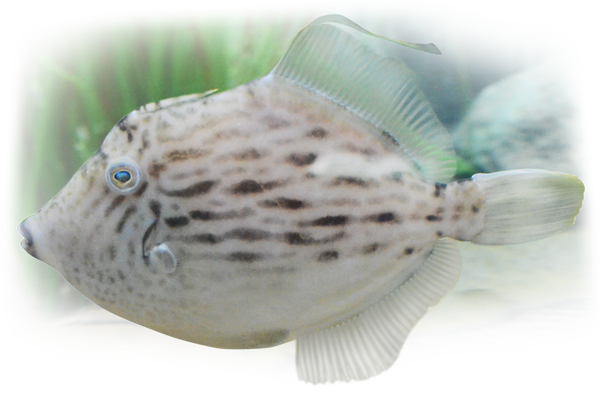
Stephanolepis cirrhifer (Temminck & Schlegel, 1850)
体色でわかるカワハギの心理状態
Reading a Filefish’s Mood Through Its Colors
体長は最大で30cmほど。北海道から九州にかけての日本沿岸のほか、台湾や東シナ海に分布します。岩礁域や砂底域に生息し、特に伊豆・小笠原諸島周辺ではカワハギ科の仲間が多く見られ、重要な漁獲対象となっています。
食性は雑食性で、海藻のほか、ゴカイ類やフジツボ類、甲殻類、貝類など幅広い餌を捕食します。硬い殻をもつ生物も、発達した歯で器用にかみ砕いて食べるのが特徴です。また大型のクラゲ類も捕食対象となり、エチゼンクラゲに対しては群れでつついて分解しながら食べる行動が知られています。
本種は体色変化が顕著な魚としても知られ、環境や状態に応じて色や模様を変えます。通常は淡い体色ですが、外敵に捕らえられるなど強いストレスを受けると黒化し、興奮時や他個体に対して優位なときには斑紋がくっきりと現れます。このような変化は、擬態や威嚇、個体間のコミュニケーションに関係していると考えられています。
食用魚としても広く親しまれ、上品でクセのない白身は刺身や煮付け、唐揚げなどさまざまな料理に利用されます。名の由来どおり厚く丈夫な皮は容易に剥ぐことができ、調理の際には取り除かれます。特に肝は濃厚な味わいで珍重され、晩秋から冬にかけてが旬とされています。
The thread-sail filefish reaches a maximum length of about 30 cm. It is distributed along the coasts of Japan from Hokkaido to Kyushu, as well as in Taiwan and the East China Sea. It inhabits rocky and sandy coastal areas, and members of the filefish family are particularly abundant around the Izu and Ogasawara Islands, where they are important fishery resources.
This species is omnivorous, feeding on a wide variety of prey including seaweeds, polychaete worms, barnacles, crustaceans, and mollusks. It is capable of crushing hard-shelled organisms with its strong teeth. Large jellyfish are also part of its diet; in particular, it has been observed attacking giant jellyfish such as Nomura’s jellyfish in groups, pecking at them and breaking them apart before consuming them.
The species is also known for its remarkable ability to change body coloration. Normally pale in color, it can turn dark when under strong stress, such as when captured. When excited or dominant over other individuals, its body patterns become more distinct. These changes are thought to play roles in camouflage, intimidation, and communication.
Widely consumed as a food fish, it has a mild, delicate white flesh suitable for a variety of dishes, including sashimi, simmered preparations, and deep-frying. As its Japanese name suggests, the tough skin is easily removed before cooking. The liver is especially prized for its rich flavor, with the peak season occurring from late autumn to winter.
参考文献
東京都島しょ農林水産総合センター | 東京おさかな図鑑 | カワハギ 2025年4月20日閲
川越カワハギ研究所 | 「カワハギの脳科学」 釣り人のためのカワハギ解剖学④ 最終回 | (2024年11月6日) 2025年4月20日閲覧
友利 友利, 階 久雄, 橋本 芳郎, 「カワハギおよびアミメハギの体色変化」日本水産学会誌 24 (6-7), 389-393, 1958 2025年4月20日閲覧
豊洲MEKIKI.JP | 料理レシピ | 晩秋のカワハギ 肝が充実してきています !! | (2021年10月21日) 2025年4月20日閲覧