
Plectorhinchus cinctus (Temminck & Schlegel, 1843)
三本帯に胡椒を塗した大魚
The Giant Fish with Three Bands and Pepper-Like Spots
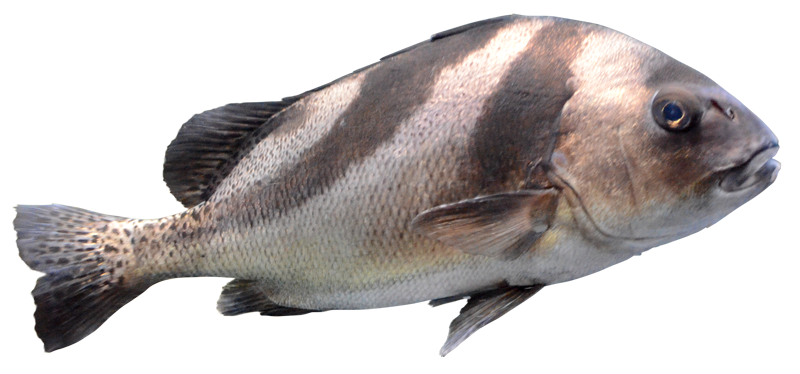
最大で全長90cm近くに達する大型魚。インド太平洋の熱帯から温帯域に広く分布し、日本では青森県以南から九州南部、屋久島周辺までの沿岸域に生息しています。体型はマダイ類に似ていますが、分類上はイサキ科に属する魚です。体色は灰色から銀灰色で、体側には3本の暗色帯が斜めに入り、体や各鰭には胡椒を散らしたような細かな黒斑が見られます。この特徴が「コショウダイ」という和名の由来になりました。
地方によっては「コロダイ」と呼ばれることもありますが、コロダイは近縁種 Diagramma pictum pictum の標準和名でもあり、名称が混同される場合があります。コショウダイ類は厚く柔らかな唇を持つことから、英語では “Sweetlips” と総称され、本種は一般に “Painted sweetlips” の英名で知られています。幼魚は成魚とはまったく異なる白黒の派手な模様を持ち、海中を漂う枯葉のように体を揺らしながら泳ぐ姿が特徴です。
岩礁域やサンゴ礁周辺に生息し、甲殻類やゴカイ、小型底生動物などを捕食します。食用魚としても利用され、白身は淡泊ながら旨味があり、刺身や塩焼き、煮付けなどで食べられています。しかし知名度はそれほど高くなく、地域によっては未利用魚として扱われることもあります。また、ディディモゾイド類と呼ばれる寄生虫が体内や筋肉中に見られる個体が多いことで知られています。これらは人体には無害とされていますが、見た目の問題から調理時に取り除かれることが一般的です。
The Crescent Sweetlips is a large fish that can grow to nearly 90 cm in length. It is widely distributed throughout the tropical and temperate Indo-Pacific region, and in Japan it occurs along coastal waters from Aomori Prefecture southward to southern Kyushu and around Yakushima Island. Although its body shape resembles that of sea breams, it actually belongs to the family Haemulidae. Its body is gray to silvery gray, marked with three oblique dark bands along the sides and numerous small black spots scattered across the body and fins, resembling grains of pepper. These pepper-like markings are the origin of its Japanese name, “Koshodai.”
In some regions of Japan, it is also called “Korodai,” although that name properly refers to the closely related species Diagramma pictum pictum, which sometimes causes confusion. Members of this group are collectively known in English as “Sweetlips” because of their thick, fleshy lips. This species is generally known by the English name “Painted sweetlips.” Juveniles look completely different from adults, displaying bold black-and-white patterns and swimming with a swaying motion that resembles drifting leaves.
The species inhabits rocky reefs and coral reef areas, where it feeds on crustaceans, polychaete worms, and other small bottom-dwelling animals. It is also valued as a food fish, with mild but flavorful white flesh enjoyed as sashimi, grilled fish, or simmered dishes. However, despite its good taste, it is not especially well known and is sometimes treated as an underutilized fish in local fisheries. Many individuals are known to harbor parasites of the family Didymozoidae within their bodies or muscles. Although these parasites are considered harmless to humans, they are commonly removed during preparation because of their appearance.
参考文献
ぼうずコンニャクの市場魚介類図鑑 | コショウダイ 2025年4月27日閲覧
TSURIHACK | 魚図鑑 | コショウダイを食べる際は寄生虫に注意!?テレビで話題になった魚の生態と釣り方を解説 | (2023年5月15日) 2025年4月27日閲覧
フィシュル! | コショウダイのおすすめレシピ5選!特徴や捌き方をプロが直伝 | (2023年8月17日) 2025年5月25日閲覧