
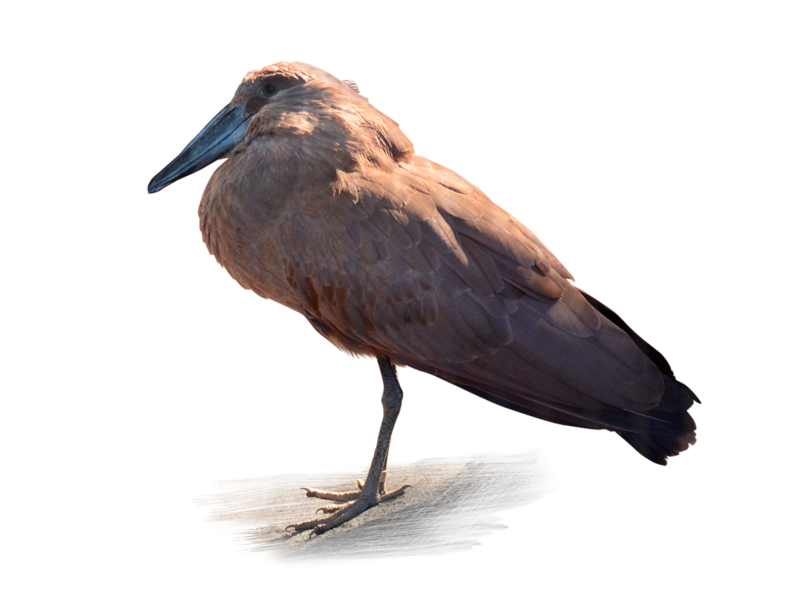
Scopus umbretta (Gmelin, 1789)
夫婦で作る巨大なマイホーム
Building a Giant Home Together
全長約58cm。サハラ砂漠以南のアフリカのほか、アラビア半島南西部やマダガスカルに分布する水鳥です。長くまっすぐな嘴と、後頭部が後方へ突き出した独特の頭部形状をもち、その姿が鐘を鳴らす木槌(撞木)に似ていることから「シュモクドリ」の名が付けられました。同じ由来をもつ動物としてシュモクザメが知られています。英名の「Hamerkop」も、アフリカーンス語で「ハンマーの頭」を意味します。
湖沼や河川、湿地、水田などの浅い水辺を好み、魚類やカエル、水生昆虫、小型甲殻類などを捕食します。水中をゆっくり歩きながら獲物を探し、鋭い嘴で素早く捕らえるのが特徴です。本種はシュモクドリ科(Scopidae)を構成する唯一の現生種であり、一見するとサギの仲間のように見えるものの、近年のDNA解析により巨大なハシビロコウと比較的近縁であることが明らかになっています。また、つがいの一方が他方の背中に乗る「擬似マウンティング」と呼ばれる不思議な行動が知られていますが、その詳しい役割はまだ解明されていません。
本種を最も特徴づけるのは、その巨大な巣です。水辺の樹上や崖の上などに、オスとメスが協力して大量の枝や草を運び込み、完成まで1か月以上をかけてドーム状の巣を築きます。巣は高さ・直径ともに最大約2mに達し、重さが100kg近くになることもあります。内部には産卵室が設けられ、雨を防ぐ屋根と泥で補強された狭い入口を備えています。建設には数千本もの枝や植物片が用いられ、ある観察例では6~7週間の造巣期間中に少なくとも8,000回分の巣材が運び込まれたと報告されています。完成した巣は長期間にわたって利用されることもあり、本種の繁殖と生活を支える重要な役割を果たしています。
The Hamerkop is a medium-sized waterbird measuring about 58 cm in length. It is distributed throughout sub-Saharan Africa, as well as southwestern Arabia and Madagascar. Its Japanese name, Shumokudori (“hammer-bird”), derives from its distinctive head shape, formed by a long, straight bill and an elongated crest projecting backward from the rear of the head, giving it the appearance of a wooden mallet used to strike a temple bell. The same origin is shared by the Japanese name for the hammerhead shark. Its English name, “Hamerkop,” comes from Afrikaans and means “hammer head.”
The species inhabits shallow wetlands such as lakes, rivers, marshes, and rice fields, where it feeds on fish, frogs, aquatic insects, and small crustaceans. It typically forages by slowly walking through shallow water and quickly seizing prey with its sharp bill. The Hamerkop is the only living member of the family Scopidae. Although it resembles a heron in appearance, recent DNA studies have revealed that it is relatively closely related to the Shoebill. Another unusual feature of this species is a behavior known as “false mounting,” in which one bird climbs onto the back of another. The exact function of this behavior remains unclear.
Perhaps the most remarkable characteristic of the Hamerkop is its enormous nest. Pairs cooperate to build a large dome-shaped structure in trees or on cliffs near water, carrying vast quantities of sticks and vegetation over a period of more than a month. The nest may reach up to 2 meters in both height and diameter and can weigh nearly 100 kilograms. Inside is a nesting chamber accessed through a small entrance reinforced with mud and protected by a roof that helps keep out rain. Thousands of sticks and plant materials are used in construction, and one study reported that at least 8,000 loads of nesting material were delivered during a 6–7 week building period. These impressive nests may be used for extended periods and play an important role in both the breeding and daily lives of the birds.
参考文献
東京ズーネット | ニュース | 人が入っても大丈夫!? シュモクドリの巨大な巣 | (2019年7月27日) 2024年8月18日閲覧
Hamerkop. Animal of the week. South African National Biodiversity Institute (SANBI) 2024年8月18日閲覧
“Hamerkop (Scopus umbretta)” The Biodiversity & Development Institute. 2026年6月28日閲覧
Kahl, M.P. (1967), OBSERVATIONS ON THE BEHAVIOUR OF THE HAMERKOP SCOPUS UMBRETTA IN UGANDA. Ibis, 109: 25-32. 2026年6月28日閲覧