

Sittiparus varius (Temminck & Schlegel, 1847)
おみくじを運んだ杜の賢者
The Fortune-Bearing Sage of the Shrine Grove
全長約14cm。シジュウカラ科に属する留鳥で、日本では北海道を除く本州・四国・九州と周辺の島々に広く分布し、国外では朝鮮半島、中国東北部、ロシア極東の一部にも生息します。頭部は黒と白の鮮やかな模様をもち、胸から腹にかけて赤褐色、翼は青灰色を帯びる美しい羽色が特徴です。カラ類の中でも特に色彩が豊かで、英名「Varied Tit(多彩なシジュウカラ)」もこの印象的な姿に由来しています。
平地から山地の落葉広葉樹林や照葉樹林、寺社林、公園など幅広い環境で見られ、昆虫やクモ類を捕食するほか、秋から冬にかけてはドングリやエゴノキ、マツ類などの木の実も盛んに利用します。木の実を樹皮の隙間や地中に蓄える「貯食」を行う習性があり、優れた空間記憶によって数多くの貯食場所を覚え、必要に応じて回収します。回収されずに残った種子は発芽することも多く、森林の更新を支える重要な種子散布者としての役割も果たしています。冬にはシジュウカラやコゲラ、メジロなどと混群をつくり、採餌効率を高めるとともに、仲間同士で外敵への警戒も分担しています。
繁殖期は4~7月頃で、樹洞やキツツキの古巣、巣箱などを利用して営巣します。雌は5~8個ほどの卵を産み、抱卵中は主に雄が餌を運びます。孵化後は雌雄が協力して昆虫を中心とした高タンパクな餌を何度も運び、雛を育てます。身近な森林や公園では巣箱もよく利用し、人の生活圏に適応した繁殖の様子を観察できる野鳥としても親しまれています。
ヤマガラは学習能力の高さでも古くから知られ、江戸時代には飼い慣らしたヤマガラに芸を仕込んで披露する「ヤマガラの芸」が人気を集めました。中でも、お賽銭を供え、鈴を鳴らしてから社の中へ入り、おみくじをくわえて戻ってくる「おみくじ引き」は代表的な演目として広く親しまれました。現在では野鳥の捕獲・飼育は法律によって厳しく規制されており、このような芸を見る機会はほとんどありません。優れた知能と記憶力を備えたヤマガラは、身近な里山や神社の森で四季の移ろいを感じさせてくれる、日本を代表する森の小鳥の一つです。
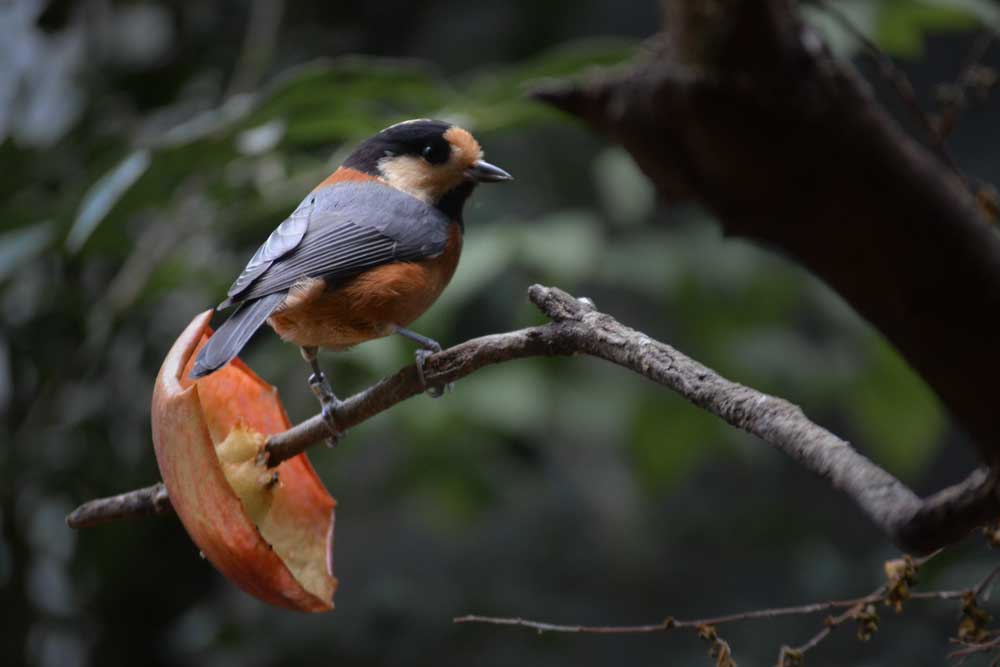
The Varied Tit is a resident member of the tit family, measuring about 14 cm in length. In Japan it is widely distributed throughout Honshu, Shikoku, Kyushu, and many surrounding islands, while outside Japan it occurs in the Korean Peninsula, northeastern China, and parts of the Russian Far East. It is distinguished by its striking black-and-white head, rich chestnut underparts, and bluish-gray wings. Among the tits, it is one of the most colorful species, giving rise to its English name, “Varied Tit.”
It inhabits a wide range of environments, including deciduous and evergreen broadleaf forests, shrine groves, and urban parks. Its diet consists mainly of insects and spiders during the breeding season, while acorns, snowbell seeds, pine seeds, and other nuts become important food sources from autumn through winter. The species practices food caching, storing seeds in bark crevices or in the ground. Thanks to its remarkable spatial memory, it can relocate many of these hidden caches when food becomes scarce. Seeds that are not recovered may germinate, making the Varied Tit an important contributor to forest regeneration. During winter, it often joins mixed-species flocks with Japanese Tits, Japanese Pygmy Woodpeckers, Japanese White-eyes, and other woodland birds, improving foraging efficiency while sharing vigilance against predators.
The breeding season extends from April to July. Nests are built in tree cavities, abandoned woodpecker holes, or nest boxes. Females lay five to eight eggs, while males mainly provide food during incubation. After hatching, both parents tirelessly deliver protein-rich insects to their chicks. Because they readily use nest boxes, Varied Tits are among the woodland birds whose breeding behavior can often be observed close to human habitation.
The Varied Tit has long been admired for its intelligence and learning ability. During the Edo period, trained birds performed a variety of tricks in popular exhibitions. The most famous performance involved the bird offering a coin, ringing a bell, entering a miniature shrine, and returning with a fortune slip (omikuji) in its bill. Today, however, the capture and keeping of wild birds are strictly regulated by law, and these performances have virtually disappeared. With its exceptional intelligence, impressive memory, and close association with Japan’s woodlands and shrine forests, the Varied Tit remains one of the country’s most beloved forest birds.
参考文献
森と水の郷あきた | 特集「野鳥シリーズ」| 野鳥シリーズ44 ヤマガラ 2026年7月25日閲覧
響 hibi-ki | 杉センセイの生物図鑑、 知らんけど | # 15 ヤマガラ | (2022年11月1日) 2026年7月25日閲覧
二〇世紀ひみつ基地 | 小鳥のおみくじ芸・伝統の見世物 | (2011年10月5日) 2026年7月25日閲覧
TBS NEWS DIG | かつて神社でおみくじを引いていた賢い小鳥「ヤマガラ」抜群の記憶力であちこちに木の実を隠す「貯食行動」| (2025年10月18日) 2026年7月25日閲覧