
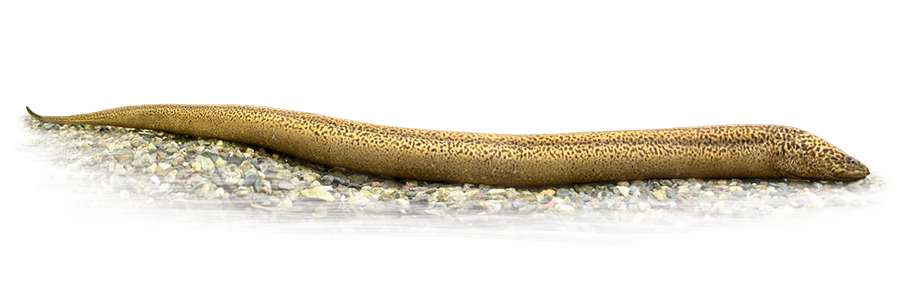
Monopterus albus (Zuiew, 1793)
雌から雄へ、その先に待つ繁殖競争
From Female to Male – and Into Fierce Competition
東アジアから東南アジアにかけて広く分布する淡水魚で、日本では本州中部以南に生息しています。全長は通常30~60cmほどですが、大型個体では80cmを超えることもあります。細長い円筒形の体と小さな頭部を持ち、一見するとウナギに似ていますが、分類上はウナギの仲間ではなく、タウナギ目に属する別系統の魚です。胸びれや腹びれがなく、背びれ・尾びれ・尻びれも著しく退化しており、蛇のように体をくねらせながら泳ぎます。
主に水田や用水路、池沼、湿地など流れの緩やかな環境に生息します。夜行性で、魚類や甲殻類、水生昆虫、カエルなどさまざまな動物を捕食する肉食魚であり、共食いも珍しくありません。皮膚や口腔内には発達した血管があり、水中の酸素が乏しい環境でも空気呼吸を行えます。このため酸欠になりやすい止水域でも生活でき、湿った地面を這って別の水場へ移動することもあります。
繁殖期には雄が泥底に巣穴を掘って縄張りを築き、訪れた雌に求愛します。一方で、接近した雄には激しく噛みつき、死亡することもあります。雄同士の共食いも見られるなど、繁殖期には非常に激しい競争が繰り広げられます。産卵後は雄が卵や鮮やかなオレンジ色の仔魚を保護し、繁殖期には巣を守ることが繁殖成功の鍵となります。
本種は成長に伴って雌から雄へ性転換する「雌性先熟」の魚として知られています。若い個体の多くは雌として成熟し、大型化すると雄へ変化します。半自然条件での研究では、大型の雄ほど巣を持ち、繁殖に成功する機会が多いことが示されており、「大きくなってから雄になる方が繁殖上有利」というサイズ有利仮説を支持する結果が得られています。このような繁殖戦略は、繁殖効率を高める適応と考えられています。
日本ではかつて水田や用水路で普通に見られる魚でしたが、水路のコンクリート化や湿地環境の減少によって生息地が失われつつある地域もあります。一方で高い環境適応力を持ち、人為的に移入された地域で定着した例も知られています。空気呼吸や性転換、雄による子育てなど、独自の適応を進化させたタウナギは、淡水魚の多様な生存戦略を知るうえで興味深い存在です。
Distributed widely across East and Southeast Asia, the swamp eel occurs in Japan from central Honshu southward. Most individuals measure 30–60 cm in length, although large specimens may exceed 80 cm. Its long, cylindrical body and small head give it the appearance of a true eel, but it actually belongs to the order Synbranchiformes and is only distantly related to true eels. It lacks pectoral and pelvic fins, while the dorsal, caudal, and anal fins are greatly reduced, allowing it to swim with snake-like undulating movements.
The swamp eel inhabits slow-moving waters such as rice paddies, irrigation canals, ponds, and marshes. Nocturnal by nature, it is a voracious predator that feeds on fish, crustaceans, aquatic insects, frogs, and a wide variety of other animals, and cannibalism is not uncommon. Rich networks of blood vessels in its skin and mouth enable it to breathe atmospheric air, allowing it to survive in oxygen-poor waters. It can even wriggle across damp ground to reach new aquatic habitats.
During the breeding season, males excavate burrows in the mud and establish territories, courting females that enter them. Rival males, however, are met with fierce attacks, and these violent encounters may sometimes prove fatal. Cannibalism between males has also been observed, making the breeding season highly competitive. After spawning, the male guards both the eggs and the bright orange larvae, and protecting the nest is essential for reproductive success.
This species is a protogynous hermaphrodite, changing sex from female to male as it grows. Most individuals first mature as females before transforming into males when they become larger. Studies under semi-natural conditions have shown that larger males are more likely to secure nests and reproduce successfully, supporting the size-advantage hypothesis, which proposes that becoming male only after reaching a larger body size provides a reproductive advantage. This reproductive strategy is thought to maximize breeding success.
Once common in rice paddies and irrigation canals throughout Japan, the swamp eel has declined in some regions because of habitat loss caused by the concrete lining of waterways and the disappearance of wetlands. On the other hand, its remarkable adaptability has enabled introduced populations to become established in some areas. With its ability to breathe air, change sex, and provide paternal care, the swamp eel is a fascinating example of the diverse survival strategies found among freshwater fishes.
参考文献
国立環境研究所 | 侵入生物データベース | タウナギ 2026年7月4日閲覧