
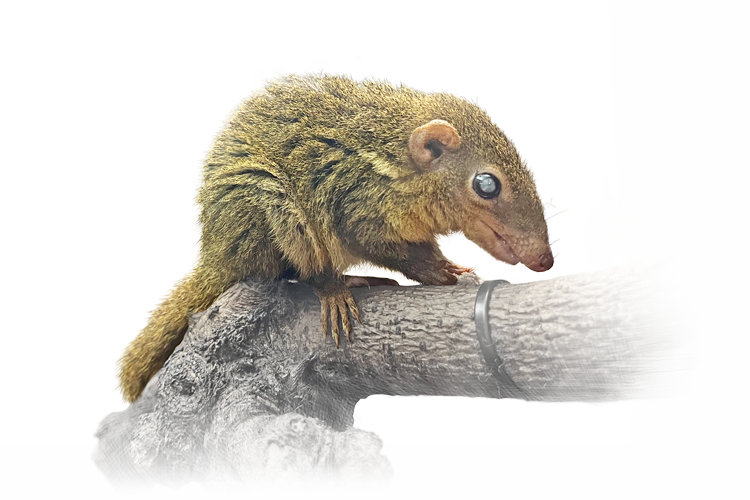
Tupaia glis (Diard, 1820)
リスク回避するツパイの子育て
The Common Treeshrew’s Risk-Avoiding Parenting Strategy
体長16~21cm、尾長13~20cm、体重約100~250g。東南アジアに広く分布し、マレー半島、スマトラ島、ボルネオ島および周辺の島々の森林や二次林、農地周辺に生息しています。細長い吻と大きな目、ふさふさした尾をもち、リスを思わせる姿が特徴です。英名のShrewはトガリネズミを意味し、細長い吻をもつ外見がトガリネズミに似ていることから名付けられました。しかし実際にはトガリネズミ類とは近縁ではなく、登木目(ツパイ目)に属する独立した分類群です。
主に昼行性で、樹上と地上の両方を活発に移動します。食性は雑食性で、昆虫やクモなどの小動物のほか、果実や種子、花蜜も食べます。発達した嗅覚と視覚を利用して餌を探し、森林生態系では昆虫の捕食者であると同時に、果実を食べることで種子散布にも関わっています。
縄張り意識が強く、単独あるいはつがいで生活します。繁殖は年間を通じて行われ、メスは樹洞や茂みの中に巣を作ります。本種の育児行動は哺乳類の中でも特異で、母親は巣を長時間離れ、約2日に1回という短い授乳のためだけに戻ることが知られています。仔は脂肪分に富んだ母乳によって急速に成長します。母親が長時間巣を離れ、短時間の授乳時だけ戻るこの独特の育児様式は absentee system of maternal care(不在型育児)と呼ばれ、捕食者に巣の存在を知られにくくする適応と考えられています。このような育児様式はウサギ類などにも見られますが、ツパイでは母親が約2日に1回しか授乳に戻らないため、哺乳類の中でも特に極端な例として知られています。
かつては霊長類の仲間と考えられたこともありましたが、現在では登木目(ツパイ目)として独立した分類群に位置付けられています。しかし遺伝子解析などの研究により、霊長類とは比較的近縁な関係にあることが示されています。大きな目や発達した視覚、比較的大きな脳など霊長類と共通する特徴も備えており、その進化を探る手がかりとして研究されています。東南アジアの森で活発に暮らすこの小さな哺乳類は、森林生態系の一員であると同時に、哺乳類進化の歴史を理解する上でも重要な存在なのです。
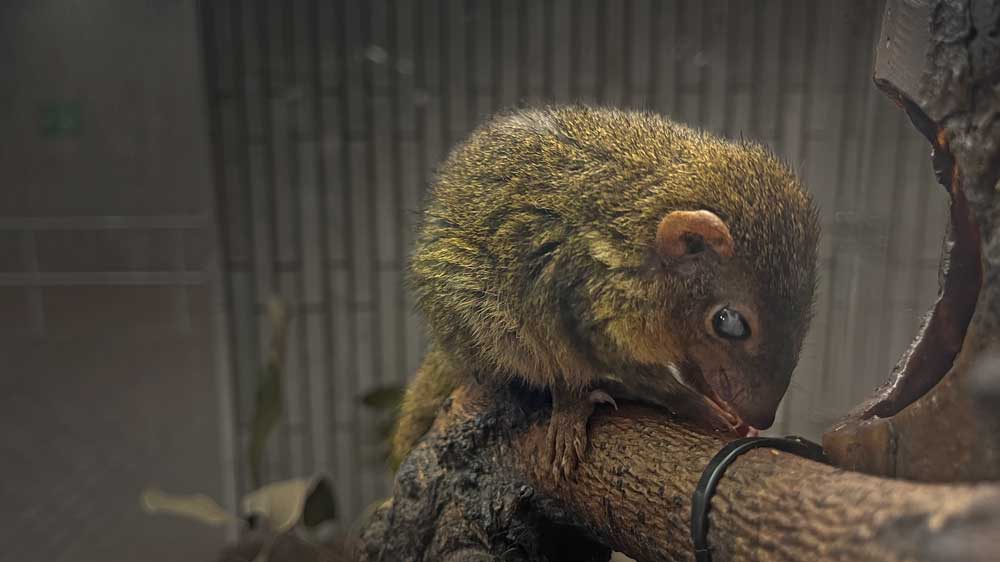
The common treeshrew is a small mammal measuring 16–21 cm in body length, with a tail length of 13–20 cm and a weight of approximately 100–250 g. It is widely distributed throughout Southeast Asia, inhabiting forests, secondary woodlands, and agricultural areas on the Malay Peninsula, Sumatra, Borneo, and surrounding islands. With its slender snout, large eyes, and bushy tail, it resembles a cross between a squirrel and a mouse. The word shrew in its English name refers to shrews, and the species was named for its resemblance to these animals. However, treeshrews are not closely related to true shrews and belong instead to the order Scandentia, a distinct group of mammals.
Primarily diurnal, the common treeshrew moves actively through both trees and on the ground. It is omnivorous, feeding on insects, spiders, and other small animals, as well as fruits, seeds, and nectar. Using its well-developed senses of smell and vision, it searches for food throughout the forest. As a predator of invertebrates and a disperser of seeds through fruit consumption, it plays an important ecological role in forest ecosystems.
Common treeshrews are territorial and usually live alone or in pairs. Breeding can occur throughout the year, and females construct nests in tree hollows or dense vegetation. Their maternal behavior is among the most unusual known in mammals. Mothers leave the nest for extended periods and return only about once every two days for a brief nursing visit. The young grow rapidly on nutrient-rich milk with a high fat content. This distinctive strategy, known as the absentee system of maternal care, is thought to reduce the likelihood of predators detecting the nest. Although similar forms of maternal care occur in rabbits and some other mammals, treeshrews represent one of the most extreme examples, with mothers returning to nurse only once every two days.
Treeshrews were once considered to be members of the primate lineage, but they are now classified as a separate order, Scandentia. Nevertheless, genetic studies have shown that they are relatively closely related to primates. Their large eyes, well-developed visual system, and relatively large brain are among the traits they share with primates, making them valuable subjects for studies of primate evolution. Active and agile inhabitants of Southeast Asian forests, common treeshrews are important not only as members of forest ecosystems but also as key animals for understanding the evolutionary history of mammals.
参考文献
Cisneros, L. 2005. “Tupaia glis” (On-line), Animal Diversity Web. 2026年6月27日閲覧
Martin RD. Tree shrews: unique reproductive mechanism of systematic importance. Science. 1966 Jun 3;152(3727):1402-4. 2026年6月27日閲覧
「【ツパイ目は哺乳類進化のカギ?ヒトと霊長類の境界を探る】スカンデンティアの謎:霊長類進化の黎明期におけるツパイの役割の再評価」とまとの気分次第研究所 (2025年5月22日) 2026年6月27日閲覧
日本モンキーセンター公式ブログ | 飼育の部屋 | 【動物猿獣医師の不定期便】辰年といえばキタツパイ| (2024年1月1日) 2026年6月27日閲覧