
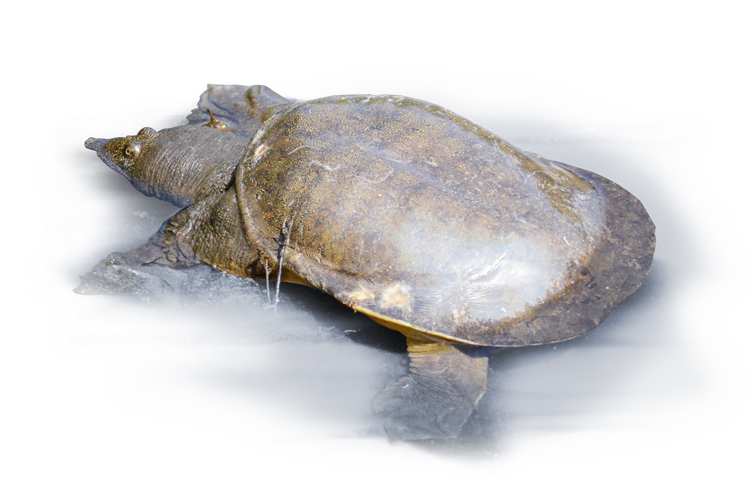
Pelodiscus japonicus (Temminck et Schlegel, 1838)
最大甲長35cmほどに達する淡水性のカメで、東アジア(日本、中国、朝鮮半島、ロシア極東、台湾、ベトナム)に広く分布しています。日本では本州、四国、九州、南西諸島に生息し、流れの緩やかな河川、池、沼、水田周辺などに見られます。泥底に潜みながら生活することが多く、夜行性の傾向が強い動物です。
甲羅は円形に近い扁平な形をしており、一般的なカメ類のような硬い角質板は退化して、柔らかな皮膚に覆われています。この柔軟で軽量な甲羅は水中での機動性を高めており、スッポンは泳ぎが非常に速いことで知られています。腹甲も小型化しているため体を大きくひねりやすく、陸上でも素早く移動できます。また、四肢には発達した水掻きがあり、前後の脚を巧みに使って水中を力強く泳ぎます。
首は非常に長く、先端にはシュノーケルのような管状の鼻孔を備えています。これによって体を泥の中に隠したまま呼吸することが可能です。歯は持ちませんが、鋭い嘴状の顎を備え、噛む力は非常に強力です。警戒心が強く、危険を感じると素早く首を伸ばして噛み付くため、扱いには注意が必要です。
食性は動物食傾向の強い雑食で、魚類、甲殻類、昆虫類、カエル、水生生物の死骸など幅広いものを食べます。特に嗅覚が発達していることが知られており、近年の研究では嗅覚受容体の遺伝子数が多いことも明らかになっています。濁った水中や泥の中でも餌を探し当てられるため、狩りでは視覚より嗅覚が重要な役割を果たしていると考えられています。
さらに、スッポンは肺呼吸だけでなく皮膚呼吸も行うことができ、咽頭内部の細かな突起を利用して水中の酸素を効率よく取り込む能力を持っています。このような高い水中適応はカメ類の中でも特異的で、スッポン類が独自の進化を遂げたことを示しています。その起源は非常に古く、石川県では約1億3千万年前の白亜紀前期の地層から、スッポンへの進化途中と考えられる化石も発見されています。恐竜が繁栄していた時代には、すでに現代のスッポンにつながる仲間が存在していたことは興味深い事実です。
The Chinese softshell turtle is a freshwater turtle reaching a maximum carapace length of about 35 cm. It is widely distributed across East Asia, including Japan, China, the Korean Peninsula, the Russian Far East, Taiwan, and Vietnam. In Japan, it inhabits Honshu, Shikoku, Kyushu, and the Ryukyu Islands, where it is found in slow-moving rivers, ponds, marshes, and areas around rice fields. It often spends much of its time buried in mud and is mainly nocturnal.
Its carapace is flat and nearly circular in shape. Unlike most turtles, the hard keratinous scutes have degenerated, and the shell is covered with soft skin. This lightweight and flexible shell improves mobility in water, making the softshell turtle an exceptionally fast swimmer. The plastron is also reduced in size, allowing the body to twist more freely and enabling surprisingly quick movement on land. In addition, the limbs possess well-developed webbing that helps propel the turtle powerfully through the water.
The neck is remarkably long, and the tip of the snout forms a tube-like nostril resembling a snorkel. This adaptation allows the turtle to breathe while remaining hidden beneath mud or underwater. Although it lacks teeth, it possesses sharp, beak-like jaws and an extremely powerful bite. Because it is highly defensive and can suddenly extend its neck to bite when threatened, careful handling is necessary.
The species is an omnivore with strong carnivorous tendencies, feeding on fish, crustaceans, insects, frogs, and even carrion. Its sense of smell is especially well developed, and recent studies have shown that it possesses a large number of olfactory receptor genes. This enables it to locate prey even in muddy or murky water, suggesting that olfaction plays a more important role than vision during hunting.
In addition to lung respiration, the softshell turtle can also absorb oxygen directly through its skin. It further possesses fine structures within the pharynx that efficiently extract dissolved oxygen from water. Such advanced aquatic adaptations are unusual among turtles and demonstrate the unique evolutionary path of softshell turtles. Their evolutionary history is also remarkably ancient. In Ishikawa Prefecture, fossils believed to represent an intermediate stage in the evolution toward modern softshell turtles have been discovered in geological strata dating to approximately 130 million years ago, during the Early Cretaceous period. It is fascinating to realize that ancestors of today’s softshell turtles already existed in the age when dinosaurs dominated the Earth.
参考文献
東邦大学医療センター | 東洋医学科コラム | 日本の土壌と文化へのルーツ65 スッポン | (2024年6月13日) 2026年5月9日閲覧
国立環境研究所 | 侵入生物データベース | ニホンスッポン 2026年5月9日閲覧
朝日新聞 | びんご案内人「スッポン 素早さの秘密」 | 古本 哲史 (2018年8月13日) 2026年5月9日閲覧
理化学研究所 | ゲノム解読から明らかになったカメの進化 | (2013年4月29日) 2026年5月9日閲覧
早稲田大学 | ニュース | 世界最古のスッポン化石を発見 国際学術院・平山廉教授が鑑定 | (2011年8月5日) 2026年5月9日閲覧