
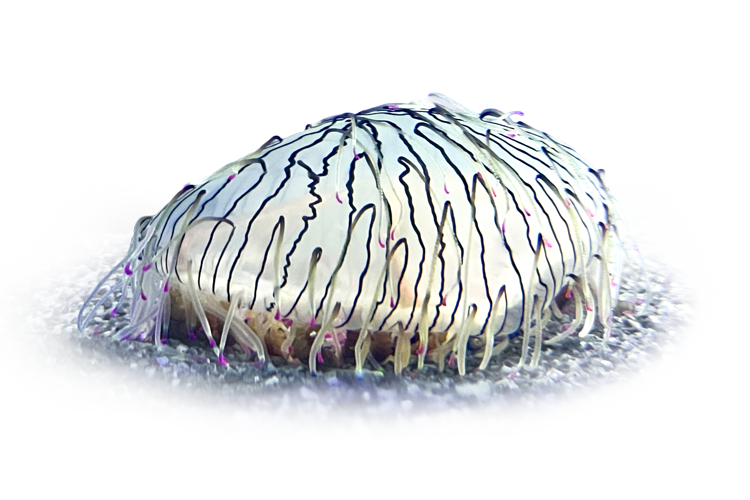
Olindias formosa (Goto, 1903)
緑色に蛍光する花のクラゲ
A Flower-Like Jellyfish That Fluoresces Green
日本沿岸をはじめ、西太平洋に分布するヒドロ虫綱のクラゲです。傘の直径は10cmほどになり、透明な傘の縁には多数の触手が並びます。赤や紫、黄色、緑などの鮮やかな色彩を帯びた触手を広げる姿は、海中に花が咲いたようにも見えます。この華やかな姿から「ハナガサクラゲ」と呼ばれ、英名も「Flower Hat Jelly」といいます。
本種の大きな特徴の一つが、触手の一部に見られる緑色の蛍光です。青色などの光を当てると、触手の特定の部分が鮮やかな緑色に光って見えます。これは暗闇で自ら光を作り出す「生物発光」とは異なり、外から受けた光を別の色の光として放つ「蛍光」です。本種からは「Gamillus」と呼ばれる緑色蛍光タンパク質が発見され、その性質についても詳しく研究されています。また、この蛍光が小型の獲物を引き寄せる視覚的なシグナルとして働く可能性も実験的に検討されています。
触手には刺胞があり、触れた小魚や小型の甲殻類などに毒針を発射して捕らえます。美しい色彩とは対照的に、刺傷は人に痛みや皮膚症状を引き起こすことがあります。さらに、ブラジルやアルゼンチン沿岸では大量に出現することがあり、遊泳者への刺傷だけでなく、クラゲが漁網を塞ぐなど、漁業に影響を及ぼす場合もあります。美しい姿の裏側には、獲物を捕らえるための巧みな仕組みが備わっています。
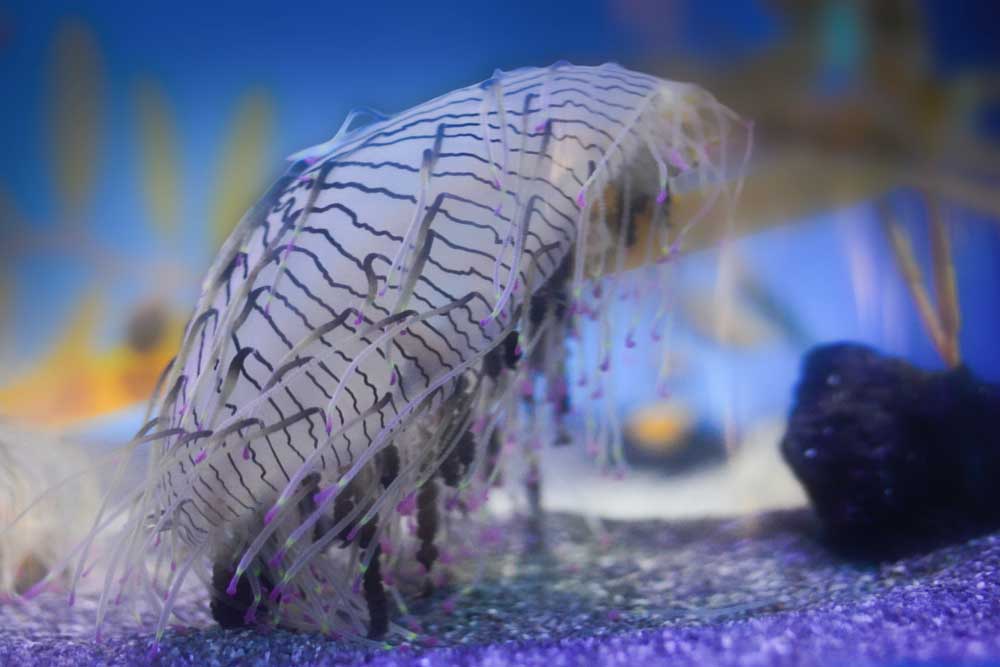
The Flower Hat Jelly is a hydrozoan jellyfish distributed along the coast of Japan and elsewhere in the western Pacific. Its bell can grow to about 10 cm in diameter, with numerous tentacles arranged around the bell margin. The tentacles display vivid colors such as red, purple, yellow, and green, and when spread out, they resemble a flower blooming underwater. This striking appearance gives the species its Japanese name, Hanagasa-kurage, as well as its English name, “Flower Hat Jelly.”
One of its most distinctive features is the green fluorescence seen in parts of its tentacles. When exposed to blue or other light, certain areas of the tentacles appear to glow a vivid green. This is different from bioluminescence, in which an organism produces light in darkness; fluorescence occurs when absorbed light is re-emitted at a different wavelength. A green fluorescent protein called “Gamillus” has been isolated from this species and studied in detail. Experiments have also investigated the possibility that this fluorescence may serve as a visual signal to attract small prey.
The tentacles are equipped with stinging cells that fire venomous capsules when they come into contact with small fish and crustaceans. Despite its beautiful appearance, its sting can cause pain and skin irritation in humans. In coastal waters of Brazil and Argentina, the species can also occur in large numbers, sometimes affecting swimmers and fisheries when jellyfish clog fishing nets. Behind its beautiful appearance lies a sophisticated system for capturing prey.
参考文献
Shinoda H, Ma Y, Nakashima R … Acid-Tolerant Monomeric GFP from Olindias formosa, Cell Chemical Biology, 2017; 25, 330-338.e7. 2026年10月31日閲覧
日本経済新聞 | 阪大など、ハナガサクラゲの触手から耐酸性で緑色の蛍光タンパク質Gamillusを開発 | (2017年12月29日) 2026年10月31日閲覧