
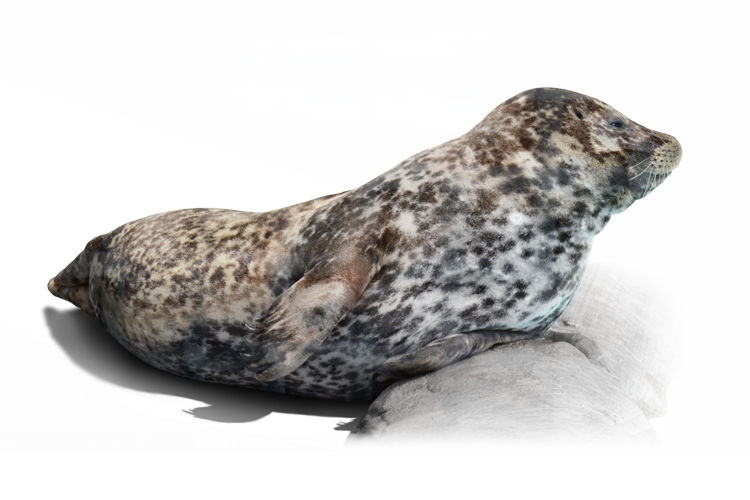
Phoca vitulina (Linnaeus, 1758)
生まれながらの銭形模様
Born with Coin-Shaped Spots
体長は雄で約1.5~1.9m、雌で約1.4~1.7m、体重は50~170kgほどになるアザラシの仲間です。北太平洋から北大西洋にかけての寒帯から温帯の沿岸域に広く分布し、日本では北海道にのみ定住するアザラシとして知られています。体色は灰色から褐色で、全身に散らばる黒色や白色の斑点が江戸時代の貨幣である「銭」に似ていることから、ゼニガタアザラシの名が付けられました。
日本に生息するゼニガタアザラシは、主に北海道東部沿岸から襟裳岬周辺にかけて分布しています。回遊性の強いゴマフアザラシとは異なり、特定の岩礁域を一年を通じて利用する習性を持ちます。主要な繁殖地や上陸場として襟裳岬や厚岸町の大黒島などが知られ、近年の遺伝学的研究では、襟裳岬周辺の個体群が道東の個体群とは異なる遺伝的特徴を持つことも明らかになっています。地域間の遺伝的交流は限られており、日本のゼニガタアザラシは複数の独立性の高い個体群から構成されていると考えられています。そのため、日本の個体群は保全上きわめて重要な存在です。
沿岸の岩礁や砂浜、河口域などを利用して生活し、魚類やイカ、タコ、甲殻類などを捕食します。優れた潜水能力を持ち、通常は数分間の潜水を繰り返しながら採餌しますが、状況によっては20分以上潜ることもあります。大きな目と発達したヒゲは水中生活への適応を示す特徴で、とくにヒゲは獲物が生み出すわずかな水流の変化を感知する高性能な感覚器として機能します。
繁殖期は地域によって異なりますが、日本では主に5~7月に出産が見られます。雌は通常1頭の子を産み、脂肪分の豊富な母乳を与えて育てます。生まれたばかりの子は比較的早い段階から泳ぐことができ、数週間ほどで離乳します。群れは比較的小規模で、岩礁上で適度な距離を保ちながら休息する姿がよく観察されます。
アザラシの赤ちゃんは真っ白というイメージがありますが、ゼニガタアザラシは例外です。多くのアザラシ類では白い胎毛に覆われて生まれますが、本種では胎毛がお母さんの胎内で抜け落ちるため、子どもは生まれた時から灰色の体色と特徴的な斑紋を備えています。岩礁域で暮らす本種にとって白い毛はかえって目立ってしまうため、この特徴は周囲の環境に溶け込むための適応と考えられています。赤ちゃんの頃から大人によく似た姿をしているのも、本種ならではの特徴です。
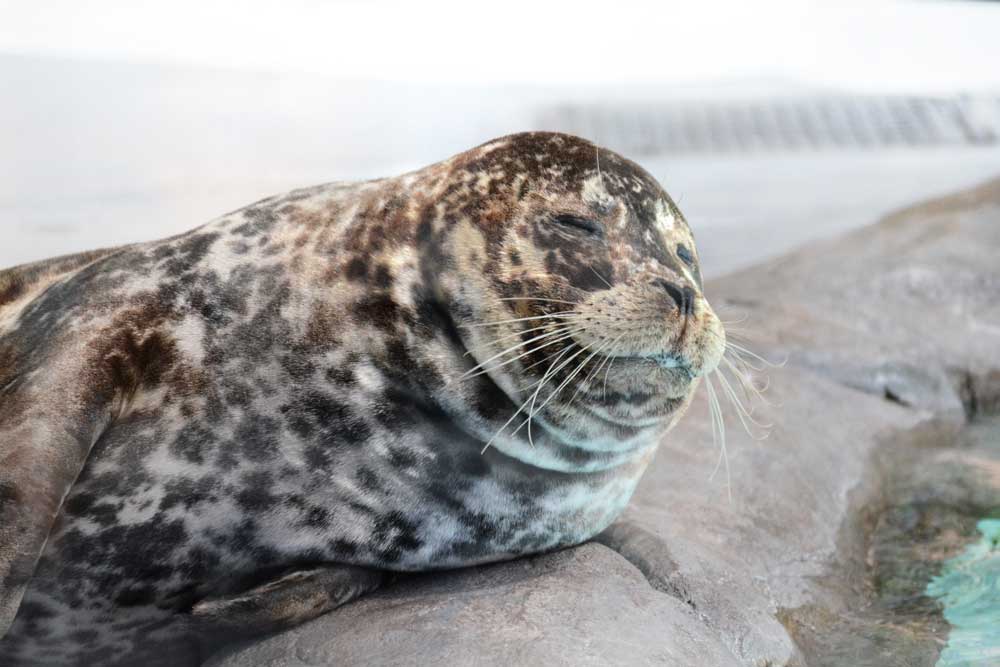
The harbor seal is a member of the seal family, reaching a body length of about 1.5–1.9 m in males and 1.4–1.7 m in females, with a weight ranging from 50 to 170 kg. It is widely distributed along the coastal waters of the North Pacific and North Atlantic, from temperate to subarctic regions. In Japan, it is the only seal species that maintains year-round resident populations in Hokkaido. Its common Japanese name, Zenigata Azarashi, derives from the numerous dark and light spots scattered across its grayish-brown body, which resemble old Japanese coins (zeni).
In Japan, harbor seals occur mainly along the eastern coast of Hokkaido and around Cape Erimo. Unlike the highly migratory spotted seal, they tend to remain within specific rocky coastal habitats throughout the year. Important breeding and haul-out sites include Cape Erimo and Daikoku Island off Akkeshi. Recent genetic studies have shown that the population around Cape Erimo possesses genetic characteristics distinct from those of eastern Hokkaido. Gene flow between regional populations appears to be limited, suggesting that Japanese harbor seals consist of several highly independent population groups. As a result, these populations are considered particularly important from a conservation perspective.
Harbor seals inhabit rocky shores, sandy beaches, and estuaries, where they feed on fish, squid, octopuses, and crustaceans. They are excellent divers, typically making repeated dives lasting several minutes while foraging, although they are capable of remaining underwater for more than 20 minutes when necessary. Their large eyes and well-developed whiskers are key adaptations for aquatic life. In particular, the whiskers function as highly sensitive sensory organs that detect subtle water movements generated by prey.
The breeding season varies among regions, but in Japan pups are usually born between May and July. Females normally give birth to a single pup and nurse it with milk rich in fat. Newborn pups are able to swim at an early age and are weaned after only a few weeks. Harbor seals generally form relatively small groups, and they are often seen resting on rocky reefs while maintaining a moderate distance from one another.
Many people imagine that all seal pups are born with pure white fur, but the harbor seal is an exception. While the pups of many seal species are covered with a white lanugo coat at birth, harbor seal pups shed this coat before birth while still in the womb. As a result, they are born with a gray coat already marked by the characteristic spotted pattern of the species. Because a white coat would stand out on the rocky shores where they live, this trait is thought to help the pups blend into their surroundings. The fact that young pups closely resemble adults from birth is one of the harbor seal’s most distinctive characteristics.
参考文献
東京ズーネット | 上野動物園 | ゼニガタアザラシ 2026年7月4日閲覧
環境省 | 野生生物小委員会(平成27年度 第9回)議事次第・資料 | 資料1-7-3 2026年7月4日閲覧
環境省 | ゼニガタアザラシ保護管理事業次期管理計画(第3期)概要 | 資料1-2 2026年7月4日閲覧