
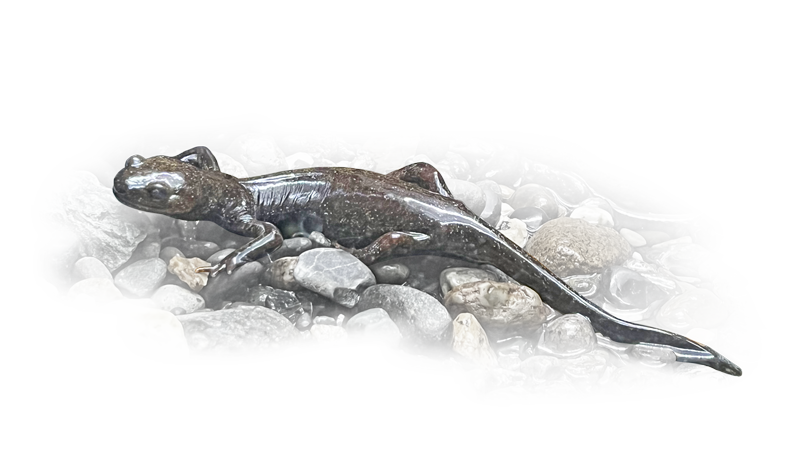
Hynobius nigrescens (Stejneger, 1907)
共食いで大顎化するサンショウウオ
The Salamander That Develops Giant Jaws Through Cannibalism
クロサンショウウオは、東北地方から中部地方を中心とした本州の広い範囲に分布する日本固有の両生類です。成体の全長はおよそ12~20cmになり、黒褐色から暗褐色の体色を持ちます。皮膚は比較的なめらかで光沢があり、夜行性のため日中は落ち葉や石の下、土中などに潜んで生活しています。繁殖期以外は森林内で過ごしますが、早春になると産卵のため池や湿地、水たまりなどの止水域へ集まります。
本種の大きな特徴の一つが、雌が産む独特な卵のうです。卵は透明から乳白色のゼリー質に包まれた一対の細長い卵のうの中に約50個収められ、水中の枝や落ち葉などに固定されます。卵のうは成長に伴って吸水し大きく膨らみます。また地域によって透明度に違いがあり、白色型から透明型までさまざまな形が知られています。
孵化した幼生は水中で小型の無脊椎動物などを捕食しながら成長します。しかし、産卵場所によっては幼生同士の共食いが見られることがあります。特に餌が不足する環境では、一部の幼生が通常よりも大きな頭部と発達した顎を持つ「大顎型(カニバル型)」へと変化し、同種の幼生を積極的に捕食します。この形態変化は成長を加速させる適応戦略と考えられており、日本のサンショウウオ類の中でも特に興味深い生態として知られています。近年の研究では、大顎型の形成に腸内細菌叢が関与する可能性も示され、共食いと形態変化の関係が注目されています。
一方で、本種の生息環境は近年悪化しています。里山の管理放棄や農業形態の変化、ため池や湿地の減少によって繁殖に適した止水環境が失われつつあります。特に産卵場所となる浅い池や一時的な水たまりの消失は個体群の存続に大きな影響を与えます。そのため各地で生息地の保全や人工産卵池の整備などが進められています。
The Japanese Black Salamander is an amphibian endemic to Japan, distributed across a wide area of Honshu, particularly in the Tohoku and Chubu regions. Adults typically reach 12–20 cm in total length and have a dark brown to blackish-brown coloration. Their skin is relatively smooth and glossy. Being primarily nocturnal, they spend the daytime hidden beneath leaf litter, rocks, or in the soil. Outside the breeding season, they inhabit forested areas, but in early spring they migrate to still-water habitats such as ponds, marshes, and temporary pools to reproduce.
One of the species’ most distinctive features is its unique egg sacs. Each female lays a pair of elongated, gelatinous sacs containing approximately 50 eggs. These sacs, ranging from transparent to milky white, are attached to submerged branches, leaves, or other objects. As development proceeds, the sacs absorb water and expand considerably. Their appearance varies among populations, with forms ranging from opaque white to nearly transparent.
After hatching, the larvae live in the water and feed on small aquatic invertebrates. However, cannibalism among larvae is sometimes observed. In environments where food is scarce, some individuals develop into a specialized “cannibal morph” characterized by an enlarged head and powerful jaws. These larvae actively prey upon smaller individuals of their own species. This remarkable transformation is considered an adaptive strategy that accelerates growth and is one of the most fascinating ecological traits found among Japanese salamanders. Recent studies have suggested that gut microbiota may play a role in the development of the cannibal morph, drawing attention to the relationship between diet, behavior, and morphological change.
In recent years, the species has faced increasing environmental pressures. Abandonment of traditional satoyama management, changes in agricultural practices, and the loss of ponds and wetlands have reduced the availability of suitable breeding habitats. The disappearance of shallow ponds and temporary pools, in particular, can have a significant impact on local populations. As a result, conservation efforts, including habitat protection and the creation of artificial breeding ponds, are being carried out in various regions.
参考文献
エコチル | 【マリンピア日本海だより】特徴的な卵のう「クロサンショウウオ」| (2025年5月12日) 2026年6月13日閲覧
岐阜県 | 自然環境課 | クロサンショウウオ | (2015年9月17日) 2026年6月13日閲覧
第2回自然環境保全基礎調査「日本の重要な両生類・は虫類の分布」(1982年7月15日), 環境省 2026年6月13日閲覧
NEXCO中日本ドライバーズサイト | ニュースリリース | ビオトープ(人工池)にクロサンショウウオが初めて自然産卵しました | (2020年06月05日) 2026年6月13日閲覧
村上 貴俊, 阿部 晴恵「クロサンショウウオ幼生の大顎化発現に関わる環境及び遺伝的要因」令和2年度「自然首都・只見」学術調査研究成果発表会 発表要旨 2026年6月13日閲覧
那須塩原市 | 広報なすしおばら | ちっちゃな自然み~つけた | 今年は、無事に上陸して!~クロサンショウウオと雪かき~ (2018年3月5日) 2026年6月13日閲覧