
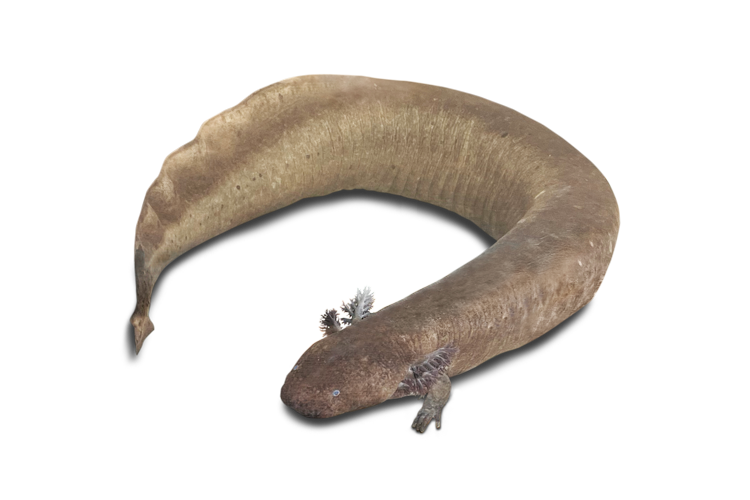
Siren lacertina (Linnaeus, 1766)
後肢を失った水棲両生類
Greater Siren: A Hindlimb-Less Aquatic Amphibian
グレーターサイレンは、北アメリカ南東部の湿地や池、沼、水路などに生息するサイレン科最大の両生類です。全長は通常50~70cmほどですが、大型個体では90cmを超えることもあり、北アメリカの有尾類の中でも最大級の種として知られています。細長い体とウナギのような外見が特徴で、前肢には4本の指がありますが、後肢は完全に失われています。また、成体になっても頭部の両側に羽毛状の外鰓を持ち続けるという、他の有尾類にはあまり見られない特徴を備えています。
一生を水中で過ごす完全水生の両生類で、水草の豊富な止水域や流れの緩やかな水域を好みます。昼間は泥の中や水草の陰、沈木の下などに潜み、夜になると活動を始めます。主に水生昆虫や甲殻類、巻貝、小魚などを捕食し、発達した嗅覚や感覚器官を利用して獲物を探します。外鰓に加えて肺も発達しており、定期的に水面へ浮上して空気呼吸を行います。さらに皮膚呼吸も可能で、酸素の少ない沼地環境でも生存することができます。
本種の最も驚くべき能力は、乾燥した環境を生き抜くための夏眠です。池や湿地が干上がると泥の中へ潜り込み、脱落した表皮細胞などからなる繭状の膜を形成して体を包みます。この状態では代謝を大幅に低下させ、外鰓も縮小します。最長で5年以上にわたり休眠を続けた記録があり、その間に体重の約80%を失っても生存できたと報告されています。雨によって再び水が戻ると速やかに活動を再開し、この驚異的な乾燥耐性によって季節的に干上がる湿地でも生き延びることができます。
繁殖は主に冬から春にかけて行われ、メスは水草などに数百個の卵を産み付けます。孵化した幼体は浅瀬で成長し、数年で性成熟に達します。本種は一生を通じて水中生活を送り、変態によって陸上生活へ移行することはありません。
サイレン科は現生有尾類の中でも最も古い系統の一つで、約1億8千万年前のジュラ紀初期には他のサンショウウオ類との分岐が始まっていたと考えられています。前肢のみを持ち、成体になっても外鰓を保持する姿は原始的な動物を思わせますが、実際には長い進化の過程で水中生活に特化した結果です。グレーターサイレンは、古い系統を受け継ぎながら独自の進化を遂げた、北アメリカの湿地を代表する興味深い両生類です。
Greater siren is the largest salamander of the family Sirenidae, inhabiting wetlands, ponds, swamps, and slow-moving waterways in southeastern North America. It typically reaches 50–70 cm in total length, though large individuals may exceed 90 cm, making it one of the largest salamanders in North America. It has an elongated, eel-like body, and the forelimbs bear four digits, while the hind limbs are completely absent. It also retains feathery external gills on both sides of the head throughout adulthood, a distinctive feature not commonly seen in other salamanders.
This fully aquatic amphibian spends its entire life in water, preferring still or slow-flowing habitats rich in aquatic vegetation. During the day it hides in mud, among submerged plants, or beneath logs, becoming active at night. It feeds mainly on aquatic insects, crustaceans, snails, and small fish, using highly developed olfactory and sensory systems to locate prey. In addition to external gills, it possesses well-developed lungs and regularly surfaces to breathe air. It is also capable of cutaneous respiration, allowing it to survive in oxygen-poor swamp environments.
Its most remarkable ability is aestivation, which enables it to survive dry conditions. When ponds and wetlands dry up, it burrows into the mud and forms a cocoon composed of shed epidermal cells that covers its body. In this state, its metabolism is greatly reduced and the external gills regress. Individuals have been reported to survive in this dormant condition for up to 5 years, and to endure a loss of approximately 80% of their body mass. When water returns, they rapidly resume activity, allowing them to persist in seasonally ephemeral wetlands.
The family Sirenidae is considered one of the most ancient lineages of living salamanders, having diverged from other salamanders by the early Jurassic period, around 180 million years ago. Although its reduced forelimbs and retention of external gills may appear primitive, these traits are actually the result of extreme specialization for an aquatic lifestyle. The greater siren is thus an evolutionarily distinctive amphibian, representing one of the most remarkable lineages of North American wetland fauna.
参考文献
McKenzie, K. 2012. “Siren lacertina” (On-line), Animal Diversity Web. 2026年6月7日閲覧
Britannica Editors. “siren”. Encyclopedia Britannica, 14 Dec. 2018. 2026年6月7日閲覧
Luhring, Thomas. (2008). Population Ecology of Greater Siren, Siren lacertina. 2026年6月7日閲覧
Etheridge, Kay. (1990). The energetics of estivating sirenid salamanders. Herpetelogica. 46. 407-414. 2026年6月7日閲覧