
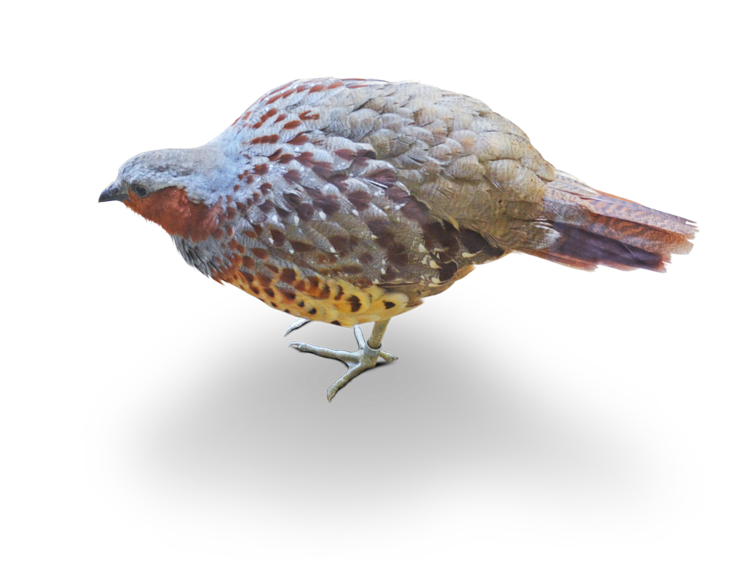
Bambusicola thoracicus (Temminck, 1815)
森へ誘う「チョットコイ」の声
The Call That Beckons from the Forest
全長約28cm。中国南部原産のキジ科の鳥で、標高1,000m以下の草原や森林、竹林、農耕地などに生息します。全体に丸みを帯びた体形と短い尾が特徴で、体色は赤褐色から黄褐色を基調とし、頭頂部や胸の一部は青灰色をしています。雌雄で羽色にほとんど差がなく、脚にある蹴爪によって見分けることができます。雄は蹴爪が鋭く長く発達するのに対し、雌では短く先端が丸みを帯びています。
日本では外来種として移入され、現在は宮城県以南の本州から四国、九州にかけて分布しています。導入は大正時代に始まり、飼育個体の逸出や狩猟目的の放鳥によって各地へ広がりました。1915年には東京で飼育されていたつがいが逃げ出した記録があり、その後も各地で放鳥が行われています。特に狩猟鳥として高く評価され、多数の個体が放鳥されたことが日本への定着を後押ししたと考えられています。当時、中国から輸入されたコジュケイは肉質が良く食味に優れることで知られ、狩猟文化の普及とともに重要な狩猟対象となりました。
地上で生活することが多く、種子や果実、昆虫などを食べます。飛ぶこともできますが、普段は藪や下草の中を歩いて移動し、危険を感じると素早く茂みに駆け込んで身を隠します。繁殖期以外は家族群や小群で行動することが多く、林縁部や竹林から響く特徴的な鳴き声でその存在に気づかされます。
近年、日本では生息数の減少傾向が報告されています。その要因として、かつて行われていた狩猟目的の放鳥がなくなったことに加え、森林の分断化による影響が指摘されています。移動能力があまり高くないため、孤立した森林間を行き来しにくく、新たな生息地への分散が妨げられていると考えられています。鳴き声が「チョットコイ、チョットコイ」と聞こえることから親しまれ、日本では「警官鳥」と呼ばれることもあります。しかし、森林へと誘うようなその独特の声は、近年少しずつ聞かれなくなりつつあります。
The Chinese Bamboo Partridge is a member of the pheasant family native to southern China, measuring about 28 cm in length. It inhabits grasslands, forests, bamboo groves, and agricultural areas at elevations below 1,000 meters. The bird has a rounded body and a short tail. Its plumage is predominantly reddish-brown to yellowish-brown, with bluish-gray coloration on the crown and parts of the breast. Males and females are very similar in appearance and can be distinguished mainly by their spurs. Males possess long, sharp spurs on their legs, whereas those of females are shorter and more rounded.
In Japan, the species was introduced as a non-native bird and is now distributed from Miyagi Prefecture southward through Honshu, Shikoku, and Kyushu. Its introduction began during the Taisho era (1912–1926), when escaped captive birds and intentional releases for hunting allowed populations to spread. Records indicate that a pair escaped from captivity in Tokyo in 1915, followed by further releases in various regions. The species was highly valued as a game bird, and large numbers were released, contributing greatly to its successful establishment. At the time, imported Chinese Bamboo Partridges were known for their tender, flavorful meat, and the growing popularity of hunting helped promote their spread.
The species spends most of its time on the ground, feeding on seeds, fruits, and insects. Although capable of flight, it usually moves by walking through dense undergrowth and quickly dashes into cover when threatened. Outside the breeding season, individuals often gather in family groups or small flocks. Their presence is frequently revealed by their distinctive calls echoing from forest edges and bamboo thickets.
In recent years, populations in Japan have shown a declining trend. One factor is the cessation of hunting-related releases that once supplemented wild populations. In addition, forest fragmentation is believed to have contributed to the decline. Because the species has limited dispersal ability, isolated woodland patches can restrict movement and hinder the colonization of new habitats. Its characteristic call is often interpreted by Japanese listeners as sounding like “Chotto koi, chotto koi” (“Come here, come here”), earning it the nickname “Keikan-dori” (“policeman bird”). However, the unique call that seems to invite people into the forest is gradually becoming less common than it once was.
参考文献
国立環境研究所 | 侵入生物データベース | コジュケイ 2026年6月13日閲覧
森林総合研究所 多摩森林科学園 | 自然探訪 | コジュケイ(3月) 2026年6月13日閲覧
バードリサーチニュース | 緑地の孤立化が影響?減少続く東京のコジュケイ| 植田 睦之 (2020年04月30日) 2026年6月13日閲覧