
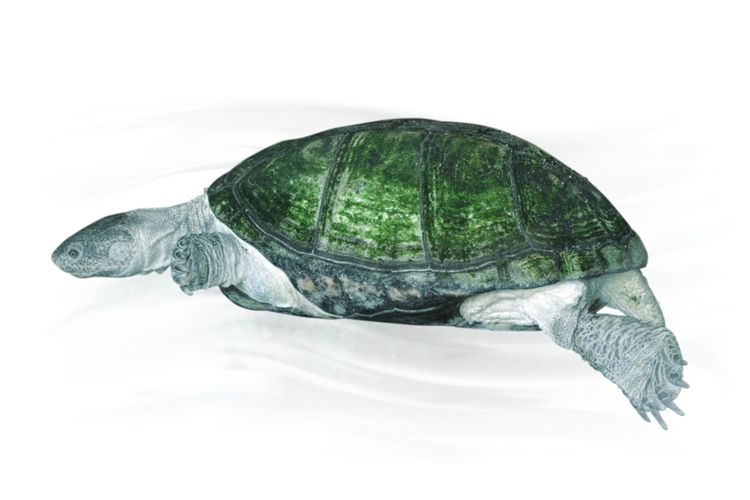
Pelusios castaneus (Schweigger, 1812)
巨大ワニやカバの棲む水辺に生きるカメ
Living Among Crocodiles and Hippos
クリイロハコヨコクビガメは、西アフリカから中部アフリカにかけて分布するヨコクビガメ科の淡水性カメです。セネガルからナイジェリア、カメルーン、コンゴ民主共和国にかけての河川や池、沼、湿地、水路などに生息し、人為的に造られたため池や灌漑用水路で見られることもあります。甲長は20~28cmほどになり、ヨコクビガメ類の中では中型種に分類されます。
背甲は栗色から暗褐色を呈し、和名の由来にもなっています。腹甲は比較的大きく、前葉と後葉がわずかに可動するため、頭部や四肢を保護するのに役立っています。頭部には細かな網目状の模様が入ることがあり、ヨコクビガメ類に共通する特徴として、首を横に折り曲げて甲羅の中へ収納します。
主に水中で生活しますが、岸辺や流木の上で日光浴を行うこともあります。食性は雑食性で、昆虫類や甲殻類、貝類、小魚、オタマジャクシなどの小動物を中心に、水草や果実なども食べます。環境への適応力が高く、一時的に水位が低下するような環境でも生息できることが知られています。
繁殖期にはメスが陸上に穴を掘って産卵します。一度に6~18個ほどの卵を産み、孵化した幼体は甲長3~4cmほどです。比較的丈夫で飼育しやすいことからペットとして世界各地で飼育されていますが、逸出した個体が定着し、外来種として繁殖している地域もあります。
本種が本来生息する西アフリカの水辺には、ワニ類やカバなどの大型動物も暮らしており、同じ生態系を共有しています。環境への適応力が高く、多様な淡水環境で見られることから、西アフリカを代表するヨコクビガメの一つとなっています。
The West African Mud Turtle is a freshwater turtle belonging to the side-necked turtle family. It is distributed across western and central Africa, ranging from Senegal and Nigeria to Cameroon and the Democratic Republic of the Congo. It inhabits a variety of freshwater environments, including rivers, ponds, marshes, swamps, and canals, and can also be found in artificial water bodies such as reservoirs and irrigation channels. Adults typically reach a carapace length of 20–28 cm, making it a medium-sized member of the side-necked turtles.
Its carapace ranges in color from chestnut brown to dark brown, which is reflected in its Japanese name. The plastron is relatively large, and its front and rear lobes are slightly movable, helping protect the head and limbs. The head may display fine reticulated markings. Like all side-necked turtles, it cannot retract its head straight back into the shell; instead, it bends its neck sideways beneath the shell.
This species spends most of its time in the water but often emerges onto logs or riverbanks to bask in the sun. It is omnivorous, feeding mainly on small animals such as insects, crustaceans, mollusks, fish, and tadpoles, while also consuming aquatic plants and fallen fruits. It is highly adaptable and can survive in habitats where water levels fluctuate seasonally.
During the breeding season, females dig nests on land and lay between 6 and 18 eggs. Hatchlings measure only about 3–4 cm in carapace length. Because of its hardiness and ease of care, the species is widely kept as a pet around the world. In some regions, escaped or released individuals have established breeding populations and become an introduced species.
In its native range, the waterways of West Africa are also home to large animals such as crocodiles and hippopotamuses, with which this turtle shares the same ecosystem. Thanks to its remarkable adaptability and ability to inhabit a wide variety of freshwater environments, it is considered one of the representative side-necked turtles of West Africa.
参考文献
Pelusios castaneus, 095, IUCN/SSC Tortoise and Freshwater Turtle Specialist Group. 2026年6月6日閲覧
Pelusios castaneus, Turtle of the World. 2026年6月6日閲覧