
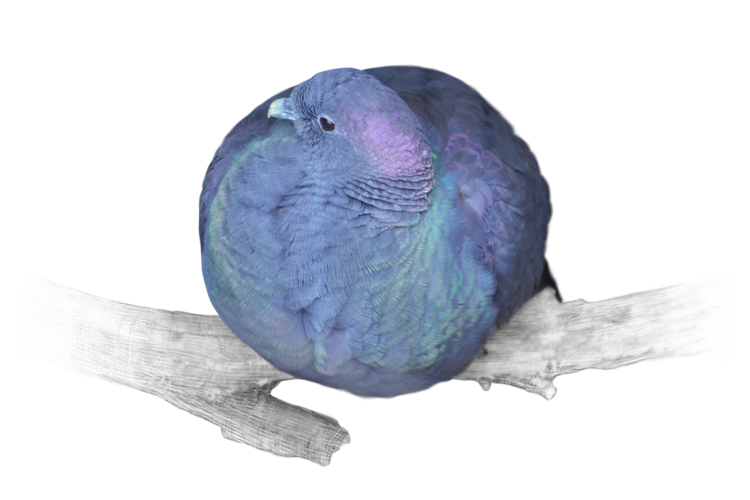
Columba janthina (Temminck, 1830)
森に響く低い声、謎に包まれたハト
A Mysterious Pigeon with a Deep Call
カラスバトは全長約40cm、体重約450gに達する日本最大級の野生のハトで、国の天然記念物に指定されています。中国東部や朝鮮半島南部、日本に分布し、日本では本州中部以南の沿岸部や島嶼の森林に生息しています。特に島で見られることが多く、これは本来の生息環境に地上性の捕食者が少なかったことと関係していると考えられています。
全身は光沢のある暗青色から黒紫色を呈し、首から胸にかけては青緑色の金属光沢が見られます。小さな頭部は赤紫色を帯び、頭頂部がやや盛り上がる独特の形状をしています。その姿は名前の由来にもなったカラスを思わせますが、実際には大型で優雅なハトの仲間です。鳴き声はドバトよりも低く、「ウッウー」「クルッウゥー」と響く重厚な声で、牛の鳴き声に似ていることから、徳之島などでは「ウシボートウ(牛バト)」と呼ばれることもあります。
食性は主に植物食で、タブノキ、シイ類、ツバキ、ガジュマル、センダンなどの果実や種子を好んで食べます。樹上だけでなく地上でも採食し、落下した果実や種子も利用します。また、海岸に下りて海水や砂、小石、貝殻片などを摂取する行動が知られており、植物質の餌だけでは不足しがちな塩類やミネラルを補給していると考えられています。このような行動はアオバトでもよく知られていますが、カラスバトでも確認されています。
警戒心が非常に強く、人前に姿を現すことは稀です。そのため生態には未解明な部分も多く残されています。近縁亜種である小笠原諸島固有のアカガシラカラスバトは、一時は数十羽まで減少した絶滅危惧種でしたが、近年は保護活動によって個体数が回復傾向にあります。さらに、京都大学などの研究により、この集団では有害な遺伝子変異が長年の自然選択によって除去される「遺伝的浄化」が起きていたことが明らかになりました。外来種ノネコの駆除とあわせて、この現象が個体群の回復を支えた可能性が示されており、島嶼生物の保全を考える上でも注目されています。
The Japanese Wood Pigeon is the largest wild pigeon in Japan, reaching about 40 cm in length and weighing around 450 g. It is designated as a National Natural Monument of Japan. The species is distributed in eastern China, the southern Korean Peninsula, and Japan, where it inhabits forests along coastal areas and on islands south of central Honshu. Its preference for islands is thought to be related to the historical scarcity of terrestrial predators in these environments.
The bird is distinguished by its glossy dark blue to blackish-purple plumage and the beautiful metallic green sheen on its neck and breast. Its small head is tinged with reddish-purple, and the crown is slightly raised, giving it a unique profile. Although its name refers to a crow-like appearance, it is in fact a large and elegant member of the pigeon family. Its call is much deeper than that of the feral pigeon, consisting of low, resonant notes often described as “woo-woo” or “kruu-woo.” On Tokunoshima and some other islands, it is locally known as the “Ushi-bato” or “Cow Pigeon” because its voice resembles the lowing of cattle.
The Japanese Wood Pigeon is primarily herbivorous, feeding on a wide variety of fruits and seeds, including those of tabunoki laurels, chinquapins, camellias, banyan trees, and chinaberry trees. It forages both in trees and on the ground, readily consuming fallen fruits and seeds. The species is also known to visit seashores, where it drinks seawater and ingests sand, small stones, and shell fragments. These materials are believed to supplement minerals and salts that may be lacking in its largely plant-based diet. Similar behavior is well known in the Japanese Green Pigeon, but it has also been documented in this species.
Extremely wary and seldom seen by people, the Japanese Wood Pigeon remains one of Japan’s least-studied birds. A closely related subspecies endemic to the Ogasawara Islands, the Bonin Wood Pigeon, declined to only a few dozen individuals in the early 2000s but has recently shown signs of recovery. Genetic research conducted by Kyoto University and collaborating institutions revealed evidence of “genetic purging,” a process in which harmful mutations are removed through natural selection. Combined with the eradication of invasive feral cats, this phenomenon may have helped the population recover and has become an important case study in island conservation biology.
参考文献
関 伸一「DNAからみた西日本のカラスバト集団構造」九州の森と林業 no.73 (2005年), 森林総合研究所九州支所 2026年5月31日閲覧
バードリサーチ | 生体図鑑 カラスバト | (2016年4月28日) 2026年5月31日閲覧
渡久地 豊, 金城 道男, 市田 豊子「カラスバトColumba janthina の塩類摂取行動」STRIX Vol. 14, pp. 186-189 (1996) 2026年5月31日閲覧