
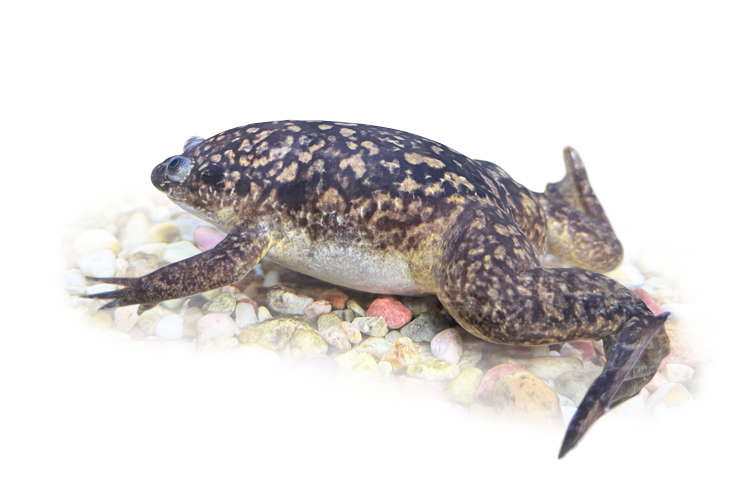
Xenopus laevis (Daudin, 1802)
妊娠検査に利用された不思議なカエル
The Unusual Frog Once Used for Pregnancy Testing
アフリカツメガエルは、サハラ砂漠以南のアフリカに広く分布する水生性のカエルです。英名は、後肢の内側に発達した3本の黒い爪に由来します。成体の体長は5〜12cmほどで、メスの方が大型になる傾向があります。体は平たく流線形で、背面は灰褐色から暗緑色、腹面は白っぽく、水底に溶け込みやすい保護色をしています。舌を持たず、完全な水中生活に適応した特徴を備えており、前肢は小さく、後肢には発達した水かきがあります。視力や嗅覚にも優れていますが、水中の振動を感知する側線器官が発達している点も特徴です。
生涯のほとんどを水中で過ごし、湖沼、池、水路など流れの緩やかな淡水域に生息します。肉食性が強く、水生昆虫、小魚、甲殻類、オタマジャクシなどを捕食します。餌を探す際には、前肢で口元へ掻き込むような独特の動作を行います。繁殖期にはオスが水中で鳴き声を発し、抱接によって産卵を行います。卵は水草などに付着し、孵化した幼生は濾過摂食を行いながら成長します。また、乾季に水場が干上がると泥中で休眠状態に入り、生き延びる能力を持つことでも知られています。
アフリカツメガエルは、生物学や医学研究において極めて重要な実験動物として利用されてきました。20世紀中頃には、妊婦の尿を注射すると排卵反応を示す性質を利用した妊娠検査にも用いられていました。さらに、発生学、再生研究、遺伝学などの分野でも重要なモデル生物となっています。一方で、ペットとして世界各地へ持ち込まれた結果、野外へ定着した地域もあり、在来生物への影響が問題視されています。特に、両生類の感染症であるツボカビ症の拡散に関与した可能性が指摘されており、生態系への影響を含めた慎重な管理が求められています。
The African clawed frog is an aquatic frog widely distributed across sub-Saharan Africa. Its English name comes from the three black claws developed on the inner side of its hind feet. Adults generally reach 5–12 cm in length, with females tending to grow larger than males. The body is flat and streamlined, with grayish-brown to dark green coloration on the back and a pale underside, providing camouflage against muddy bottoms. Lacking a tongue, this species is highly adapted to an entirely aquatic lifestyle. Its forelimbs are small, while the hind limbs possess well-developed webbing for swimming. In addition to keen eyesight and olfaction, it also has a developed lateral line system capable of detecting vibrations in the water.
Spending nearly its entire life underwater, this species inhabits slow-moving freshwater environments such as lakes, ponds, and canals. It is strongly carnivorous, feeding on aquatic insects, small fish, crustaceans, and tadpoles. When searching for food, it performs a distinctive motion of sweeping prey toward its mouth with its forelimbs. During the breeding season, males produce underwater calls and mate through amplexus. Eggs are attached to aquatic plants, and the larvae grow while filter-feeding. The species is also known for its ability to survive dry seasons by entering a dormant state within mud when water bodies dry up.
The African clawed frog has long been an important experimental animal in biological and medical research. During the mid-20th century, it was even used for pregnancy testing because females would ovulate when injected with the urine of pregnant women. It later became an important model organism in fields such as developmental biology, regenerative research, and genetics. On the other hand, because it has been introduced worldwide through the pet trade and research use, some populations have become established in the wild, raising concerns about impacts on native ecosystems. In particular, the species has been suspected of contributing to the spread of chytridiomycosis, a serious infectious disease affecting amphibians, and therefore requires careful management to minimize ecological impacts.
参考文献
基礎生物学研究所WEBマガジン | 研究所の生き物たち | アフリカツメガエル | (2012年4月26日) 2026年5月16日閲覧
広島大学両生類研究センター | アフリカツメガエル 2026年5月16日閲覧
千葉県生物多様性センター 生命(いのち)のにぎわい調査団 | 千葉市で新たに見つかった外来種:アフリカツメガエル | (2023年9月) 2026年5月16日閲覧
日本獣医師会 | 獣医師のためのツボカビ症(Chytridiomycosis)解説 | 宇根有美 2026年5月16日閲覧