
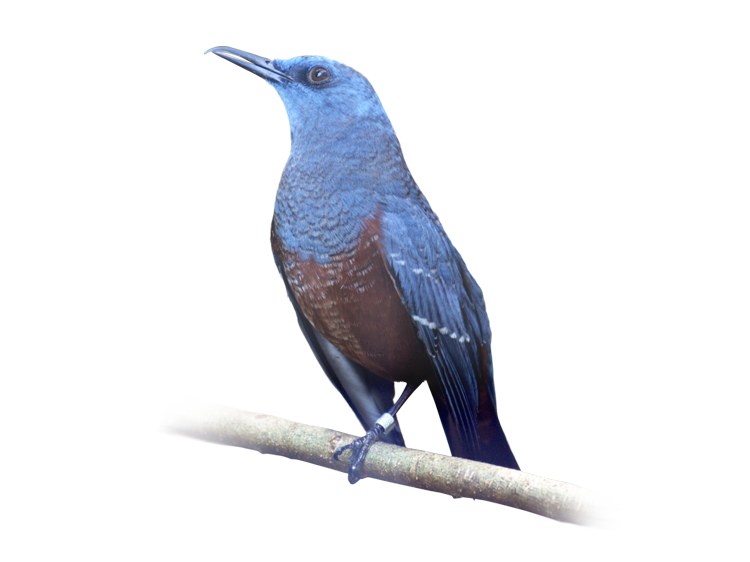
Monticola solitarius (Linnaeus, 1758)
岩場の青い鳥は街へ進出
The Blue Rock Bird Expanding into Cities
イソヒヨドリは、スズメ目ヒタキ科に属する小鳥で、全長は約23cmです。ヨーロッパ南部、アフリカ北部から中央アジア、東アジアまで広く分布し、日本では主に本州以南で見られます。かつては海岸や岩山などに多い鳥として知られていましたが、近年では都市部への進出が著しく、高層建築や港湾施設、住宅街などでも普通に観察されるようになりました。
雄は頭部から背にかけて深い青色を呈し、腹部は赤褐色で美しく、雌は全身が灰褐色で鱗状の模様を持つ地味な姿をしています。若鳥は雌に似ていますが、成長に伴って雄は鮮やかな羽色へ変化します。なお分布域によって体色差があり、青と赤褐色の体色を持つのは日本を含む東アジアの亜種の特徴であり、ヨーロッパなど西方に分布する亜種の雄は全身が青色です。
主に昆虫類やクモ、小型甲殻類などを捕食しますが、果実も食べる雑食性です。海岸では岩場を跳ね歩きながら餌を探し、都市部では街灯の周囲に集まる昆虫を捕える姿も見られます。基本的に群れを作らず、単独またはつがいで行動することが多い鳥です。縄張り意識が強く、雄同士が激しく争うこともあります。繁殖期には岩の隙間や建物の換気口、橋梁の構造物などに営巣し、椀形の巣を作ります。雄は高所でさえずりを行い、その声は気の強い性格とは裏腹に、美しく澄んだ声として知られています。
和名の「磯鵯」は、海岸の磯に多く生息し、姿や鳴き声がヒヨドリを連想させたことに由来します。ただし分類上ではヒヨドリとは近縁でなく、ツグミの仲間です。学名 Monticola solitarius は、「山に住む孤独な鳥」を意味します。英名 Blue Rock Thrush も、青い体色と岩場を好む生態に由来しています。
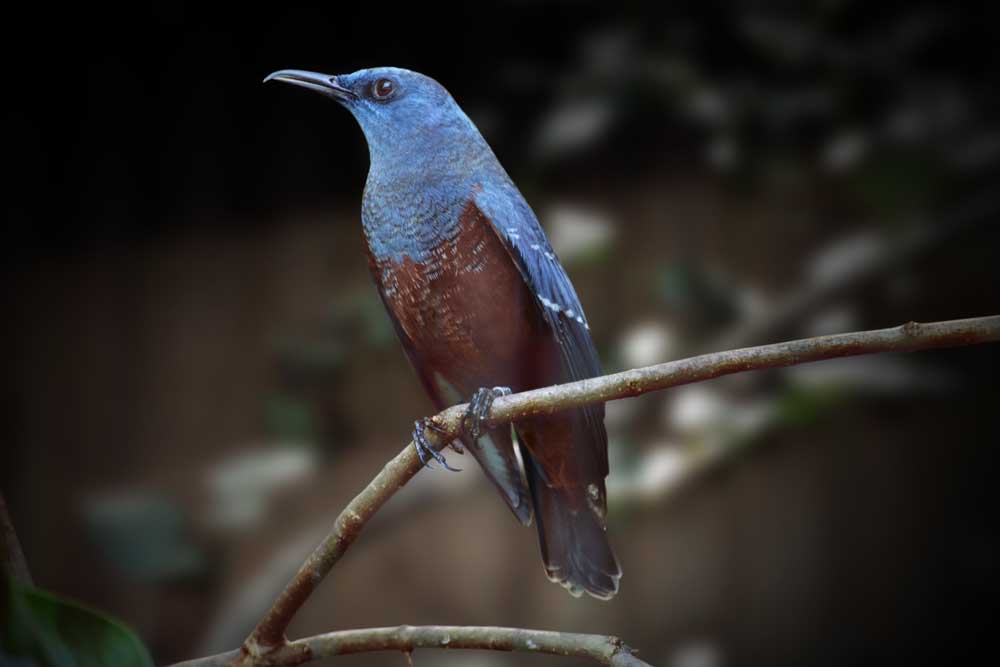
The Blue Rock Thrush is a small passerine bird belonging to the flycatcher family, reaching about 23 cm in length. It is widely distributed from southern Europe and northern Africa to Central and East Asia, and in Japan it is mainly found from Honshu southward. Formerly known as a bird of rocky coasts and seaside cliffs, it has recently expanded into urban areas and is now commonly observed around high-rise buildings, harbors, and residential districts.
Males have deep blue plumage on the head and back with a beautiful reddish-orange belly, while females are more subdued in appearance, with grayish-brown plumage marked by scaly patterns. Juveniles resemble females, but males gradually acquire their vivid coloration as they mature. Plumage coloration varies geographically: the blue-and-rufous coloration is characteristic of the East Asian subspecies, including those found in Japan, whereas males of western subspecies distributed in Europe and surrounding regions are almost entirely blue.
The species feeds mainly on insects, spiders, and small crustaceans, but it also eats fruits, making it omnivorous. Along the coast it searches for food by hopping among rocks, while in urban areas it is often seen catching insects attracted to streetlights. It usually does not form flocks and is most often encountered alone or in pairs. Territorial behavior is strong, and males may fight fiercely with one another. During the breeding season, nests are built in rock crevices, ventilation holes in buildings, and gaps within bridges or other structures, forming a cup-shaped nest. Males sing from elevated perches, and their song is known for being clear and beautiful despite their aggressive temperament.
The Japanese name “Isohiyodori” means “seaside bulbul,” reflecting its association with rocky shores and its resemblance in appearance and voice to the Brown-eared Bulbul. However, taxonomically it is not closely related to bulbuls, but instead belongs to the thrush group. The scientific name Monticola solitarius means “solitary bird of the mountains.” Its English name, Blue Rock Thrush, likewise refers to its blue plumage and preference for rocky habitats.
参考文献
兵庫県立人と自然の博物館 | ひとはく | イソヒヨドリという鳥をご存知ですか? | (2010年4月23日) 2026年5月16日閲覧
山階鳥類研究所 | イソヒヨドリはなぜ内陸部に進出するのか・謎解きに挑戦中!| (2020年5月) 川内 博 2026年5月16日閲覧
「イソヒヨドリと青梅商店街」青海市文化財ニュース 第372号 (2018年10月15日) 2026年5月16日閲覧
講談社の動く図鑑MOVE | 最新NEWS | 海辺の磯にいるはずのイソヒヨドリに異変が……!? いったい何が? | (2023年4月20日) 2026年5月16日閲覧
Kuta, Sarah (2024, April 30) “Extremely Rare Blue Rock Thrush Spotted in Oregon Might Be the First Ever in the United States” Smithsonian Magazine. 2026年5月16日閲覧