
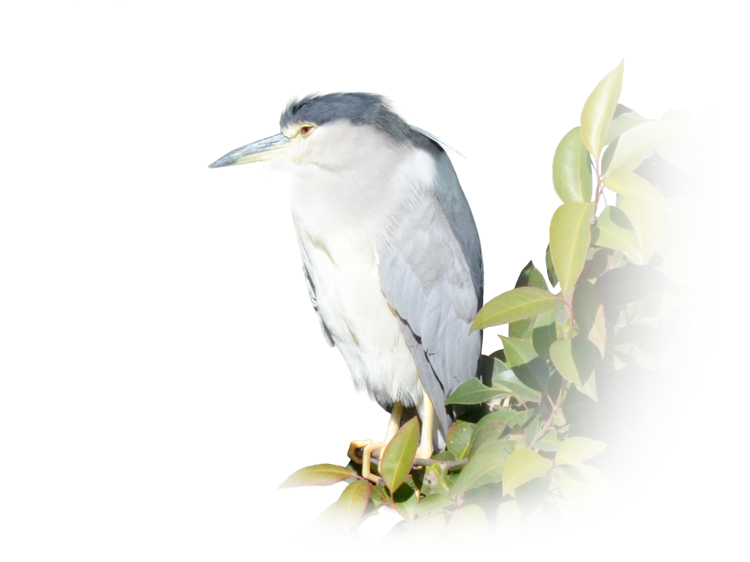
Nycticorax nycticorax (Linnaeus, 1758)
青白く光る鳥の伝説
The Legend of the Pale, Glowing Bird
全長は55〜60cmです。ユーラシア大陸、アフリカ大陸、南北アメリカ大陸(オセアニアを除く)の温帯から熱帯にかけて広く分布しています。日本では、河川、湖沼、水田、湿地、海岸など多様な水辺環境に生息しており、本州以南では周年生息する留鳥、東北地方や北海道では夏鳥として見られます。
頭部から背にかけては青灰色で、翼は灰色をしています。後頭部には2本の白い冠羽があり、成鳥は雌雄同色です。一方、幼鳥や若鳥は褐色の体色に白い斑点模様があり、成鳥とは大きく異なる外見をしています。この斑点模様から、幼鳥は「ホシゴイ」とも呼ばれています。
和名ゴイサギは、醍醐天皇が家来に命じて捕らえさせようとした際、逃げずにおとなしく従ったことを不思議に思い、その従順さを称えて「五位」の位を授けたという逸話に由来しています。この逸話に象徴されるように、日中は草地や樹木の茂みでじっと休んでいることが多く、夕方から夜にかけて活動する夜行性の性質を持っています。
日本各地には、サギが夜に青白く光って見えるという伝説があり、「青鷺火」や「五位の光」として知られています。夜間に活動するゴイサギやアオサギが、その正体ではないかと考えられてきました。発光性の微生物が体表に付着したためとする説もありますが、科学的な裏付けはありません。一方で、鳥が光として認識される民間伝承は世界各地に存在しており、文化や象徴性の違いを反映しながら語り継がれています。
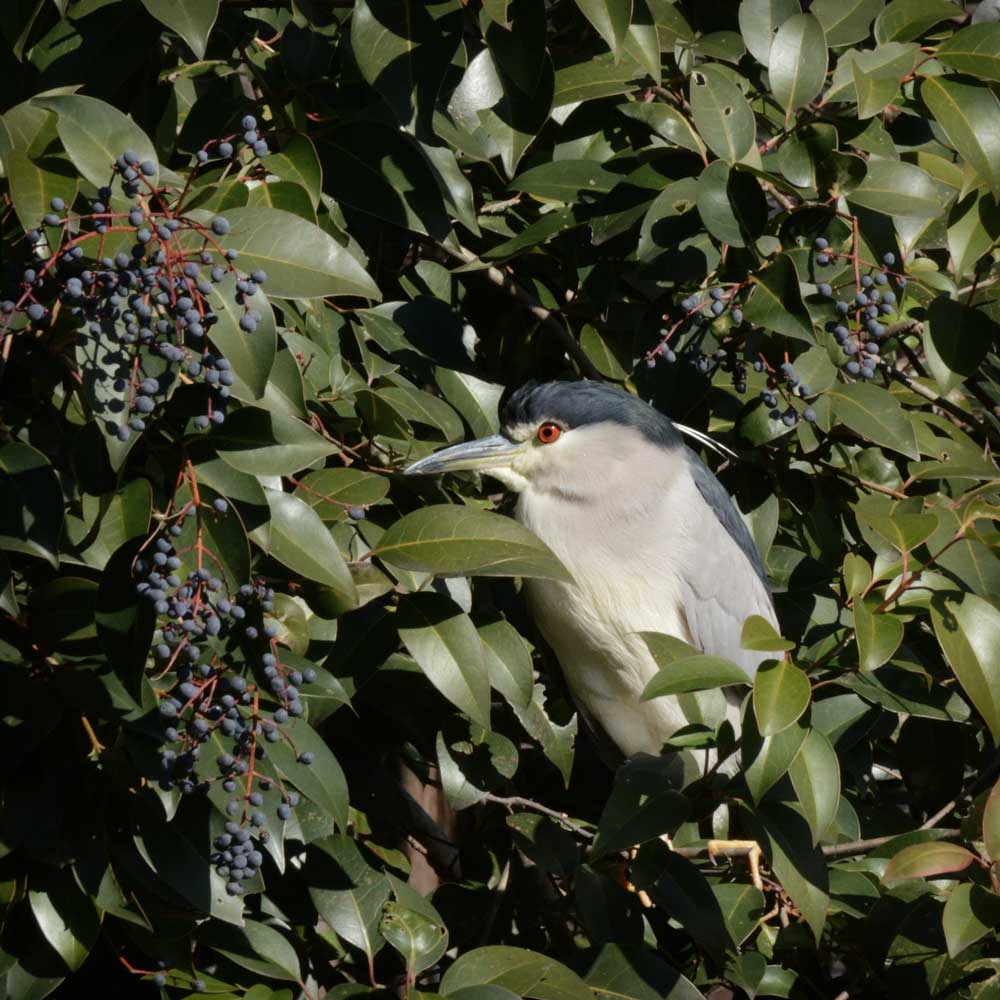
The red eyes are characteristic of adult birds, and as they mature they change from the yellow eyes of juveniles.
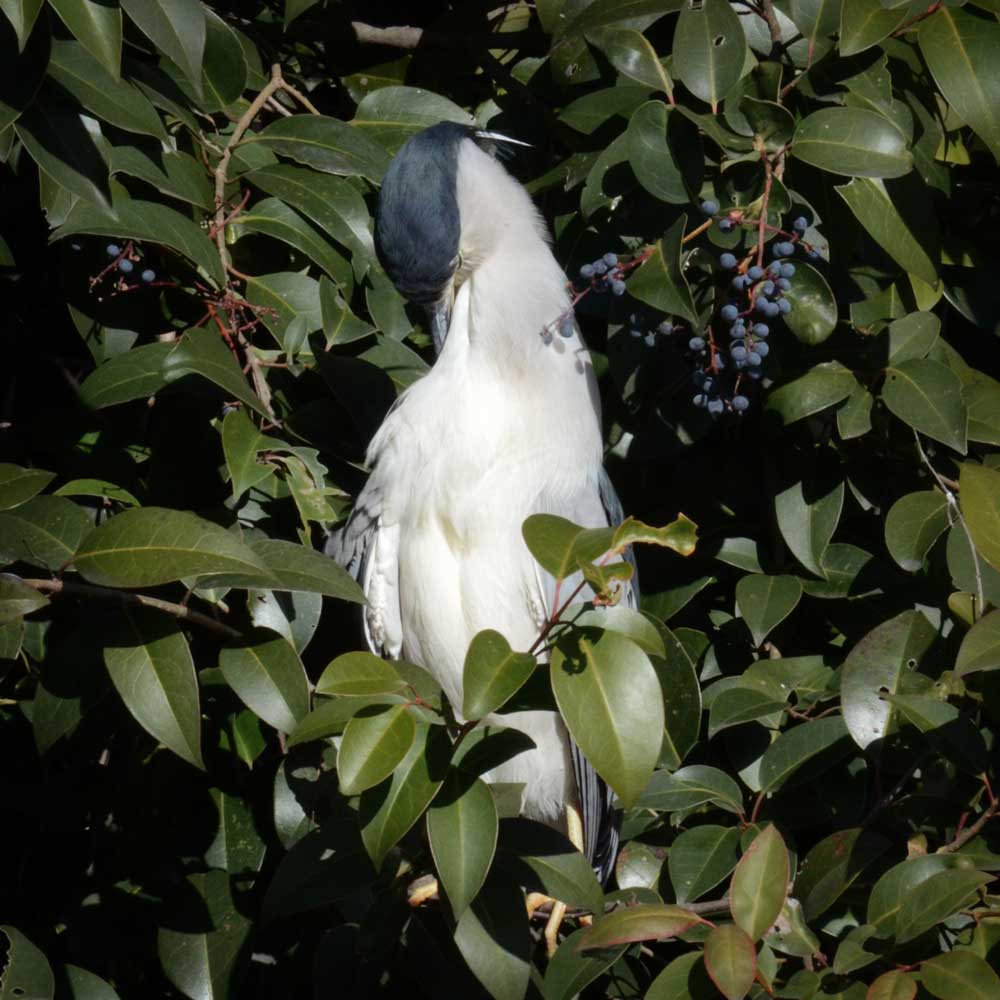
The black-crowned night heron’s neck is normally bent in an S shape, but when stretched out it is long.
The Black-crowned Night Heron has a total length of 55–60 cm. It is widely distributed across temperate to tropical regions of Eurasia, Africa, and North and South America, excluding Oceania. In Japan, it inhabits a wide variety of aquatic environments, including rivers, lakes, rice paddies, wetlands, and coastal areas. It is a year-round resident in Honshu and regions farther south, while in Tohoku and Hokkaido it appears mainly as a summer visitor.
The head and back are bluish-gray, and the wings are gray. Two white plumes extend from the back of the head. Adult males and females share the same coloration. In contrast, juveniles and immature birds are brown with white spots, giving them an appearance quite different from that of adults. Because of this spotted pattern, juveniles are also known by the name Hoshigoi in Japanese.
The Japanese name Goisagi (literally “Fifth-Rank Heron”) originates from a legend involving Emperor Daigo. According to the story, when the emperor ordered his retainers to capture a heron, the bird did not flee and allowed itself to be taken. Impressed by its obedience, the emperor granted it the court rank of Fifth Rank. Reflecting this legend, the species often remains motionless during the daytime, resting in grasses or dense vegetation, and becomes active from evening through the night, exhibiting a largely nocturnal lifestyle.
Throughout Japan, there are folktales describing herons appearing to glow with a bluish-white light at night, a phenomenon known as Aosagibi (“Blue Heron Fire”) or Goi no Hikari (“Light of the Fifth Rank”). The Black-crowned Night Heron and the Grey Heron, both active at night, have long been considered possible sources of these sightings. One hypothesis suggests that bioluminescent microorganisms attached to the birds’ bodies caused the glow; however, there is no scientific evidence to support this idea. Nevertheless, folk traditions in which birds are perceived as luminous exist in many parts of the world, reflecting diverse cultural interpretations and symbolic meanings.
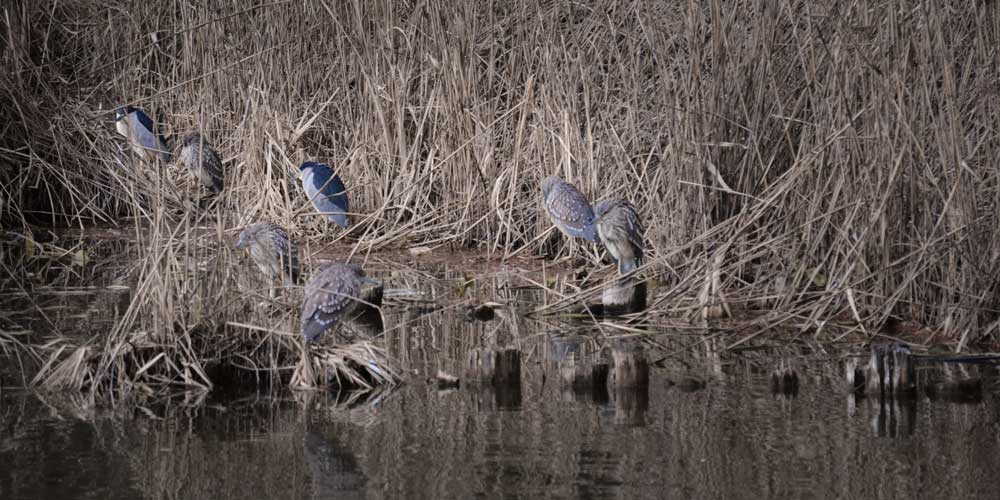
A colony of black-crowned night herons. These young birds have different markings, but are about the same size as the adults.
参考文献
日本野鳥の会 | BIRD FAN | ゴイサギ 2026年1月18日閲覧
バードリサーチ | ニュースレター2005年8月号(2005年8月17日発行) 2026年1月18日閲覧
日本気象協会 | tenki.jp | 光る鷺「青鷺火」の真相とは?田園の守り神・鷺のミステリー | (2020年7月27日) 2026年1月18日閲覧