
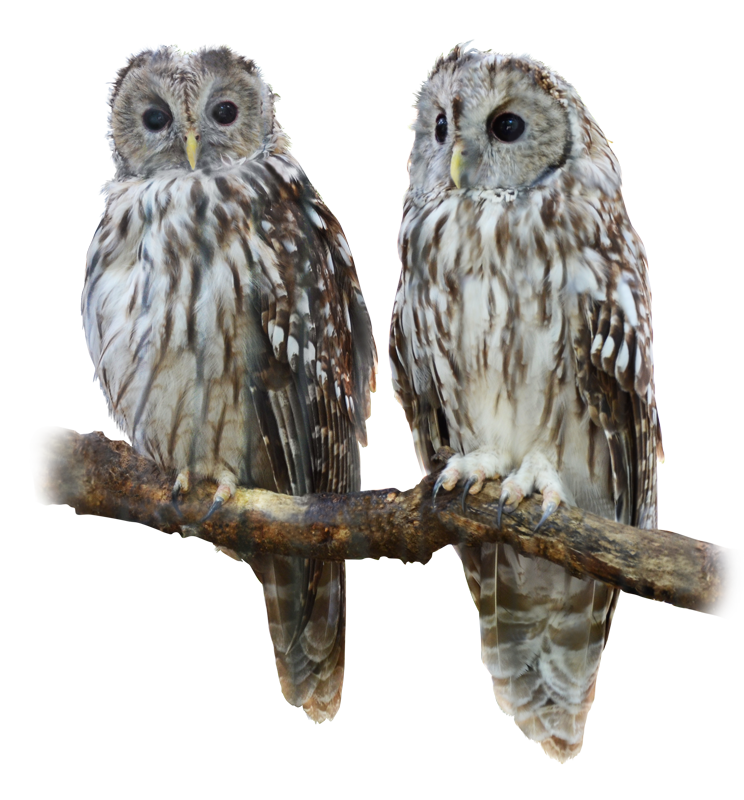
Strix uralensis (Pallas, 1771)
闇と静寂の狩人
Hunter of the Dark and the Silent Night
全長約50cm。スカンジナビア半島東部からロシア、極東を経て日本列島に至るまで、帯状に広く分布する森林性の中型猛禽類です。「フクロウ」という名称はフクロウ科全体を指す総称でもあるため、本種は区別のために「ウラルフクロウ」と呼ばれることもあります。日本では留鳥(年間を通して同じ地域に生息する鳥)として、九州以北の四国・本州・北海道に分布しています。国内では、エゾフクロウ、ホンドフクロウ、モミヤマフクロウ、キュウシュウフクロウの4亜種に分類され、地域ごとに体色や大きさにわずかな違いが見られます。夜行性で、主な餌はネズミ類ですが、小鳥や両生類を捕食することもあります。
一般に「鳥目(とりめ)」と言われるように、多くの鳥類は夜間の視力が弱いとされています。しかしフクロウの目は人間の約100倍にもなる高い集光力をもち、わずかな光でも周囲を認識することができます。その反面、昼間は光が強すぎるため、薄暗い場所で休息することが多いのが特徴です。さらに聴覚も非常に優れており、その秘密は耳の位置にあります。右耳は右目の上に、左耳は左目の下に位置し、左右上下で非対称になっています。この構造によって、音の上下左右の方向を正確に把握でき、暗闇の中でも獲物の位置を知ることができます。
また、フクロウは飛翔時にほとんど羽音を立てずに獲物へ近づくことができます。これは、風切羽の縁に細かな毛状構造があり、羽根同士がこすれて生じる摩擦音を抑えるためです。加えて羽根そのものが柔らかいことも、静かな飛行を可能にしています。
The Ural Owl has a total length of about 50 cm. It is a medium-sized forest-dwelling raptor distributed in a broad belt from eastern Scandinavia through Russia and the Far East to the Japanese Archipelago. Because the term “owl” can refer to the entire family Strigidae, this species is sometimes specifically called the Ural Owl to avoid confusion. In Japan, it is a resident species, meaning it inhabits the same areas year-round, and is found from Kyushu northward across Shikoku, Honshu, and Hokkaido. Within Japan, it is divided into four subspecies—Ezo Owl, Honshu Owl, Momiyama Owl, and Kyushu Owl—which show slight regional differences in body size and coloration. The species is nocturnal and feeds mainly on rodents, but it also preys on small birds and amphibians.
Many birds are said to be “night-blind,” having poor vision in low light conditions. In contrast, the eyes of owls have an exceptional ability to gather light, estimated to be up to one hundred times greater than that of humans, allowing them to see clearly in darkness. On the other hand, bright daylight can be overwhelming, and they often rest in shaded places during the day. Their hearing is also highly developed, owing to the unique positioning of their ears. The right ear is located above the right eye, while the left ear is positioned below the left eye, creating an asymmetrical arrangement. This structure enables the owl to accurately determine the vertical and horizontal direction of sounds, allowing it to locate prey even in complete darkness.
In addition, the Ural Owl can approach its prey with almost no sound while flying. This silent flight is made possible by the fine, hair-like structures along the edges of the primary feathers, which reduce the friction noise produced when feathers rub against each other. The softness of the feathers themselves also plays an important role in enabling this remarkably quiet flight.
参考文献
サントリーの愛鳥活動 | 日本の鳥百科 | フクロウ 2024年9月29日閲覧
板谷 浩男, 坂本 大輔 (2020年)「多摩川流域におけるフクロウの生息状況確認調査」公益財団法人 東急財団 2024年9月29日閲覧
南アルプスの宝箱 | コンテンツ一覧 | フクロウ 2024年9月29日閲覧
サントリー世界愛鳥基金 | トピックス | 月夜の鳥たち | (2012年11月) 2024年9月29日閲覧
日本テレビ |「所さんの目がテン!」| 闇夜の王者!フクロウ #487 (1999年6月27日) 2024年9月29日閲覧
大宮公園小動物園 | 飼育係より | フクロウたちの羽根の秘密 | (2022年6月15日) 2024年9月29日閲覧