
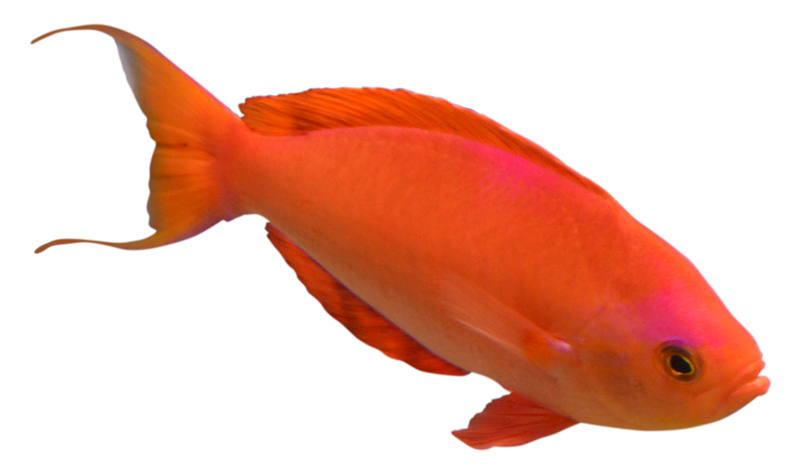
Callanthias japonicus (Franz, 1910)
「敷島」の名を与えられた美魚
A Beautiful Deepwater Fish Named After Ancient Japan
体長19cm、全長では29cmほどになる海水魚です。シキシマハナダイ科の魚類は、インド洋・太平洋から東部大西洋にかけて広く分布し、水深50〜200mほどのやや深い海底付近を遊泳して暮らしています。本種シキシマハナダイも深場に生息する魚で、日本近海では相模湾以南に見られ、韓国南部から琉球列島、台湾周辺まで分布しています。学名は Callanthias japonicus といい、属名の Callanthias はギリシア語の「kallos(美しい)」と「anthias(魚)」に由来します。
体色は淡い桃色から赤橙色を基調とし、各鰭には黄色が入り、特に背鰭や尾鰭の鮮やかな発色がよく目立ちます。深海に近い暗い環境で暮らす魚ですが、その華やかな姿は熱帯魚を思わせるほどで、日本産魚類の中でも高い観賞価値を持つ種として知られています。和名の「シキシマ」は「敷島」と書き、日本の古称を意味します。この美しい名は、「日本魚類学の父」と称され、多数の新種記載を行った魚類学者・田中茂穂博士によって名付けられました。
見た目の華麗さから観賞魚の印象が強い一方で、食用魚としても評価されています。白身は上品な旨味を持ち、アマダイに似た味わいがあるとされます。ただし深場に生息するため漁獲量は多くなく、市場で見かける機会はあまりありません。鮮やかな色彩と美味しさを兼ね備えた、日本近海を代表する美魚のひとつです。
The yellowsail red bass is a marine fish that reaches about 19 cm in standard length and up to 29 cm in total length. Members of the family Callanthiidae are distributed across the Indian and Pacific Oceans as well as the eastern Atlantic, inhabiting relatively deep waters at depths of around 50–200 meters near the seafloor. This species, Callanthias japonicus, occurs around Japan, ranging from southern Korea through the Ryukyu Islands to Taiwan.
Its scientific name reflects its beauty. The genus name Callanthias derives from the Greek words kallos (“beautiful”) and anthias (“fish”). The body is mainly pinkish to reddish orange, accented with vivid yellow on the fins, especially the dorsal and caudal fins. Although it inhabits dim deep-water environments, its brilliant coloration rivals that of tropical reef fishes, making it one of Japan’s most striking marine fishes.
The Japanese name “Shikishima” refers to an ancient poetic name for Japan. It was given by Dr. Shigeho Tanaka, often called the “father of Japanese ichthyology,” who described numerous new fish species during his career. The elegant name suits the fish well.
Despite its ornamental appearance, the yellowsail red bass is also regarded as an excellent food fish. Its white flesh is said to have a refined flavor similar to that of tilefish. However, because it lives in deep offshore waters, it is not commonly caught and rarely appears in markets. Combining vivid beauty with fine taste, this species is considered one of the most attractive deepwater fishes found around Japan.
参考文献
畑 晴陵, 土田 洋之, 本村浩之『宇治群島から得られたシキシマハナダイ』Nature of Kagoshima Vol. 42, Mar. 2016
ぼうずコンニュクの市場魚貝類図鑑 | シキシマハナダイ 2024年8月18日閲覧
坂本 一男『魚名の由来』WEB大学出版第45号(2000年4月1日発行) 2024年8月18日閲覧