
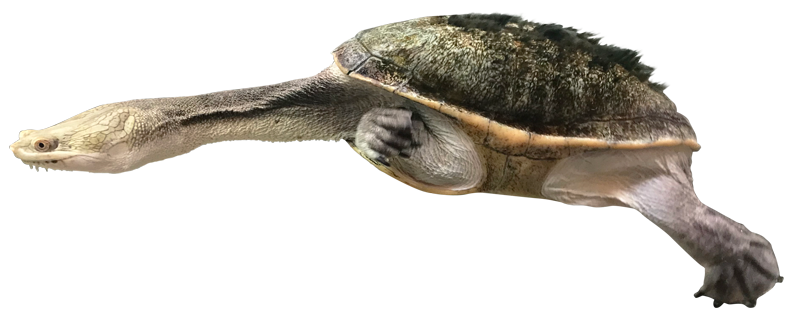
Macrochelodina rugosa (Ogilby, 1890)
首のしまい方が異なるカメたち
Turtles and Their Different Ways of Retracting the Neck
ジーベンロックナガクビガメは、甲長30cmほどになるナガクビガメ科の淡水性カメです。ニューギニア南部の沿岸低地に分布し、流れの緩やかな河川や沼、湿地などに生息しています。ほぼ一生を水中で過ごす完全水生種で、陸上に上がることは産卵時などに限られます。かつてはニューギニア産をジーベンロックナガクビガメ、オーストラリア北部産をチリメンナガクビガメとして別種に分類する考えが一般的でしたが、近年では両者を同種とみなす説が有力になっています。
非常に長い頸が最大の特徴で、この首を左右に振るように動かしながら水底を探り、魚類や甲殻類、水生昆虫などを捕食します。待ち伏せだけでなく積極的に動き回って餌を探すことでも知られ、日本で流通するナガクビガメ類の中では特に知名度の高い種です。驚いた際には頭を甲羅の正面へ引き込むのではなく、長い首を横方向へ折りたたむように収納します。
カメ類は首のしまい方によって大きく二つに分類されます。本種を含むナガクビガメ類は「曲頸類(きょくけいるい)」と呼ばれ、首を横へ曲げて収納します。一方、イシガメやリクガメ、スッポンなど世界のカメの大半は「潜頸類(せんけいるい)」に属し、首を縦方向のS字状に曲げて甲羅内へ引き込みます。そのため頭が完全に隠れたように見えます。
ただし潜頸類であっても、すべての種が頭や手足を完全に収納できるわけではありません。ウミガメ類は遊泳に適した大きなヒレ状の前肢を持つため甲羅に引っ込めることができず、ワニガメも巨大な頭部のため完全には収納できません。カメの甲羅は強力な防御手段ですが、生息環境や捕食者との関係の中で、首や四肢の構造も多様な進化を遂げてきたのです。
Siebenrock’s snake-necked turtle is a freshwater turtle belonging to the family Chelidae, reaching a carapace length of about 30 cm. It inhabits slow-moving rivers, swamps, and wetlands in the coastal lowlands of southern New Guinea. This species is highly aquatic and spends almost its entire life in the water, coming onto land mainly for nesting. In the past, the New Guinea population was classified as Siebenrock’s snake-necked turtle, while the northern Australian population was treated as a separate species known as the northern snake-necked turtle. However, recent studies increasingly support the view that they are the same species.
Its most distinctive feature is its remarkably long neck. The turtle swings this neck from side to side underwater while searching for prey such as fish, crustaceans, and aquatic insects. Unlike ambush predators that remain motionless, it actively moves about in search of food. Among snake-necked turtles, it is one of the most commonly kept species in Japan. When threatened, it does not retract its head straight back into the shell; instead, it folds its neck sideways beneath the edge of the carapace.
Turtles are broadly divided into two groups according to the way they retract their necks. Snake-necked turtles belong to the Pleurodira, or side-necked turtles, which bend the neck sideways. In contrast, most turtles in the world, including pond turtles, tortoises, and softshell turtles, belong to the Cryptodira, or hidden-necked turtles, which pull the neck backward in an S-shaped curve. This makes the head appear to disappear completely into the shell.
Even among hidden-necked turtles, however, not all species can fully retract their heads and limbs. Sea turtles cannot withdraw their flipper-like limbs, while alligator snapping turtles have heads too massive to fit entirely inside the shell. Although the shell serves as a powerful defense, the structure of the neck and limbs has diversified through evolution in response to habitat, feeding behavior, and predators.
参考文献
All About | 趣味 | ジーベンロックナガクビガメ!爬虫類・亀の基本的な知識と飼育方法 | 星野 一三雄 (2023年09月19日) 2024年8月18日閲覧
広島市安佐動物公園 | 飼育係のasazooブログ! | はちゅうるい館の仲間たち(11)2種のナガクビガメ | (2020年6月7日) 2024年8月18日閲覧
Northern long-necked turtle and Siebenrock’s snake-necked turtle. THE REPTILES OF AUSTRALIA 2024年8月18日閲覧