
Amphilophus citrinellus (Günther, 1864)
こぶと体色が際立つシクリッド
A Cichlid with a Distinctive Hump and Coloration
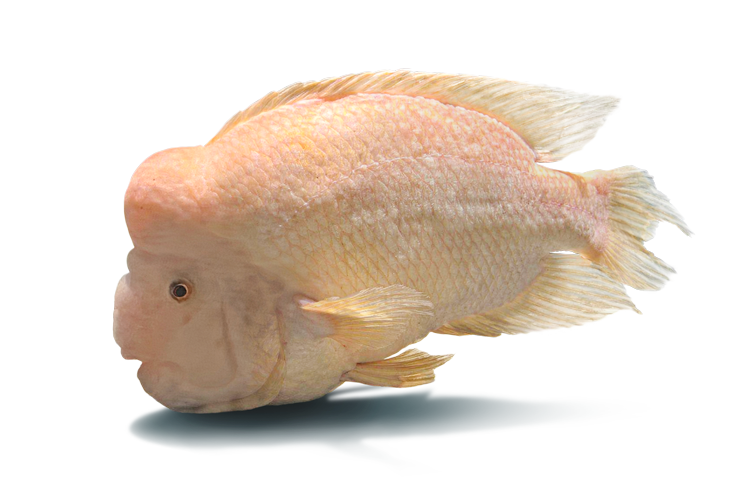
中米のニカラグアやコスタリカに分布するシクリッドの仲間です。湖沼などに生息し、成魚は全長25cmほどになります。がっしりとした体つきと力強い顎を持ち、成長した個体では額が盛り上がり、大きなこぶが目立つことがあります。近縁のミダスシクリッド類を対象にした研究では、こぶがメスによる配偶相手の選択や、オス同士の競争に関係することが示されています。
食性は雑食性で、岩などに付着する藻類や小さな巻貝、小魚、水生昆虫の幼虫など、さまざまなものを食べます。繁殖時には岩や流木などに卵を産み、親魚は卵や孵化した稚魚を守ります。とくに稚魚はほかの魚などに捕食される危険があるため、親魚による保護は子孫を残すうえで重要です。
本種は観賞魚としても流通し、赤を基調としたものや、白っぽい体色のものなど、色彩に違いが見られます。野生にも黄色や金色などの色彩変異があり、観賞魚の色は、もともと備わっていた変異に加え、人が好みの特徴を持つ個体を選んで繁殖させることで多様化してきました。
さらに、本種など複数のシクリッドを人為的に交雑させて作出された観賞魚が、フラワーホーンです。1990年代に東南アジアで作出が進み、体色や模様、こぶの形状などに特徴を持つ品種が現れました。系統はいくつかあり、金属光沢を帯びたコバルトブルーの体色、鱗に沿って網目状に見える模様、ひときわ大きく盛り上がったこぶなど、姿の違いが際立ちます。
姿かたちに独特の個性を持つ本種は、観賞魚としての魅力も豊かで、体色や額のこぶの特徴を引き出すブリードの対象としても親しまれています。
The Midas cichlid is a member of the cichlid family native to Central America, where it occurs in Nicaragua and Costa Rica. It inhabits lakes and other freshwater environments and can reach about 25 cm in length. It has a sturdy body and powerful jaws, and mature individuals may develop a prominent hump on the forehead. Studies of the closely related Midas cichlid complex suggest that this hump plays a role in mate choice by females and competition between males.
The species is omnivorous, feeding on a variety of foods, including algae growing on rocks, small snails, small fish, and aquatic insect larvae. During breeding, it lays its eggs on surfaces such as rocks and driftwood, and the parents guard both the eggs and the newly hatched fry. Young fish are vulnerable to predation by other fish, making parental care important for their survival.
The Midas cichlid is also traded as an ornamental fish, with color variations ranging from predominantly red to pale or whitish. Yellow and golden individuals also occur in the wild. The diversity of colors seen in aquarium fish reflects both naturally occurring variation and selective breeding by people who favor particular traits.
The Flowerhorn cichlid is an ornamental fish developed through the deliberate hybridization of this species and other cichlids. Breeding programs began in Southeast Asia in the 1990s, producing varieties with distinctive body colors, patterns, and forehead humps. The different strains vary considerably in appearance, with features such as metallic cobalt-blue coloration, net-like patterns along the scales, and exceptionally large humps.
With its distinctive appearance and individual character, the Midas cichlid has considerable appeal as an ornamental fish. It is also valued in selective breeding, where efforts focus on enhancing its coloration and the shape and size of its forehead hump.
参考文献
FishBase. “Amphilophus citrinellus (Günther, 1864) – Midas cichlid.” 2026年11月15日閲覧
“Genetic Variation and Hybridization in Evolutionary Radiations of Cichlid Fishes.” Annual Review of Animal Biosciences. 2026年11月15日閲覧