
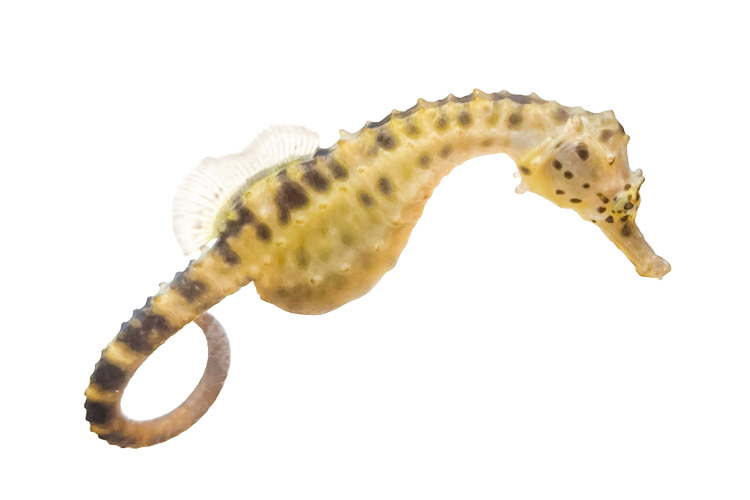
Hippocampus abdominalis (Lesson, 1827)
大きなお腹と華やかな求愛ダンス
A Big Belly and an Elaborate Courtship Dance
ビッグベリーシーホースは、オーストラリア南部からニュージーランドにかけての温帯海域に生息するヨウジウオ科の魚です。タツノオトシゴの仲間のなかでも大型で、全長は最大約35cmに達します。名前は「大きなお腹のタツノオトシゴ」を意味し、雌雄ともに腹部が大きく丸みを帯びているのが特徴です。体色は白や黄色、オレンジ、灰色、茶色など変化に富み、暗色の斑点やまだら模様が現れることもあります。頭部には冠のような突起があり、体には糸状の突起が伸びる個体もいます。
生息環境は幅広く、浅い岩礁や海草の茂る場所から、海藻や海綿動物が豊富な深場まで見られます。尾は物に巻きつけられる構造になっており、海草や海藻などにつかまって体を支えます。泳ぎは得意ではありませんが、長い吻を使って小さな甲殻類などを吸い込むように捕食します。周囲の環境に溶け込むような体色や模様は、外敵から身を隠すうえでも役立ちます。
繁殖期になると、オスは育児嚢に水を取り込んで膨らませ、体色を明るく変化させながらメスに求愛します。オスが頭を下げ、ひれを動かしながら近づくと、メスも体色を変えて応じます。2匹は尾を絡めたり、並んで泳いだりしながら求愛のダンスを繰り広げ、やがて一緒に泳ぎ上がります。メスは卵をオスの育児嚢へと受け渡し、オスはその中で卵を保護します。卵は育児嚢の中で発生し、孵化した稚魚はオスの腹部から海中へと放たれます。こうした求愛行動や、オスが育児嚢で卵を保護する繁殖方法も、本種の興味深い特徴です。
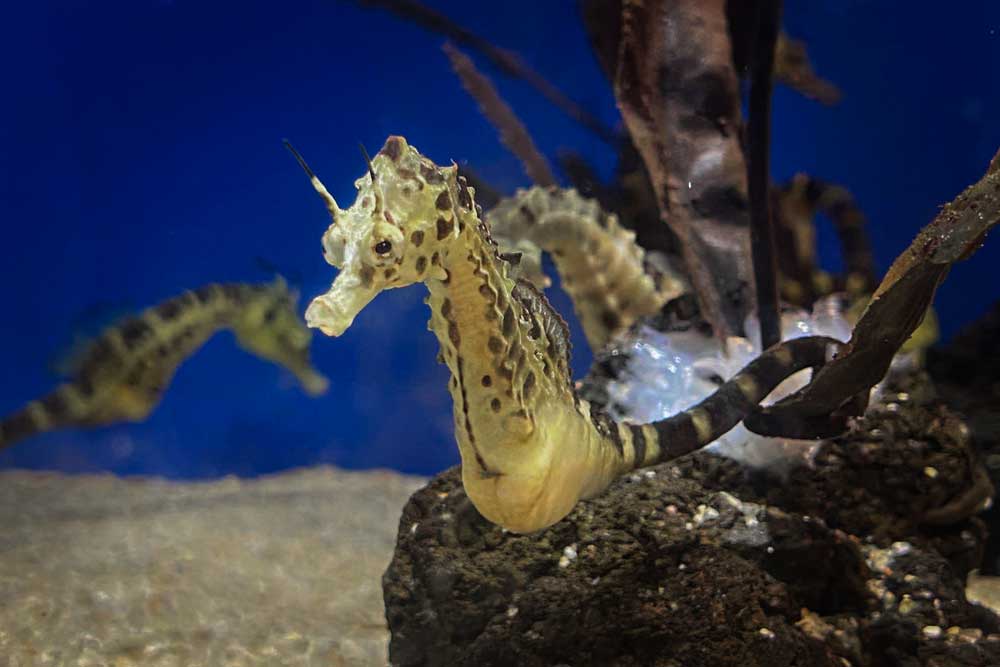
The Big-belly Seahorse inhabits temperate waters from southern Australia to New Zealand. It is one of the larger members of the seahorse family, reaching up to about 35 cm in length. Its name refers to its notably large belly, which is rounded in both males and females. Its coloration varies widely, ranging from white and yellow to orange, gray, and brown, sometimes with dark spots or mottled patterns. It has a low, crown-like projection on its head, and some individuals also develop thread-like appendages on their bodies.
It inhabits a variety of environments, from shallow rocky reefs and seagrass beds to deeper areas rich in seaweeds and sponges. Its prehensile tail allows it to grip seagrass, seaweed, and other structures, helping it remain anchored in place. Although it is not a strong swimmer, it uses its elongated snout to suck in small crustaceans and other tiny prey. Its coloration and patterns help it blend into its surroundings and avoid detection by predators.
During the breeding season, males court females by inflating their brood pouches with water and brightening their body coloration. As a male approaches with his head lowered and fins fluttering, the female responds by changing her own coloration. The pair perform an elaborate courtship dance, sometimes entwining their tails or swimming side by side before rising together through the water. The female then transfers her eggs into the male’s brood pouch, where he protects them as they develop. Once the young hatch, the male releases the tiny seahorses into the water from his pouch. These courtship displays and the male’s unusual role in carrying and protecting the eggs are among the species’ most fascinating characteristics.
参考文献
“Hippocampus abdominalis Lesson, 1827″ Fshbase. 2026年11月7日閲覧
“Hippocampus abdominalis” Animal Diversity Web. 2026年11月7日閲覧
“Bigbelly Seahorse, Hippocampus abdominalis Lesson, 1827″ Australian Museum. 2026年11月7日閲覧