
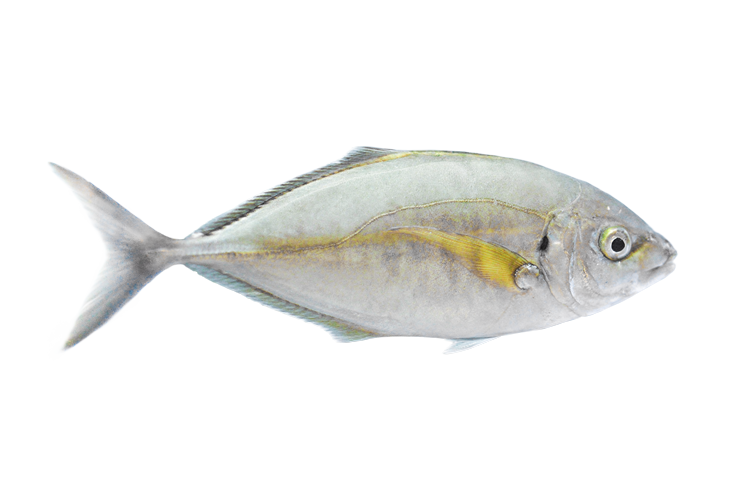
Pseudocaranx dentex (Bloch and Schneider,1801)
1メートルを超える高級アジ
A Premium Trevally Over One Meter Long
マアジと同じアジ科の魚ですが、シマアジはマアジ属とは別のシマアジ属に分類されます。北海道南部以南の日本沿岸に分布し、海外ではインド・太平洋の広い範囲に生息しています。マアジが比較的細長く側扁した体形なのに対し、シマアジは体高が高く、厚みのある堂々とした体つきをしています。全長1mを超える大型魚に成長し、背側は青緑色、腹側は銀白色で、体側には鮮やかな黄色の縦帯が1本走ります。
マアジとの違いを見分けるうえで興味深いのが、アジの仲間を特徴づける「ゼイゴ」です。ゼイゴとは、側線上に並ぶ硬く発達した鱗の列のことで、シマアジにも見られます。ただし、マアジでは側線のほぼ全体にわたって発達するのに対し、シマアジでは体の後半部に限られます。両種ともゼイゴを持ちながら、その発達する範囲が異なるのです。さらに、シマアジはマアジより体高が高く、成長すると大型化するため、見慣れると体つきからも違いが分かります。
幼魚や若魚は比較的浅い沿岸域で成長し、成魚になると岩礁域などの中・下層を群れで泳ぎます。小魚や甲殻類、軟体動物などを捕食するほか、プランクトンを取り込むような摂餌も行います。また、釣り上げたときなどに「ギュウギュウ」と音を出すことでも知られ、静岡ではその音に由来する「ギュウギュウ」という地方名があります。
「シマアジ」という標準和名には、二つの由来が考えられています。ひとつは、体側に鮮やかな縦帯があることから「縞鰺」とするもの。もうひとつは、伊豆諸島などの島から江戸へ運ばれてきたことから「島鯵」とする説です。江戸時代にはすでに「島鯵」と記された例があり、東京市場で使われていた呼び名が標準和名になったとされています。庶民的な魚の代表ともいえるマアジに対し、シマアジは身の味わいがよく、刺身や寿司種として珍重される高級魚です。同じアジ科でありながら、食卓での位置づけは大きく異なります。
Although it belongs to the same family as the Japanese horse mackerel, the White Trevally is classified in a different genus. It occurs along the Japanese coast from southern Hokkaido southward and is also widely distributed across the Indo-Pacific. Whereas the Japanese horse mackerel has a relatively slender, laterally compressed body, the White Trevally has a deeper, more robust body. It can grow to more than 1 m in length. The back is blue-green, the underside is silvery white, and a vivid yellowish stripe runs along each side of the body.
One interesting feature for distinguishing it from the Japanese horse mackerel is the row of hard, enlarged scales known as scutes along the lateral line. Both species possess these structures, but they differ in their distribution. In the Japanese horse mackerel, scutes extend along almost the entire lateral line, whereas in the White Trevally they are confined mainly to the posterior part of the body. The White Trevally also has a deeper body and grows much larger, making the difference in body shape apparent to an experienced observer.
Young fish grow in relatively shallow coastal waters, while adults form schools and move through the middle and lower parts of the water column around rocky coastal habitats. They feed on small fish, crustaceans, mollusks, and other prey, and may also consume plankton while swimming. The species is also known to produce a distinctive “gyu-gyu” sound when caught. In Shizuoka Prefecture, this sound has given rise to the local name “Gyu-gyu.”
There are two proposed explanations for the standard Japanese name “Shima-aji.” One derives it from shima, meaning “stripe,” referring to the conspicuous stripe along the body. The other derives it from shima, meaning “island,” because fish were brought to Edo from the Izu Islands and other islands. The name “島鯵” (island aji) was already recorded in the Edo period, and the name used in the fish markets of Tokyo is thought to have eventually become the standard Japanese name. In contrast to the Japanese horse mackerel, one of the quintessential everyday fish in Japan, the White Trevally is prized for its excellent flavor and is regarded as a premium fish, often served as sashimi and sushi.
参考文献
魚住商店 | シマアジとは?普通のアジとの違いを魚屋が徹底解説【旬・栄養・食べ方】| (20261年5月11日) 2026年10月24日閲覧
ぼうずコンニャクの市場魚貝類図鑑 | シマアジ 2026年10月24日閲覧
Smith-Vaniz, W.F., Williams, J.T., Pina Amargos, F., Curtis, M. & Brown, J. 2015. Pseudocaranx dentex. The IUCN Red List of Threatened Species 2015: e.T190070A16643997. 2026年10月24日閲覧
内田恵太郎『さかな異名抄』朝日新聞社、1966年 2026年10月24日閲覧