
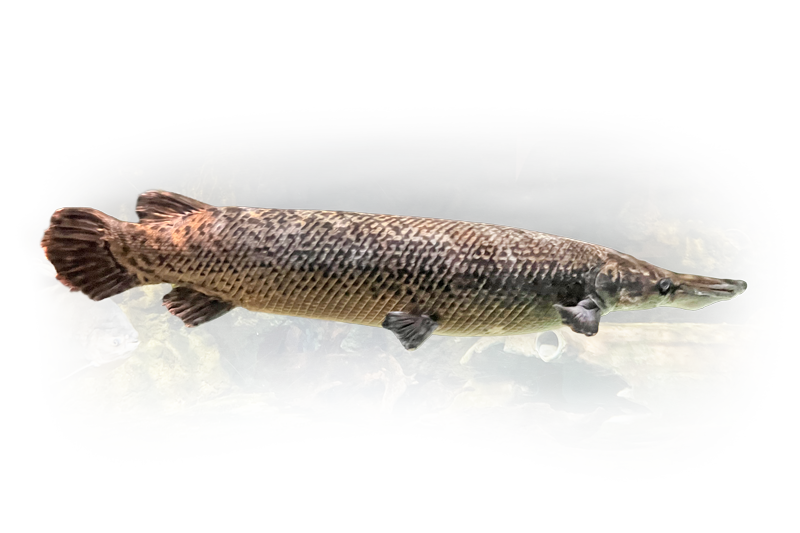
Tractosteus spatula (Lacepède, 1803)
ゴミ扱いされていた巨大魚
The Giant Fish Once Called a “Trash Fish”
北アメリカ南部の大河川や湖、沼、湿地、沿岸の汽水域などに生息する、ガー科最大の魚です。全長は2m前後になるものが多いものの、最大では約3m、体重150kg近くに達します。幅広く短い吻と大きな口をもつ姿はワニを思わせ、英名の「Alligator Gar」もその姿に由来します。成魚の上あごには鋭い歯が並び、獲物をくわえて逃がさないのに適しています。
体を覆うのは、普通の魚とは大きく異なる「ガノイン鱗」です。ひし形をした非常に硬い鱗が互いにかみ合うように並び、まるで鎧のような防御壁をつくっています。硬いガノイン鱗は外敵から身を守る一方、体を大きく曲げる動きには向きません。古くからその頑丈さは人にも利用され、鱗が装飾品などに加工された例もあります。
肉食性で、魚類を中心に甲殻類なども捕食します。水中で待ち伏せ、獲物が近づくと頭部を素早く動かして大きな口でくわえます。鋭い歯は獲物を切り裂くというより、捕らえた獲物を逃がさないために役立ちます。巨大で鋭い歯をもつ魚ですが、人を獲物として襲うことはありません。人への攻撃記録もなく、見た目とは対照的に、人を襲う魚ではありません。
時折、水面に浮上して体を横倒しにする不思議な行動を見せることがあります。これは「ローリング」と呼ばれ、空気呼吸のための行動と考えられています。ガー類は特殊な鰾(うきぶくろ)をもち、これを空気呼吸にも利用することができます。
もう一つの特徴は卵にあります。アリゲーターガーの卵には毒性があり、人を含む哺乳類などが食べると中毒を起こすことがあります。これは卵を捕食者から守るための防御の一つと考えられています。一度に10万個もの卵を産みますが、それでも生き残るのはわずかです。成長は遅いものの寿命は長く、野生下で50年から70年ほど生きるといわれています。
生息地では魚を食べることなどから「ゴミ魚(trash fish)」と呼ばれ、価値の低い魚として扱われていました。しかし現在では、その巨大な体と強い引きからスポーツフィッシングの対象として人気が高まり、大型個体を求めて専門に狙う釣り人もいるなど、かつての「ゴミ魚」という評価は大きく変わりました。
The alligator gar is the largest member of the gar family. It inhabits large rivers, lakes, swamps, wetlands, and coastal brackish waters in the southern United States. Most individuals grow to around 2 m in length, but the largest can reach nearly 3 m and weigh close to 150 kg. Its broad, short snout and large mouth give it an unmistakably alligator-like appearance, which is reflected in its English name, “Alligator Gar.” Adult fish have rows of sharp teeth on the upper jaw, adapted for gripping prey and preventing it from escaping.
Its body is covered with unusual scales known as ganoine scales. These extremely hard, diamond-shaped scales interlock to form a protective layer resembling armor. While this rigid covering protects the fish from predators, it also limits its ability to bend its body sharply. The durability of these scales has long been useful to humans, and they have been used to make ornaments and other objects.
The alligator gar is carnivorous, feeding mainly on fish as well as crustaceans and other prey. It often waits motionless in the water and, when prey approaches, rapidly swings its head and seizes it with its large mouth. Its sharp teeth are used less for tearing prey apart than for gripping it firmly and preventing escape. Despite its enormous size and sharp teeth, the alligator gar does not prey on humans. There are no documented records of attacks on people, and despite its intimidating appearance, it is not a fish that targets humans.
At times, it rises to the surface and rolls onto its side in a curious behavior known as “rolling.” This is thought to be associated with aerial respiration. Gar possess a specialized swim bladder that can also be used for breathing air.
Another notable feature is its eggs. Alligator gar eggs are toxic, and consuming them can cause poisoning in mammals, including humans. This toxicity is thought to be one of the defenses that protects the eggs from predators. A female may lay as many as 100,000 eggs at a time, yet only a small proportion survive. Although the species grows slowly, it is long-lived and is thought to survive for around 50 to 70 years in the wild.
In their native range, alligator gar were once called “trash fish” because they were regarded as having little value, partly because they prey on other fish. Today, however, their enormous size and powerful fighting ability have made them popular targets for sport fishing, with anglers specifically seeking out large individuals. The species’ reputation has changed considerably from the days when it was dismissed as a “trash fish.”
参考文献
講談社の動く図鑑MOVE | 最新NEWS | 本当にキケン? 巨大古代魚『アリゲーターガー』<後編> | (2018年11月6日) 2026年9月27日閲覧
ナショナルジオグラフィック | 動物大図鑑 | アリゲーターガー | (2014年12月1日) 2026年9月27日閲覧
Graham, David (2022年10月26日)「アリゲーター ガーの旅: 知っておくべきこと」Boundless Pursuit. 2026年9月27日閲覧
“Alligator Gar (Atractosteus spatula)” U.S. Fish & Wildlife Service. 2026年9月27日閲覧
“All About Alligator Gar “ U.S. Fish & Wildlife Service. 2026年9月27日閲覧
“Alligator Gar — Not A Threat to Humans” Texas Parks and Wildlife. 2026年9月27日閲覧