
Periparus ater (Linnaeus, 1758)
夏山に響く澄んだ歌声
The Clear Song of the Summer Mountains
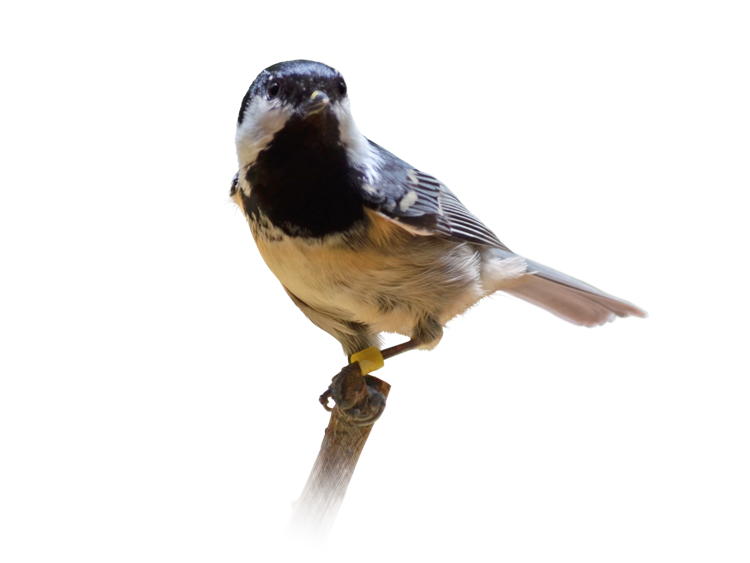
全長約11cm。シジュウカラやヤマガラ、コガラなど日本に生息するカラ類の中では最も小さな種です。頭部から喉にかけては黒く、頬は白色で、一見するとシジュウカラによく似ていますが、嘴の付け根の下に小さな三角形の黒斑があり、腹部にネクタイ状の黒帯がないこと、翼に緑色の部分がないことなどで見分けられます。ユーラシア大陸に広く分布し、日本では北海道から九州まで見られますが、冷涼な環境を好み、低地では主に針葉樹林や針広混交林、関東から近畿地方では標高1000~1500m以上の山地で繁殖することが多い鳥です。
主な餌は昆虫やクモ類ですが、秋から冬にはマツやモミ、トウヒなど針葉樹の種子もよく食べます。冬にはシジュウカラやコガラ、ゴジュウカラ、キクイタダキなどと混群を作って行動し、樹木の枝先を忙しく動き回りながら採餌します。繁殖期には樹洞や朽木の穴を利用して営巣し、コケや獣毛、羽毛を敷いた巣で子育てを行います。カラ類の中でも針葉樹林への適応が進んだ種として知られ、小さな体を生かして細い枝先まで器用に移動する姿がよく見られます。
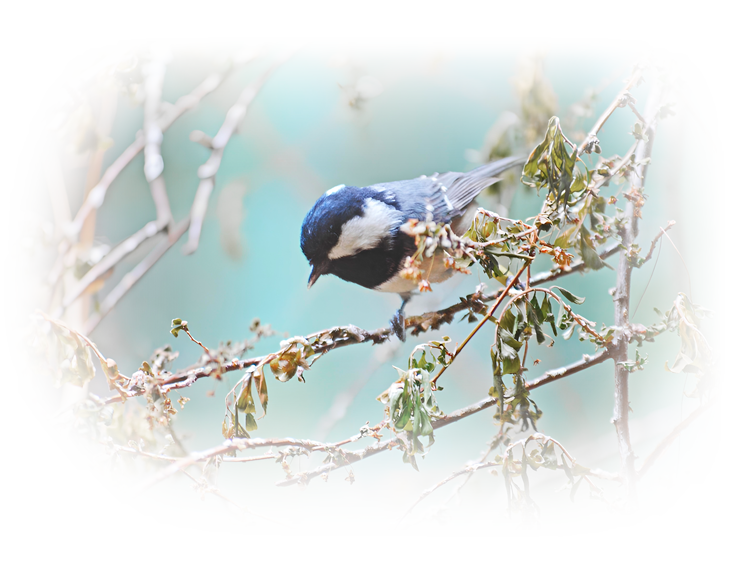
「ツツピン」「ツピンツピンツピン」と澄んだ高い声でさえずり、この「ピン」という音とカラの仲間であることから、「ひんから」が転じて「ヒガラ」になったという説があります。英名の「Coal Tit」は、「炭のように黒い頭をもつカラ」を意味します。また、俳句では「夏の鳥」に分類され、初夏から晩夏にかけての山林の季節感を表す季語として親しまれてきました。澄んださえずりは夏の山林によく響き、登山者にとってなじみ深い鳥の声です。
Measuring about 11 cm in length, the Coal Tit is the smallest member of the tit family found in Japan, which also includes the Japanese Tit, Varied Tit, and Willow Tit. It has a black head and throat with white cheeks, making it resemble the Japanese Tit at first glance. However, it can be distinguished by the small triangular black patch beneath the base of its bill, the absence of the black “necktie” running down the underparts, and the lack of greenish coloration on the wings. Widely distributed across Eurasia, it occurs throughout Japan from Hokkaido to Kyushu. It prefers cool environments, inhabiting mainly coniferous and mixed forests in lowlands, while in central and western Honshu it breeds chiefly in montane forests at elevations above 1,000–1,500 meters.
Its diet consists mainly of insects and spiders, although from autumn through winter it also feeds extensively on the seeds of coniferous trees such as pines, firs, and spruces. During winter, Coal Tits often join mixed-species foraging flocks with Japanese Tits, Willow Tits, Eurasian Nuthatches, and Goldcrests, busily searching for food among the outer branches of trees. During the breeding season, they nest in tree cavities or holes in decaying trunks, lining the nest with moss, animal fur, and feathers. Among Japan’s tits, the Coal Tit is particularly well adapted to coniferous forests, and its small body allows it to move with remarkable agility along the finest branch tips.
Its clear, high-pitched song, often rendered as “tsu-tsu-pin” or “tsu-pin, tsu-pin, tsu-pin,” is said to have inspired its Japanese name: one theory suggests that Higara evolved from hinkara, a combination of the “pin” note in its song and kara, meaning “tit.” The English name Coal Tit refers to its coal-black head. In Japanese haiku, it is regarded as a seasonal bird of summer, symbolizing the mountain forests from early to late summer. Its clear song echoes through the summer woods and is a familiar sound to hikers.
参考文献
バードリサーチニュース | 日本の森の鳥の変化:ヒガラ | 植田睦之 (2023年7月3日) 2026年7月11日閲覧
植田睦之・植村慎吾 (2021) 全国鳥類繁殖分布調査報告 日本の鳥の今を描こう 2016-2021 年, 鳥類繁殖分布調査会. 2026年7月11日閲覧
C.E.C. | 徒然野鳥記 | 第143回 ヒガラ | (2013年10月1日) 2026年7月11日閲覧
納家 仁 (2022)「榎本佳樹と中西悟堂」榎本佳樹生誕150年記念事業2023 プレ企画, 大阪自然史フェスティバル, 日本野鳥の会大阪支部 2026年7月11日閲覧