
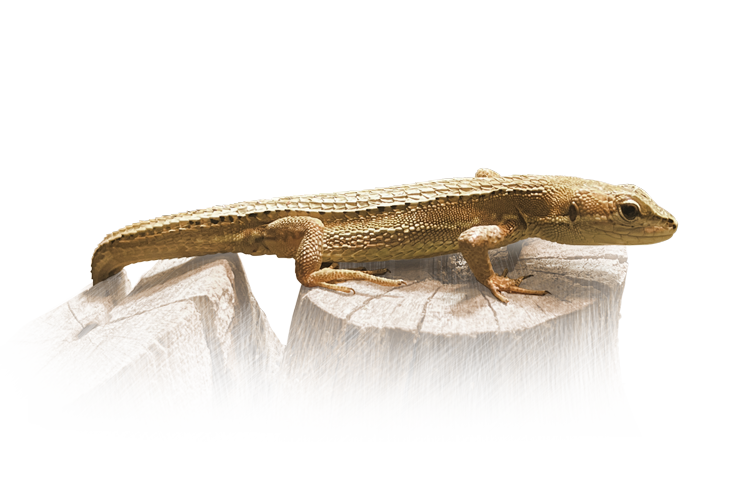
Takydromus tachydromoides (Schlegel, 1838)
庭先を駆ける身近な爬虫類
A Familiar Reptile Running Through Our Gardens
全長15~25cm。本州、四国、九州および周辺の島々に分布する日本固有のカナヘビ科の爬虫類です。草地や河原、林縁、農地、公園、庭先など日当たりの良い環境に広く生息し、人家の近くでもよく見られます。細長い体形をしており、全長の約3分の2を占める長い尾を巧みに使って、草むらの中を素早く走り回ります。
姿がよく似たニホントカゲとは異なり、カナヘビ科に分類される爬虫類です。ニホントカゲよりやや小型で細身の体つきをもち、光沢の少ない褐色の体色と、縦に隆起したざらつきのある鱗が特徴です。幼体もニホントカゲのような鮮やかな青い尾にはならず、成体とよく似た姿で成長します。
昼行性である本種は、昆虫やクモ、ダンゴムシなどの小型無脊椎動物を捕食します。鋭い視力を頼りに獲物を見つけると素早く駆け寄って捕らえます。朝には日光浴で体温を高めて活動を始め、危険を察知すると草むらへ逃げ込みます。捕食者に捕まった際には尾を自切して相手の注意をそらし、その隙に逃げることがあります。失われた尾は再生しますが、元の尾とは内部構造や形状が異なります。
繁殖期は春から初夏で、雌は湿った土の中や石の下、落ち葉の下などに数個ずつ卵を産みます。卵は約40~60日でふ化し、幼体は親の保護を受けることなく自立して生活を始めます。若い個体も成体と同じように昆虫やクモなどの小型無脊椎動物を捕食しながら成長します。
「カナヘビ」という少し不思議な名前の語源ですが、「愛蛇(かなへび)」あるいは「金蛇(かなへび)」に由来するとする説が有力です。「愛蛇」は「愛らしいヘビ」、「金蛇」は体色が金色がかって見えることにちなむとされます。子どもたちの間では単に「トカゲ」と呼ばれることも多く、日本人に古くから親しまれてきた、なじみ深い爬虫類の一つです。
The Japanese Grass Lizard is a reptile of the family Lacertidae endemic to Japan, occurring on Honshu, Shikoku, Kyushu, and several surrounding islands. Adults measure 15–25 cm in total length, with about two-thirds of that length consisting of the remarkably long tail. It inhabits a wide range of sunny environments, including grasslands, riverbanks, forest edges, farmland, parks, and residential gardens, where it can often be seen darting swiftly through the vegetation.
Although it closely resembles the Japanese Skink, the Japanese Grass Lizard belongs to a different family. It is generally smaller and more slender, with a dull brown coloration and rough, strongly keeled scales. Unlike juvenile Japanese Skinks, young grass lizards never develop a brilliant blue tail and instead resemble miniature versions of the adults.
A diurnal species, it feeds mainly on small invertebrates such as insects, spiders, and woodlice. Using its keen eyesight, it quickly detects and captures prey. It begins the day by basking in the sun to raise its body temperature before becoming active. When threatened, it usually escapes into nearby vegetation, but if seized by a predator, it can shed its tail to distract the attacker. The tail later regenerates, although the replacement differs from the original in both structure and appearance.
The breeding season extends from spring to early summer. Females lay small clutches of eggs in moist soil, beneath stones, or under leaf litter. The eggs hatch after about 40–60 days, and the hatchlings receive no parental care, feeding on small invertebrates from an early age just as the adults do.
The origin of the slightly unusual Japanese name Kanahebi remains an interesting topic. The most widely accepted explanations derive it either from kanahebi meaning “beloved snake” (愛蛇) or from “golden snake” (金蛇), referring to its golden-brown coloration. Many Japanese children simply call it “tokage” (“lizard”), and for generations it has been one of the reptiles most familiar to people in Japan.
参考文献
Hondaの社会貢献活動 | なぜ?なに?自然の大図鑑! | トカゲとカナヘビのなぜ?なに?編 2026年7月11日閲覧
広島大学デジタルミュージアム | ニホントカゲとニホンカナヘビの見分け方 2026年7月11日閲覧
三鷹市 | みたかいきもの図鑑 | ニホンカナヘビ(日本金蛇)| (2009年6月1日) 2026年7月11日閲覧
環境省 | 皇居外苑ニュース | ニホンカナヘビ(日本金蛇 日本蛇舅母)| (2018年8月2日) 2026年7月11日閲覧
長崎歴史文化博物館 | 動物 | カナヘビ、ニホンカナヘビ 2026年7月11日閲覧
竹中践のページ | 日本のカナヘビ類 解説 2026年7月11日閲覧
南部 久男, 身近に見られるトカゲ類, 『とやまと自然』第2巻夏の号, 1979年, P10-12. 2026年7月11日閲覧