
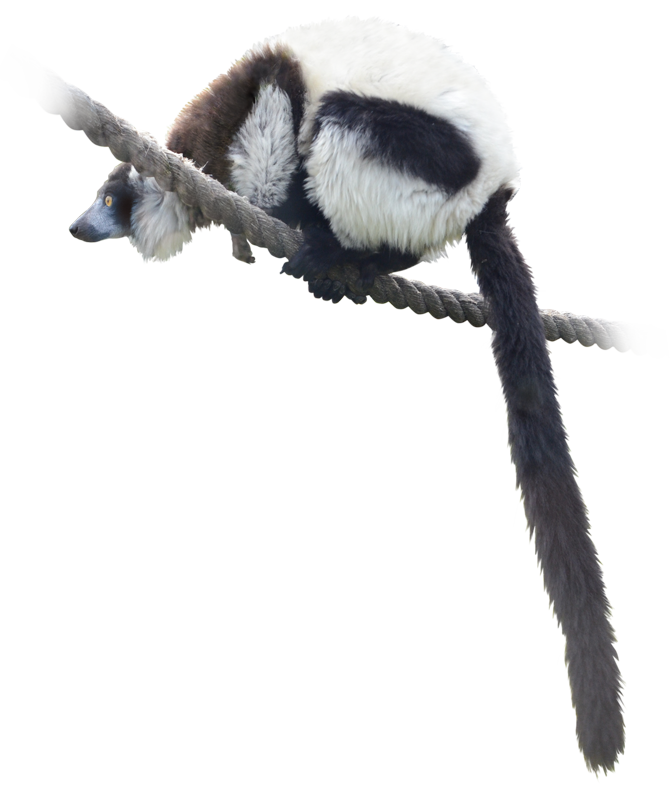
Varecia variegata (Kerr, 1792)
森をつなぐ花粉媒介者
A Pollinator Linking the Forest
クロシロエリマキキツネザルは、マダガスカル島の熱帯雨林にのみ生息する固有の霊長類です。体長は約40~60cm、尾長58~66cm、体重は3.5~4.5kgほどで、長くふさふさした尾は樹上を移動する際のバランス維持に重要な役割を果たします。生活のほとんどを高木の樹冠部で送り、地上に降りることはほとんどありません。高さ10~20mほどの枝上に巣を作り、その中で出産や子育てを行います。
主に果実を食べる果食性ですが、花の蜜も好みます。花に口を差し入れて蜜を吸う際、鼻先や体毛に花粉が付着し、それを別の花へ運ぶことで受粉を助けます。特にタビビトノキとの関係はよく知られ、蜜を得る代わりに花粉を媒介する相利共生の関係にあります。このように大型の花粉媒介者である点は霊長類の中でも特徴的です。
天敵にはフォッサがいますが、現在の最大の脅威は人間活動です。森林伐採や農地開発による生息地の減少に加え、食用やペット目的の捕獲も行われています。昼行性で体が比較的大きく目立つことも捕獲されやすい要因であり、個体数は減少しています。生息地の保全と適切な保護対策が求められています。
The black-and-white ruffed lemur is an endemic primate found only in the tropical rainforests of Madagascar. It has a body length of about 40–60 cm, a tail length of 58–66 cm, and weighs approximately 3.5–4.5 kg. Its long, bushy tail plays an essential role in maintaining balance while moving through the trees. It spends most of its life in the forest canopy and rarely descends to the ground. Nests are built on branches at heights of around 10–20 meters, where it gives birth and raises its young.
This species is primarily frugivorous, feeding mainly on fruits, but it also consumes nectar. When inserting its snout into flowers to drink nectar, pollen adheres to its nose and fur and is transported to other flowers, aiding in pollination. Its relationship with the traveler’s palm is particularly well known, forming a mutualistic association in which the lemur obtains nectar while acting as a pollinator. As a relatively large pollinator, it represents a unique example among primates.
Although it is preyed upon by the fossa, the greatest threat to this species today is human activity. Habitat loss due to deforestation and agricultural expansion, along with hunting for bushmeat and the pet trade, has significantly impacted its population. Its diurnal habits and relatively large, conspicuous body also make it an easy target. As a result, its numbers are declining, and effective conservation measures and habitat protection are urgently needed.
参考文献
到津の森公園 | 到津の動物たち | クロシロエリマキキツネザル 2024年9月2日閲覧
ときわ動物園 | 飼育員ブログ | 1月14日 より良いごはんをもとめて ~エリマキキツネザルの栄養研究(1)~ | (2022年1月14日) 2024年9月2日閲覧
Black-and-white ruffed lemur. Smithsonian’s National Zoo & Conservation Biology Institute. 2024年9月2日閲覧