
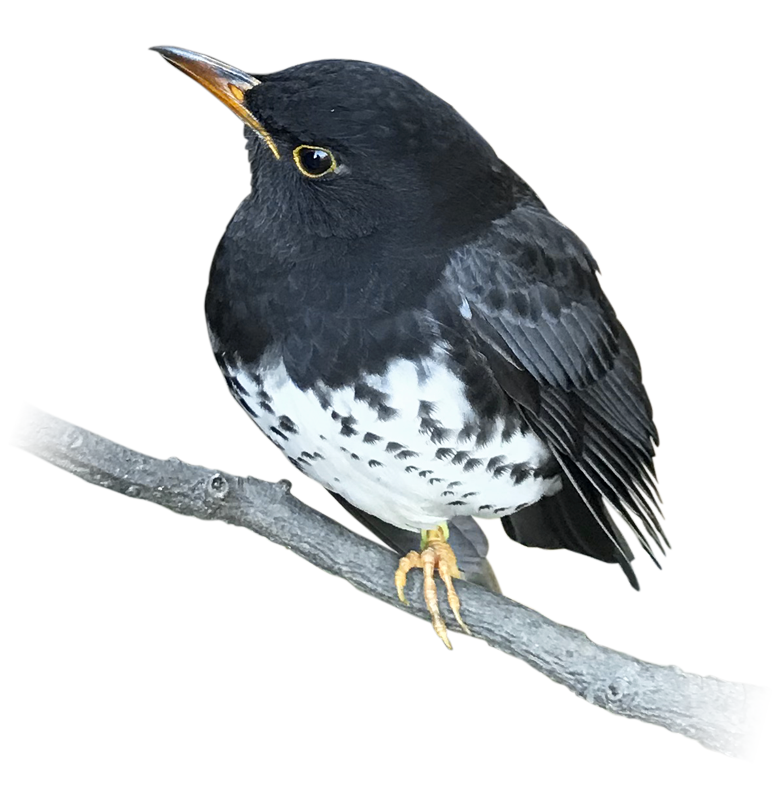
Turdus cardis (Temminck, 1831)
多彩なさえずりを響かせる夏の歌鳥
A Summer Songbird with Rich and Varied Songs
体長は約22cmで、ツグミよりやや小型の種です。全身は黒を基調とし、腹部は白く暗色の斑点が散在します。嘴と脚は鮮やかな黄色を帯び、暗い体色との対比が際立ちます。東アジアに分布し、越冬地は中国南部などの温暖な地域に広がります。日本では夏鳥として渡来し、主に本州中部以北の山地や丘陵の森林で繁殖します。
繁殖期には落葉広葉樹林や混交林の林内で生活し、林床を跳ね歩きながら採食します。主な餌は昆虫やミミズなどの小動物で、落ち葉をくちばしで払いのけて探し出します。秋には果実も利用し、季節によって食性を変化させます。巣は樹上の枝分かれ部分などに作られ、枯れ枝や落ち葉、泥などを用いて堅固に築かれます。
鳴き声は多彩で、「キョキョキョ」といった地鳴きのほか、澄んだ声で長く続く複雑なさえずりを持ち、日本を代表する歌鳥の一つに数えられます。他種の鳥の声を模倣して取り入れることもあります。さえずりは「ホイッスル音」と「トリル音」から構成され、多くの音型を組み合わせることで個体ごとに異なるレパートリーを形成します。このため歌声には明瞭な個体差があり、録音によって個体識別が可能であることが研究により示されています。特に繁殖期のオスは声量が豊かでよく響く個体ほどメスに選ばれやすいとされ、初夏の森では競い合うように美しいさえずりが響き合います。
The Grey Thrush is a medium-sized thrush, measuring about 22 cm in length and slightly smaller than the Dusky Thrush. Its plumage is predominantly black, contrasted by a white belly marked with dark spots. The bill and legs are bright yellow, standing out clearly against the dark body. It is distributed across East Asia, wintering mainly in southern China and other warm regions. In Japan, it is a summer visitor, breeding בעיקר in montane and hilly forests from central Honshu northward.
During the breeding season, it inhabits deciduous broadleaf and mixed forests, foraging mainly on the forest floor. It feeds on insects, earthworms, and other small invertebrates, often flipping over leaf litter with its bill to locate prey. In autumn, it also consumes fruits, showing seasonal variation in diet. The nest is typically built on tree branches, constructed firmly with twigs, fallen leaves, mud, and fine roots.
Its vocalizations are highly varied. In addition to calls such as “kyokyokyo,” it produces long, clear, and complex songs, making it one of Japan’s representative songbirds. It is also known to incorporate mimicry of other bird species into its song. The song consists of “whistle notes” and “trill notes,” which are combined into diverse patterns forming individual repertoires. As a result, each bird has distinctive vocal characteristics, and studies have shown that individuals can be identified by their songs. During the breeding season, males with louder and more resonant songs are more likely to attract females, and in early summer forests, their rich songs echo as they compete with one another.
参考文献
サントリーの愛鳥活動 | 日本の鳥百科 | クロツグミ 2024年9月1日閲覧
C.E.C. | 徒然野鳥記 | 第106回クロツグミ | (2010年9月1日) 2024年9月1日閲覧
東京都レッドデータブック | クロツグミ 2024年9月1日閲覧