
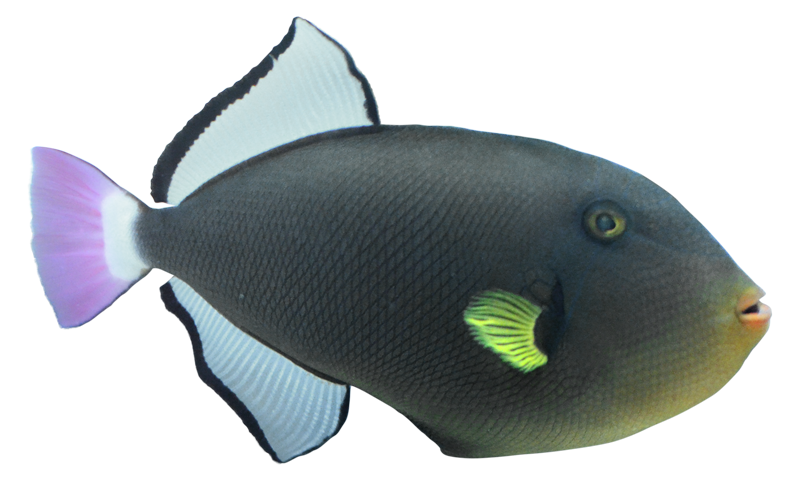
Melichthys vidua (J. Richardson, 1845)
鰭の色と機能が際立つモンガラカワハギ
A Triggerfish with Distinctive Fin Colors and Functions
体長は最大で約30cmに達するモンガラカワハギ科の海水魚です。日本では岩手県以南の沿岸に分布し、インド洋から西太平洋にかけての熱帯・亜熱帯域に広く見られます。主にサンゴ礁や岩礁域に生息し、水深の浅い場所からやや深場までの比較的開けた環境で活動します。
体は側扁し、全体に暗い緑褐色を基調としています。顎の周辺はやや黄色味を帯び、胸鰭も黄色を呈します。第2背鰭と臀鰭は白色で、尾鰭は淡いピンク色となり、この特徴が英名「Pinktail triggerfish」の由来となっています。落ち着いた色調ながら、各部位の配色の違いが識別点となります。
本種を含むモンガラカワハギ科の特徴として、第1背鰭に3本の棘を持つ点が挙げられます。この棘はトリガーのように固定される構造を持ち、外敵に対して岩の隙間に体を押し込み、引き抜かれにくくする防御に役立ちます。近縁のカワハギ科では棘が2本である点が明確な違いであり、系統分類学的には本群の方がより原始的な形質を残していると考えられています。
食性は雑食性で、甲殻類や貝類、ウニ、小魚、海藻などを食べます。強い顎と歯を用いて硬い殻の獲物も砕くことができ、海底付近を遊泳しながら採餌します。行動は昼行性で、単独またはつがいで行動することが一般的です。
なお、本種は個体によって肝臓などにパリトキシンを蓄積することがあります。この毒は有毒な渦鞭毛藻に由来し、食物連鎖を通じて取り込まれると考えられています。安全性の観点から食用には適さず、一般に利用されることは少ない魚です。
The pinktail triggerfish is a member of the family Balistidae and grows up to about 30 cm in length. In Japan, it occurs along coastal waters south of Iwate Prefecture and is widely distributed throughout the tropical and subtropical Indo-Pacific. It inhabits coral reefs and rocky areas, ranging from shallow waters to moderately deeper zones, typically in relatively open habitats.
The body is laterally compressed and generally dark greenish-brown in coloration. The chin area is slightly yellowish, and the pectoral fins are also yellow. The soft dorsal and anal fins are white, while the caudal fin is pale pink, a feature that gives rise to its English name, “pinktail triggerfish.” Although not brightly colored overall, the contrast among these մարմ parts serves as a useful identifying characteristic.
Like other triggerfishes, this species possesses three मजबूत spines in the first dorsal fin. These spines can be locked upright in a trigger-like mechanism, allowing the fish to wedge itself into crevices and resist being pulled out by predators. In contrast, filefishes (family Monacanthidae) have only two such spines. From a phylogenetic perspective, triggerfishes are considered to retain more primitive characteristics than filefishes.
It is omnivorous, feeding on crustaceans, mollusks, sea urchins, small fishes, and algae. Its strong jaws and teeth enable it to crush hard-shelled prey. It is diurnal and typically observed swimming near the bottom either alone or in pairs.
Some individuals may accumulate palytoxin in the liver and other organs. This toxin is not produced by the fish itself but is believed to originate from toxic dinoflagellates and enter the body through the food chain. Due to potential toxicity and its low culinary value, this species is generally not considered suitable for consumption.
参考文献
市立しものせき水族館 海響館 | 海響館の生き物紹介 | クロモンガラ 2025年4月27日閲覧
川瀬 裕司 「モンガラカワハギ科 (Balistidae) とカワハギ科 (Monacanthidae) 魚類の繁殖行動とその進化」魚類学雑誌 1998 年 45 巻 1 号 p. 1-19. 2025年4月27日閲覧
天城町文化遺産データベース | 資料情報 | クロモンガラ 2025年4月27日閲覧
J. Am. Chem. Soc. 1995, 117, 19, 5389–5390. 2026年4月29日閲覧