
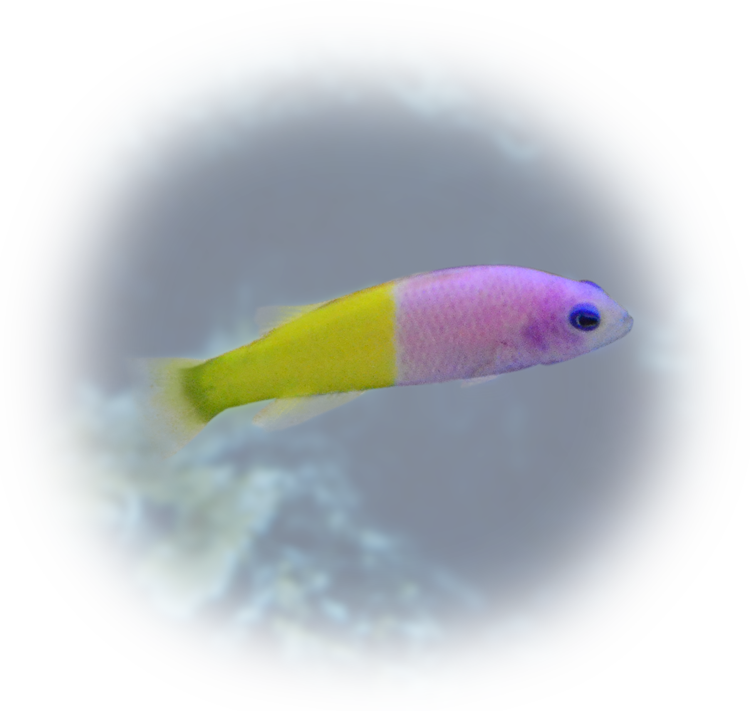
Pictichromis paccagnellae (Axelrod, 1973)
小さくても際立つ色彩と気の強さ
Bright Colors and a Bold Temper in a Tiny Fish
体長約7cm。体の前半が鮮やかな紫色、後半が黄色に分かれる、メギス科の海水魚です。よく似た配色の魚に大西洋産のロイヤルグラマがいますが、両者は別の種類です。バイカラードティーバックは紫色と黄色の境界が明瞭なのに対し、ロイヤルグラマでは両色が混ざり合うようなグラデーションが見られます。小さな体に鮮烈な二色をまとった姿は、サンゴ礁でもひときわ目を引きます。
インドネシア東部からパラオ、パプアニューギニア、ソロモン諸島など、西太平洋の熱帯域に分布します。サンゴ礁や岩礁の斜面、急な崖状の地形にできた小さな洞窟や岩の隙間を隠れ家とし、水深2〜70mで見られます。単独で暮らすことが多いものの、少数の個体がまとまって見つかることもあります。食性は肉食性で、自然界では小型の甲殻類や動物プランクトンなどを捕食します。
小型ながら縄張り意識が強く、隠れ家の周辺に侵入する魚に対して攻撃的な行動をとります。自分より大きな魚にも立ち向かうことがあり、体の大きさからは想像しにくい気の強さを備えています。繁殖期には岩穴などに産卵し、オスが卵を守る習性も知られています。
鮮やかな色彩と丈夫さから、観賞魚としても人気があります。ただし、飼育下では同種やほかの魚を激しく攻撃することがあるため、混泳相手や隠れ場所の確保には十分な配慮が必要です。また、飼育中に色彩が薄れる場合もあります。甲殻類を含む栄養バランスのよい餌を与えることは、健康と鮮やかな体色を維持するうえで大切ですが、色褪せを必ず防げるわけではありません。
Approximately 7 cm in length, the Bicoloured Dottyback is a member of the family Pseudochromidae, distinguished by its striking two-tone coloration: the front half of its body is vivid purple, while the rear half is yellow. The Royal Gramma, a fish native to the Atlantic, has a similar color scheme, but the two are different species. In the Bicoloured Dottyback, the boundary between purple and yellow is sharply defined, whereas the Royal Gramma displays a gradual transition between the two colors. Its vivid coloration makes this small fish particularly eye-catching among the inhabitants of coral reefs.
The Bicoloured Dottyback is distributed throughout the tropical western Pacific, including eastern Indonesia, Palau, Papua New Guinea, and the Solomon Islands. It inhabits coral and rocky reefs, sheltering in small caves and crevices along reef slopes and steep rock faces. It occurs at depths of approximately 2–70 m. Although individuals are often found alone, small groups may also be observed. It is carnivorous, feeding on small crustaceans, zooplankton, and other tiny animals in the wild.
Despite its small size, this fish is highly territorial and aggressively defends the area around its shelter against intruders. It may even confront fish much larger than itself, displaying a feisty temperament that belies its diminutive stature. During the breeding season, it lays eggs in rock crevices or similar sheltered locations, and males are known to guard the eggs.
Its brilliant coloration and hardiness have made the Bicoloured Dottyback a popular aquarium fish. However, it can aggressively attack both members of its own species and other fish, so careful consideration must be given to tank mates and the provision of suitable hiding places. Its coloration may also fade during captivity. Providing a balanced diet that includes crustaceans is important for maintaining its health and vibrant colors, although this cannot guarantee that fading will be prevented.
参考文献
Kurtz, Jeff (2015, June 19) “The Royal Dottyback: Pretty but Potentially a Royal Pain” Reef builders. 2025年5月6日閲覧
“Royal dottyback” Fishpedia. 2025年5月6日閲覧
“Bicolor dottyback color changes” (2006, April 8) Forum, Reef Central. 2025年5月6日閲覧