
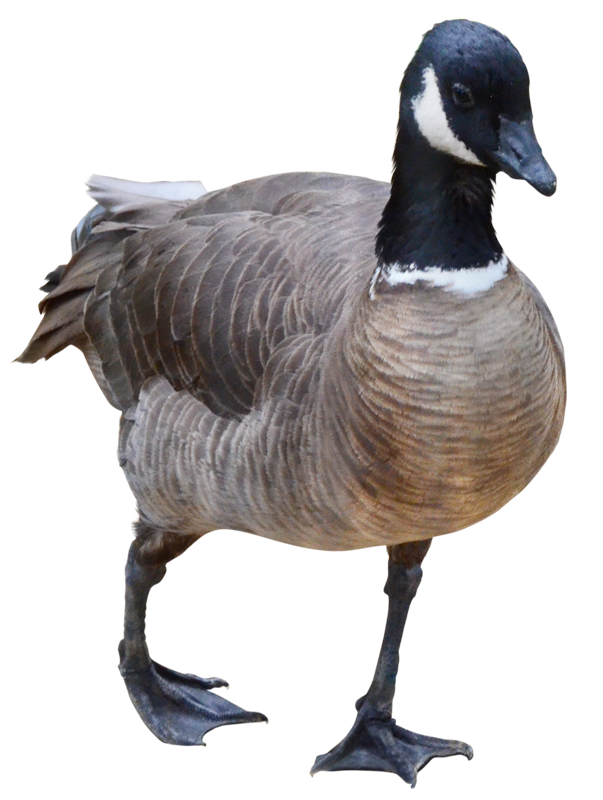
Branta hutchinsii (Richardson, 1832)
外来キツネの脅威に晒された北海の雁
The Northern Goose Threatened by Introduced Foxes
体長60〜70cm。アリューシャン列島や千島列島など、北太平洋の寒冷で険しい島々に営巣・繁殖する小型のガンです。黒い首と白い頬斑が特徴で、その姿が小鳥のシジュウカラを思わせることから「シジュウカラガン」の名が付けられました。かつてはカナダガンの亜種とされていましたが、形態や遺伝的研究により、現在では独立種として扱われています。
主に海岸近くの草地や湿地で生活し、草本類や植物の芽、種子などを食べます。繁殖期には断崖や小島など、外敵の侵入しにくい場所を利用して営巣します。警戒心が強く、群れで行動することが多い鳥です。冬季には日本へ渡来し、かつては東北地方や関東地方を中心に多数が飛来する身近な冬鳥でした。しかし1930年代後半から急激に減少し、日本への渡りはほぼ途絶えてしまいました。
この激減の背景には、人為的に持ち込まれた外来捕食者の存在があります。毛皮採取を目的として繁殖地の島々へアカギツネやホッキョクギツネが導入され、卵や雛が捕食されたことで個体数が深刻に減少しました。特に島嶼環境で繁殖する本種は外敵に弱く、大きな打撃を受けたと考えられています。
現在では、キツネ類が生息していないことが確認された千島列島のエカルマ島で放鳥が行われ、周辺の島々にも分散・繁殖する個体群が確認されています。また、アリューシャン列島各地でも保護活動が進められ、減少していた個体数は徐々に回復しつつあります。日本国内でも仙台市八木山動物公園をはじめとする施設や研究機関が野生復帰事業や飛来調査に取り組み、近年では各地で再び群れが観察されるようになりました。現在も絶滅危惧種として国際的な保護の対象となっており、人間による環境改変と保全活動の双方を象徴する鳥として知られています。
The Cackling Goose is a small species of goose measuring 60–70 cm in length. It breeds on the cold, rugged islands of the Aleutian and Kuril archipelagos in the North Pacific. Its black neck and white cheek patches resemble the markings of the Japanese tit, which inspired its Japanese name “Shijukara-gan.” Once regarded as a subspecies of the Canada Goose, it is now treated as a distinct species based on morphological and genetic studies.
This species inhabits coastal grasslands and wetlands, feeding mainly on grasses, shoots, and seeds. During the breeding season, it nests on cliffs and small offshore islands where predators are less likely to reach. Highly wary by nature, it often travels and feeds in flocks. In winter, the species migrates to Japan and was once a familiar winter visitor in the Tohoku and Kanto regions. However, its numbers declined drastically in the late 1930s, and the migratory population visiting Japan nearly disappeared.
The main cause of this decline was the introduction of non-native predators. Arctic foxes and red foxes were intentionally released on breeding islands for the fur trade, leading to severe predation on eggs and chicks. Because the species breeds on isolated islands with few natural predators, it was especially vulnerable to these introduced mammals.
Today, conservation efforts are underway on Ekarma Island in the Kurils, where foxes are absent, and released birds have begun to establish breeding populations that are spreading to nearby islands. Protection and restoration programs in the Aleutian Islands have also helped the population recover. In Japan, institutions such as Yagiyama Zoological Park in Sendai participate in reintroduction and monitoring projects, and wintering flocks have once again begun to appear in parts of the country. Although the species remains threatened, it is now regarded as a symbol of both the damage caused by human activities and the success of international conservation efforts.
参考文献
森と水の郷あきた | 野鳥シリーズ22 シジュウカラガン 2024年11月23日閲覧
山階鳥類研究所 | 鳥類標識調査 | 絶滅から復活した絶滅危惧種シジュウカラガンの渡り経路と繁殖地を初めて明らかにしました | (2023年8月28日) 2024年11月23日閲覧
BirdLife International. 2021. Branta hutchinsii. The IUCN Red List of Threatened Species 2021: e.T22733619A139214707. 2024年11月23日閲覧
八木山動物公園 | 野生シジュウカラガンの羽数回復事業 | 仙台市八木山動物公園における野生シジュウカラガン羽数回復事業について | (2024年6月27日) 2024年11月23日閲覧
仙台・宮城ミュージアムアライアンス | 野生シジュウカラガンの羽数回復事業をご存知でしょうか? | (2010年4月6日) 2024年11月23日閲覧
「シジュウカラガン回復事業の理解のために」(2018年8月31日) 化女沼観光資料館 日本雁を保護する会 2024年11月23日閲覧