
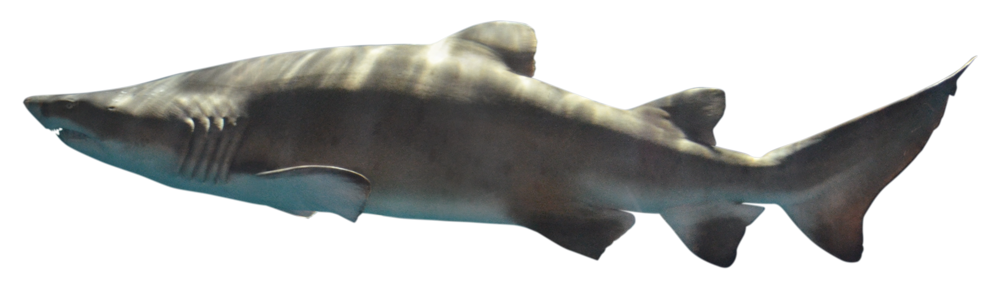
Carcharias taurus (Rafinesque, 1810)
ウサギを騙した真犯人?
The Real Culprit Behind the White Rabbit Legend?
全長最大3.2m、体重150kgを超える大型のサメです。世界の温帯から熱帯の海に広く分布しますが、東太平洋にはほとんど生息していません。口の外にはみ出すように並んだ鋭い歯と大きな体から非常に危険な印象を受けますが、実際には比較的おとなしい性質で、人を積極的に襲うことはまれです。その穏やかな性格から、水族館でもしばしば飼育されています。
細長く突き出た歯は獲物をしっかり捕らえるためのもので、肉を切り裂くよりも、魚やイカなどを丸のみするのに適しています。主な餌は魚類や頭足類、甲殻類で、夜間に活動することが多いとされています。
シロワニには他のサメではあまり見られない特徴があります。それは海面で空気を飲み込み、胃の中にためる習性です。飲み込んだ空気は浮力の調節に利用され、水中を効率よく漂いながら獲物を探すのに役立っていると考えられています。
繁殖方法も非常に興味深く、母親の子宮内で育った胎仔同士が共食いを行うことで知られています。最初に十分な大きさへ成長した胎仔が、他の胎仔や未受精卵を食べて成長し、最終的にごく少数だけが誕生します。この現象は「子宮内共食い」と呼ばれ、サメ類の中でも特に有名な繁殖戦略の一つです。
ところで、サメであるにもかかわらず「ワニ」という名が付くのはなぜでしょうか。有力な説として、山陰地方では古くからサメを「ワニ」と呼んでいたことが挙げられます。そのため、『古事記』に登場する「因幡の白兎」のワニも、実際にはサメだったのではないかと考えられています。
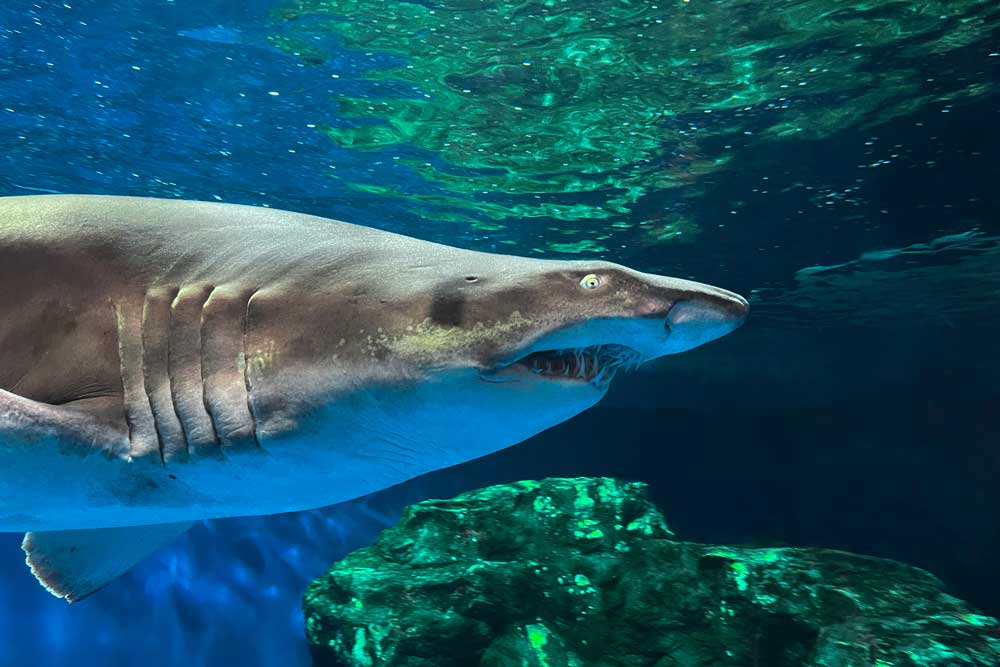
The sand tiger shark is a large species of shark that can reach over 3.2 meters in length and weigh more than 150 kilograms. It inhabits temperate and tropical seas around the world, although it is notably absent from the eastern Pacific Ocean. With its protruding, needle-like teeth and imposing appearance, it looks fearsome, but it is actually a relatively docile shark and rarely poses a threat to humans. Because of its calm nature, it is commonly kept in public aquariums.
Its long, slender teeth are designed to grasp slippery prey rather than tear flesh apart. As a result, the sand tiger shark mainly feeds on fish, squid, and other animals small enough to be swallowed whole. It is most active at night, when it patrols the water in search of prey.
One of the most remarkable features of this species is its ability to gulp air at the surface. The swallowed air is stored in the stomach and acts as a buoyancy aid, allowing the shark to hover almost motionless in the water while conserving energy. This adaptation is unusual among sharks and helps it ambush prey more efficiently.
Its reproductive strategy is even more extraordinary. Like many sharks, the embryos develop inside the mother’s uterus. However, in the sand tiger shark, the developing embryos engage in a form of cannibalism known as intrauterine cannibalism. The largest embryo consumes its smaller siblings and unfertilized eggs, continuing to grow until only a few well-developed young remain to be born. This is one of the most dramatic reproductive strategies known among sharks.
Despite being a shark, the species is called wani in Japanese. One widely accepted explanation is that in parts of western Japan, particularly the San’in region, the word wani was once used to refer to sharks. For this reason, some scholars believe that the “wani” appearing in the ancient Japanese myth The White Rabbit of Inaba was not a crocodile at all, but a shark.
参考文献
ナショナルジオグラフィック | 動物大図鑑 | シロワニ | (2014年12月1日) 2024年8月4日閲覧
豊海おさかなミュージアム | 解説ノート | サメにまつわるエトセトラ | (2023年8月21日) 2024年8月4日閲覧
ウォーカープラス | 世界でも繁殖例はわずか5園のみ。サメ・シロワニは生まれる前からハードモード!?【会えなくなるかもしれない生き物図鑑】(2023年2月6日) 2024年8月4日閲覧
農林水産省 | うちの郷土料理 | ワニの刺身 広島県 2024年8月4日閲覧
歌舞伎座 | 江戸食文化紀行 | no.252 鮫と鱶 | 松下 幸子 (2012) 2024年8月4日閲覧
川田 順造(2017)『アメリカ先住民の口頭伝承から「因幡の白兎」を再考する ーレヴィ=ストロースによる分析ー』日本口承文芸学会 2024年8月4日閲覧
松浦 啓一『したたかな魚たち』角川新書 pp.219 – 221