
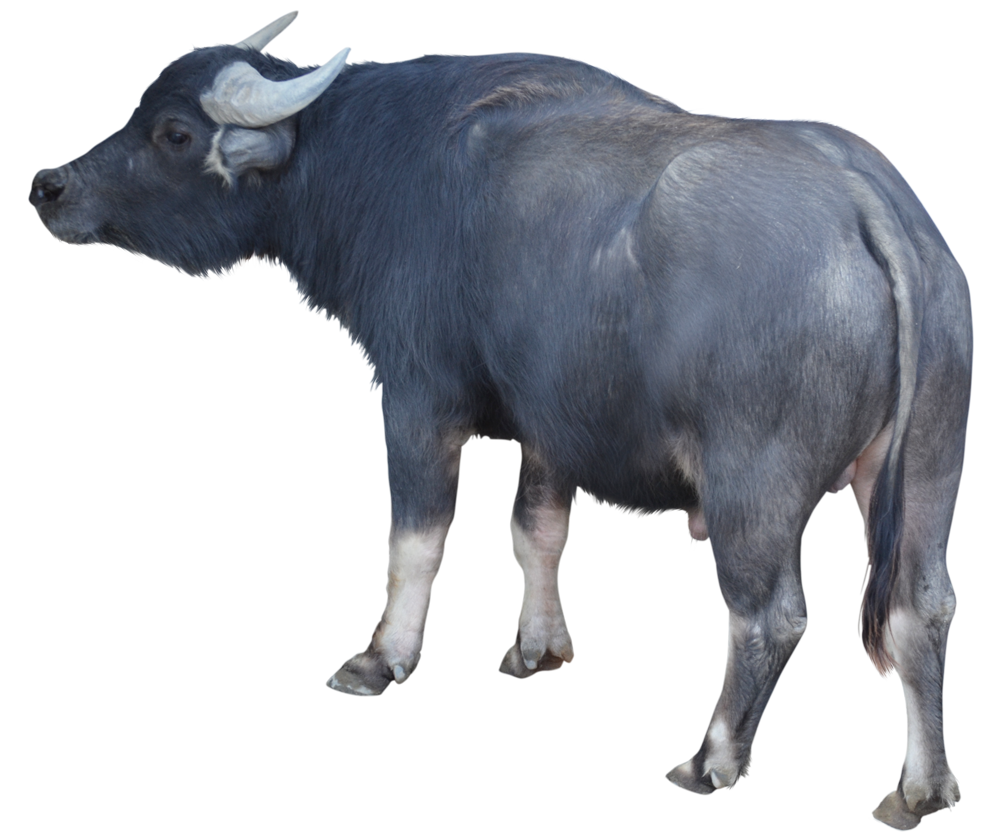
Bubalus bubalis (Linnaeus, 1758)
家畜は繁栄し、祖先は消えゆく
Domestic Buffaloes Flourish While Their Ancestor Fades Away
体長240〜300cm、尾長60〜100cm、肩高150〜190cm、体重700〜1200kg。野生のアジアスイギュウはインド北東部やネパール南部を中心とした河川沿いや湿地帯に生息する大型のウシ科動物です。一般に「スイギュウ」と呼ばれるのは家畜化された個体群を指し、野生のものは「アジアスイギュウ」と区別されます。なお、アフリカに生息するアフリカスイギュウとは別系統の動物で、近縁ではありますが交雑することはありません。
現生のウシ科動物の中でも最大級の種であり、数千年前からアジア各地で家畜として利用されてきました。大きな体と力強さに加え、泥や水辺を好む性質を持つため、水田耕作を行う地域では特に重要な役割を果たしてきました。農耕や運搬に利用されるだけでなく、肉や乳は食料に、角は工芸品に、皮は革製品に加工されます。さらに乾燥させた糞は燃料として利用されるなど、人々の暮らしを幅広く支えてきた家畜です。
現在、家畜スイギュウは世界で約2億頭が飼育されており、その数は増え続けています。しかし、その祖先である野生のアジアスイギュウは絶滅の危機にあります。かつては南アジアから東南アジアにかけて広く分布していましたが、現在ではインド北東部とネパール南部を中心にわずかに残るのみです。生息地の減少に加え、家畜との交雑が広く起きているため、純粋な野生個体群がどれほど残っているのかさえ正確にはわかっていません。野生個体群は数千頭規模まで減少しており、IUCNレッドリストでは絶滅危惧種に指定されています。
こうした野生種と家畜種の複雑な関係は分類にも影響を与えました。2003年、ICZN(国際動物命名審議会)は野生種をアジアスイギュウ Bubalus arnee、家畜種をスイギュウ Bubalus bubalis として扱うことを認めました。世界中で繁栄する約2億頭の家畜の陰で、その祖先は静かに姿を消しつつあります。しかし野生のアジアスイギュウは、家畜化以前の姿と遺伝的特徴を今に伝える貴重な存在です。スイギュウは、人類による家畜化の歴史と野生動物との関わりを考えさせる動物でもあります。
The water buffalo measures 240–300 cm in body length, with a tail length of 60–100 cm, a shoulder height of 150–190 cm, and a weight of 700–1,200 kg. The wild Asian water buffalo inhabits riversides and wetlands, primarily in northeastern India and southern Nepal. In general, the term “water buffalo” refers to the domesticated form, while the wild form is distinguished as the wild water buffalo. Despite their similar names, the African buffalo belongs to a different evolutionary lineage and cannot interbreed with the Asian water buffalo.
Among the largest living members of the cattle family, water buffaloes have been domesticated across Asia for several thousand years. Their immense strength and affinity for muddy wetlands made them indispensable for rice cultivation. Beyond serving as draft animals, they provide meat and milk, their horns are crafted into ornaments and tools, their hides are made into durable leather products, and even their dried dung is widely used as fuel. Few domestic animals have supported human life in as many different ways.
Today, approximately 200 million domestic water buffaloes are kept worldwide, and their numbers continue to grow. In stark contrast, their wild ancestor faces extinction. Once distributed across much of South and Southeast Asia, wild populations now survive mainly in northeastern India and southern Nepal. Habitat loss and extensive hybridization with domestic buffaloes have made it difficult to determine how many genetically pure wild individuals remain. The wild population has declined to only a few thousand animals and is listed as Endangered on the IUCN Red List.
This complicated relationship between the wild and domestic forms has also influenced scientific classification. In 2003, the International Commission on Zoological Nomenclature (ICZN) recognized the wild form as Bubalus arnee and the domestic form as Bubalus bubalis. While around 200 million domestic buffaloes thrive across the globe, their ancestor is quietly disappearing. Yet the wild Asian water buffalo remains a priceless survivor, preserving the appearance and genetic characteristics that existed before domestication. It stands as a living reminder of humanity’s long history of domestication and its relationship with the natural world.
参考文献
ナショナルジオグラフィック | 動物大図鑑 | スイギュウ | (2014年12月1日) 2024年8月4日閲覧
前田 芳實『アジアおよび西南日本の家畜遺伝資源 ―保存と評価―』熱帯農業研究 1(1)2008 2024年8月4日閲覧
愛媛県立とべ動物園 | 動物図鑑 | アジアスイギュウ | (2014年1月) 2024年8月4日閲覧
エコファミリーしんぶんWEB | みんなの環境 | レッドリストの動物たち「アジアスイギュウ」 | (2017年1月20日) 2024年8月4日閲覧
“Bubalus arnee” Threatened Mammal Species Database, ESABII, Biodiversity Center of Japan. 2026年7月26日閲覧