
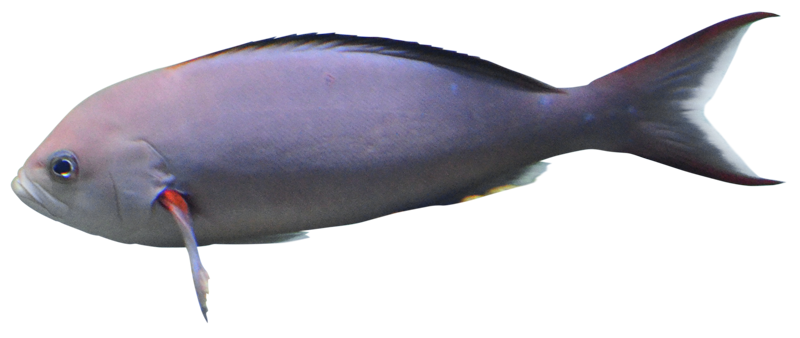
Paranthias colonus (Valenciennes, 1846)
2つの大洋に分かれた仲間
Companions Divided Between Two Oceans
クレオールフィッシュ(Pacific creole-fish)は、ハタ科に属する中型魚で、成魚は全長最大35cmほどに達します。東太平洋の温暖な海域に広く分布し、カリフォルニア沿岸から中米、ペルーにかけての岩礁域やサンゴ礁に生息しています。体色は赤みを帯びた灰色で、体の後半部には白色から淡青色の小斑点が3~5個並ぶのが特徴です。尾びれはやや二叉し、流線型の体つきとあいまって遊泳力に優れています。
主に水深数メートルから数十メートルの範囲で見られ、サンゴ礁や岩礁の上方、水中のやや開けた空間を泳ぎながら生活します。普段は数匹から十数匹ほどの小群を形成し、動物プランクトンや小型甲殻類、魚類の仔魚などを捕食する遊泳性の肉食魚です。警戒心が強く、外敵が接近すると素早く礁の隙間や陰に身を潜める行動が観察されます。また、時間帯や環境によって群れのまとまり方や行動範囲が変化することも知られています。
本種はかつて、大西洋に分布する近縁種と同一種とみなされていましたが、現在では別種として区別されています。近縁種として知られるのは、アトランティック・クレオールフィッシュParanthias furcifer(Valenciennes, 1828)で、ユカタン半島東岸やカリブ海に分布します。両者の分化には、約300万年前に形成されたパナマ地峡が大きく関与したと考えられており、この地史的出来事によって太平洋と大西洋の生物相が分断され、同属内での種分化が進んだ典型例の一つとされています。
The Pacific creole-fish is a medium-sized member of the family Serranidae, reaching a maximum total length of about 35 cm. It is widely distributed in the warm waters of the eastern Pacific, from the coast of California through Central America to Peru, where it inhabits rocky reefs and coral reefs. The body is reddish-gray, with 3–5 small white to pale blue spots aligned on the posterior half. The caudal fin is slightly forked, and together with its streamlined body, enables strong swimming ability.
This species is typically found at depths ranging from a few meters to several tens of meters, swimming in the open water just above reefs. It usually forms small groups of several to a dozen individuals and feeds on zooplankton, small crustaceans, and fish larvae, making it a pelagic carnivore. It is wary, and when threatened, quickly retreats into crevices or shelters within the reef. Group cohesion and movement patterns may vary depending on time of day and environmental conditions.
This species was long regarded as conspecific with its Atlantic relative, but is now recognized as distinct. A closely related species is the Atlantic creole-fish, Paranthias furcifer (Valenciennes, 1828), which occurs along the eastern coast of the Yucatán Peninsula and in the Caribbean Sea. The divergence between these species is thought to be associated with the formation of the Isthmus of Panama around 3 million years ago, which separated marine faunas of the Pacific and Atlantic and promoted speciation within the genus.
参考文献
“Paranthias colonus” Reef Life Survey 2025年2月1日閲覧
“Paranthias furcifer (Valenciennes, 1828) Creole-fish” FishBase. 2025年2月1日閲覧
Gigazine | 南北アメリカ大陸がつながった後に南アメリカの哺乳類だけが北アメリカで繁栄できなかった理由とは? | (2020年10月13日) 2025年2月1日閲覧