
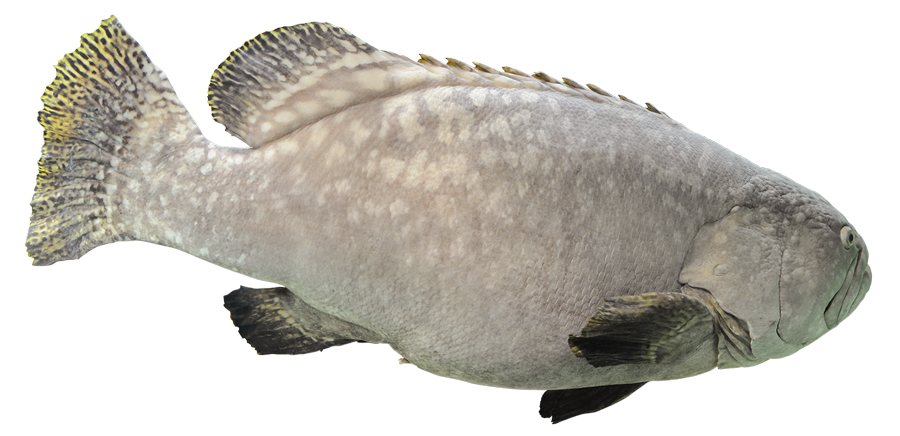
Epinephelus lanceolatus (Bloch, 1790)
サンゴ礁に潜む海の巨影
The Colossal Shadow Hidden in the Reef
ハタ科最大種であり、成魚は体長1.8mほどに達します。大型個体では体長2.7m、体重400kgを超える記録もあり、世界最大級の硬骨魚類の一つです。体色は灰褐色から暗褐色で、体側には黄色と黒色の斑紋が見られますが、成長とともに不明瞭になります。一方、幼魚では斑紋がはっきりと現れ、成魚とは異なる美しい姿をしています。
紅海からハワイ諸島まで、インド洋や西太平洋の熱帯域に広く分布しています。日本では南西諸島を中心に見られます。巨大な体を持ちながら、外洋を回遊する魚ではなく、沿岸の岩礁域やサンゴ礁域、浅い海域の洞窟や岩陰などに生息しています。大きな口を持つ待ち伏せ型の捕食者で、魚類や甲殻類などを捕らえて暮らしています。
近年では、食用魚や養殖対象としても注目されています。2011年には近畿大学水産研究所が、同じハタ科の高級魚であるクエとの交雑に成功し、「クエタマ」と呼ばれる交雑魚が誕生しました。クエの食味とタマカイの成長の速さを併せ持つことが期待され、養殖魚として市場にも流通しています。2023年には、養殖施設から逃げ出したとみられるクエタマが鹿児島湾で相次いで確認され、大きな話題となりました。
また、タマカイはハタ科に多く見られる雌性先熟の性質を持つ魚です。幼魚から若魚の時期にはメスとして成熟し、その後、成長した大型個体がオスへと性転換します。タマカイはオスとして繁殖に参加できる大型個体になるまでには約5年を要するため、養殖では精子を得られる親魚の確保が課題となっていました。そのため、近畿大学では未成魚を早い段階でオス化させ、精子を得る研究が進められています。巨大な姿だけでなく、成長に伴って性を変化させる独特の生態も、タマカイを特徴づける大きな魅力です。
The giant grouper is the largest species in the grouper family, with adults typically reaching around 1.8 m in length. Some exceptionally large individuals have been recorded exceeding 2.7 m in length and 400 kg in weight, making it one of the largest bony fishes in the world. Its body coloration ranges from grayish brown to dark brown, with yellow and black markings on the sides that gradually become less distinct as it matures. In contrast, juveniles display vivid patterns that give them a striking appearance quite different from adults.
The species is widely distributed throughout tropical waters of the Indian Ocean and western Pacific, from the Red Sea to the Hawaiian Islands. In Japan, it is mainly found around the Nansei Islands. Despite its enormous size, it is not a migratory oceanic fish but instead inhabits coastal rocky reefs, coral reefs, shallow waters, caves, and crevices. As an ambush predator with a large mouth, it feeds on fishes, crustaceans, and other prey.
In recent years, the giant grouper has also attracted attention as a food fish and aquaculture species. In 2011, the Kindai University Fisheries Research Institute successfully produced a hybrid between the giant grouper and the longtooth grouper, another valuable member of the grouper family. This hybrid, known as “Kuetama,” combines the desirable flavor of the longtooth grouper with the rapid growth of the giant grouper and has been developed as an aquaculture fish that is now available on the market. In 2023, several escaped Kuetama individuals believed to have originated from aquaculture facilities were discovered in Kagoshima Bay, attracting considerable attention.
The giant grouper also exhibits protogynous hermaphroditism, a reproductive strategy common among groupers. Young individuals first mature as females, and larger adults later change sex to become males. Because it takes about five years for individuals to reach a size at which they can participate in reproduction as males, securing broodstock capable of producing sperm has been a challenge in aquaculture. As a result, Kindai University has conducted research aimed at inducing earlier male development in immature fish to obtain sperm. Beyond its gigantic size, this remarkable ability to change sex during growth is another fascinating characteristic of the giant grouper.
参考文献
「絶滅危惧種タマカイの採卵と人工ふ化に成功! 奄美海域では初の成果 安定採卵と種苗生産・完全養殖技術の確立をめざす」ニュースリリース (2024年9月10日), 近畿大学 2025年2月16日閲覧
WEB魚図鑑 | タマカイ 2025年2月16日閲覧
南日本新聞デジタル | 鹿児島のニュース | いないはずの人工交雑魚「クエタマ」が鹿児島湾で相次ぎ目撃 養殖場から逃げた? 生態系への影響危惧 | (2023年1月31日) 2025年2月16日閲覧
TSURINEWS | 鹿児島で人工巨大魚『クエタマ』が増殖中 「美味しいからOK」とはいかないワケ | (2023年4月7日) 2025年2月16日閲覧
サカナト | 雌雄同体の巨大魚<タマカイ> その生態や日本での研究成果とは? | (2024年3月24日) 2025年2月16日閲覧