
Zanclus cornutus (Linnaeus, 1758)
収斂進化でチョウチョウウオに似た魚
A Fish That Resembles Butterflyfish Through Convergent Evolution
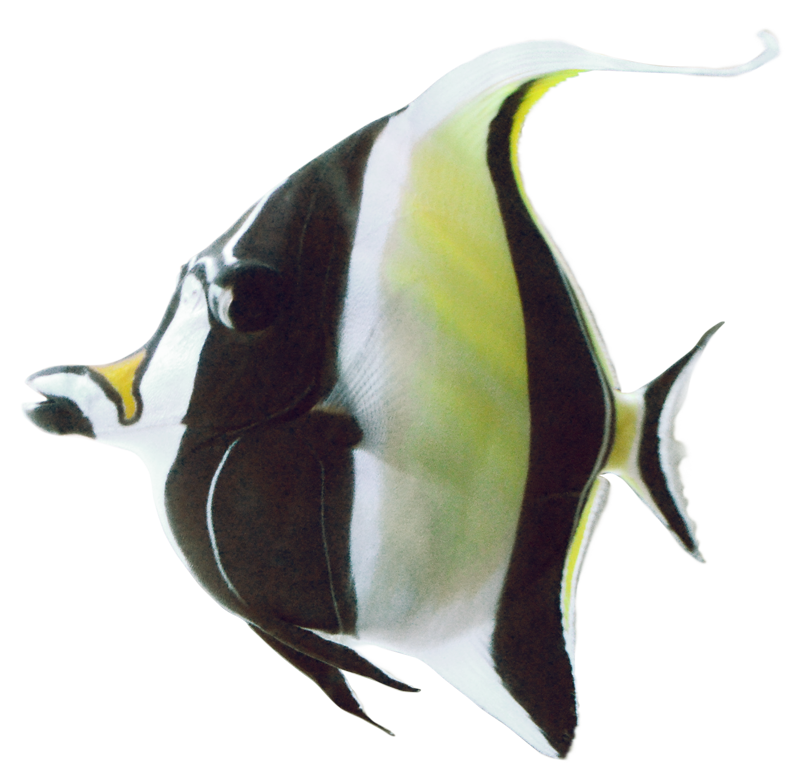
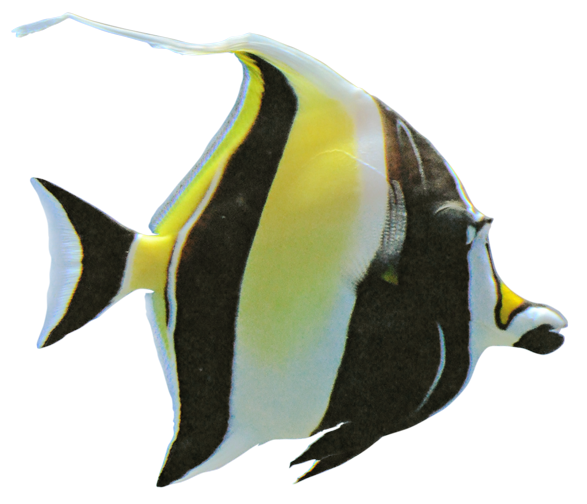
体長25cm。インド太平洋のサンゴ礁域に広く分布します。白い体に3本の黒い横帯が入り、後半部は鮮やかな黄色に染まります。細長く伸びた口吻の根元には黒く縁取られた黄色斑があり、背鰭第3棘は糸状に長く伸びます。また、成魚では眼の上に小さな角状の骨質突起があり、独特の姿をつくっています。この角のような突起が「ツノダシ」という和名の由来とされ、学名Zanclus cornutusにもその特徴が表れています。属名Zanclusは古代ギリシャ語で「鎌」を意味し、鎌のように長く伸びた背鰭にちなみます。種小名cornutusはラテン語で「角のある」を意味し、眼の上の角状突起を表しています。
チョウチョウウオ科のハタタテダイによく似ていますが、ツノダシはツノダシ科に属し、現生種は本種1種のみです。分類学的にはチョウチョウウオ科よりもニザダイ科のグループに近縁です。つまり、姿がよく似たハタタテダイとは近縁ではありません。異なる系統の魚が、サンゴ礁という似た環境の中でよく似た体形や色彩を獲得した、収斂進化の興味深い例といえます。
広い分布域をもつ一方、地域によって個体数には差があります。IUCNでは「低懸念(LC)」と評価されており、現在のところ絶滅の可能性は低いと考えられています。通常は単独や小さな群れで見られますが、パラオでは繁殖期に多数が集まり、数百個体の大きな群れを形成します。EtpisonとColinが2018年に発表した観察記録によると、パラオ西側のバリアリーフでは12月から3月にかけて、上弦の月の頃に繁殖集群が形成され、特に1月と2月に大きな群れとなります。集まった個体は昼頃にサンゴ礁から離れて水面近くまで上昇し、外洋で放卵・放精する「ブルーウォーター・スポーニング」を行います。その際にはハシグロアジサシなどではなく、主にサメ類が集群を襲い、多数の成魚が捕食されることも報告されています。
25 cm in body length. The Moorish idol is widely distributed throughout the Indo-Pacific, where it inhabits coral reef environments. Its white body is marked by three black vertical bands, while the rear portion is vivid yellow. A yellow patch edged in black lies at the base of its elongated snout, and the third spine of the dorsal fin extends into a long, filament-like structure. Adults also have two small, horn-like bony projections above the eyes, giving the fish its distinctive appearance. These horn-like projections are reflected in both its Japanese name, Tsunodashi, and its scientific name, Zanclus cornutus. The genus name Zanclus derives from an ancient Greek word meaning “sickle,” referring to the sickle-like elongated dorsal fin. The species name cornutus is Latin for “horned,” referring to the horn-like projections above the eyes.
Although it closely resembles the Heniochus bannerfish of the butterflyfish family, the Moorish idol belongs to the family Zanclidae, of which it is the only living species. Phylogenetically, it is more closely related to the surgeonfishes than to the butterflyfishes. In other words, its resemblance to the Heniochus bannerfish is not a result of close evolutionary relationship. Instead, these distantly related fishes have independently evolved similar body shapes and coloration in the coral reef environment, making the Moorish idol an interesting example of convergent evolution.
Despite its broad distribution, abundance varies considerably among regions. It is classified as Least Concern (LC) by the IUCN, indicating that it is not currently considered at significant risk of extinction. It is usually seen alone or in small groups, but during the breeding season in Palau, large numbers gather to form aggregations of several hundred individuals. According to observations published by Etpison and Colin in 2018, breeding aggregations form around the first-quarter moon from December to March along Palau’s western barrier reef, with particularly large gatherings in January and February. The fish then leave the reef around midday and rise toward the surface, where they spawn in open water in a behavior known as “blue-water spawning.” During these events, sharks have also been observed attacking the spawning aggregations.
参考文献
WEB魚図鑑 | ツノダシ 2025年2月16日閲覧
神原 勇『銀座水族館 – 七つの海の魚および水産切手 – 第19回』日新興業株式会社 2025年2月16日閲覧
海と島の雑貨屋さん | Fishes of Mina Island 水納島の魚たち | ツノダシ 2025年2月16日閲覧
マリンダイビングWEB | 【連載②パラオを潜ろう!最新情報】ツノダシの群れとサメが熱い!| (2023年7月23日) 2025年2月16日閲覧