
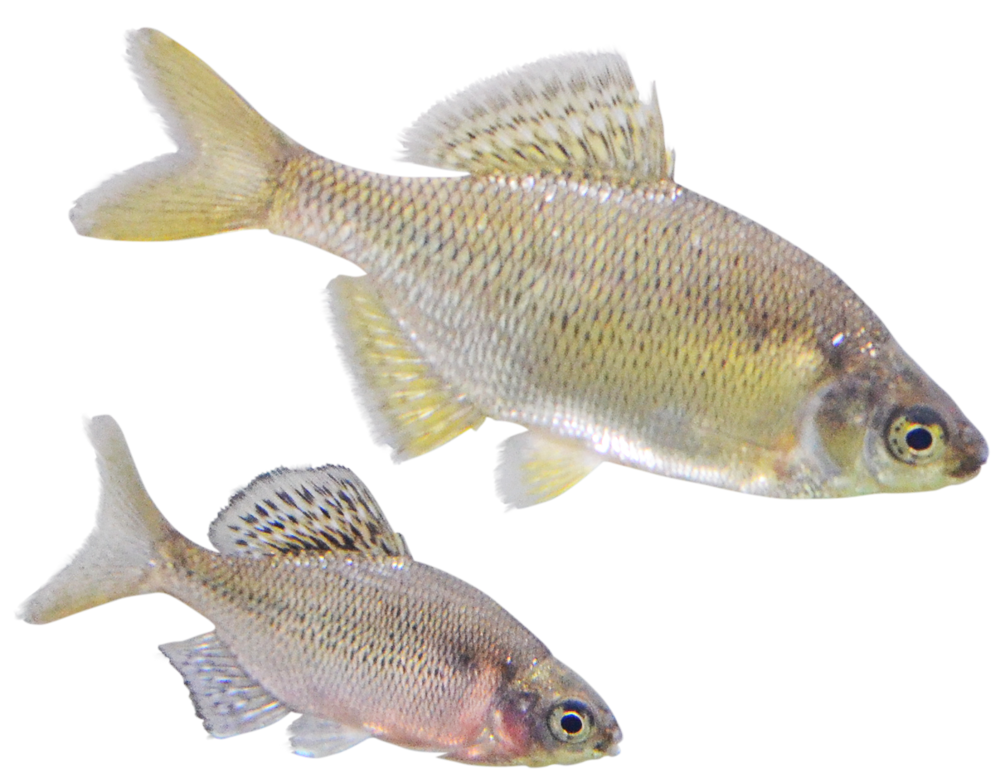
Acheilognathus typus (Bleeker, 1863)
二枚貝と共に消えゆく希少なタナゴ
A Rare Bitterling Vanishing Alongside Freshwater Mussels
体長約8cmのコイ科の淡水魚で、日本固有のタナゴです。かつては北海道を除く本州の関東以北に広く分布していましたが、現在では主な生息地は東北地方の4県に限られています。河川改修や埋め立て、干拓などによる湿地やため池の消失に加え、アメリカザリガニやオオクチバスなどの外来生物の影響を受け、生息環境は急速に失われました。その結果、個体数は著しく減少し、環境省レッドリストでは絶滅の危険性が最も高い絶滅危惧IA類(CR)に指定されています。現在は里山に残されたため池や用水路など、限られた環境で細々と命をつないでおり、日本でも特に絶滅が危惧される淡水魚の一つです。
ゼニタナゴの寿命は約1年と短く、その一生は二枚貝と深く結び付いています。繁殖期は9~10月頃で、雌は産卵管を使ってイシガイ類などの二枚貝のえらの中へ卵を産み付けます。ふ化した仔魚は翌年5~6月頃まで貝の中で保護されながら成長し、その後ようやく外の世界へ泳ぎ出ます。稚魚は水草が豊富な浅場で成長し、秋には成熟して繁殖を行い、その役目を終えるという一年周期の生活史を送ります。
このようにゼニタナゴは、自らの生息環境だけでなく、産卵に欠かせない二枚貝の存在にも生存を左右されます。かつて生息していた諏訪湖や霞ヶ浦では、水質悪化や環境改変によって二枚貝が減少し、それに伴ってゼニタナゴも姿を消しました。ゼニタナゴを守るためには、魚だけでなく、産卵に欠かせない二枚貝や里山の水辺環境全体を守る必要があります。人間の生活に最も近い淡水域は、開発や水質汚染、外来生物の侵入などの影響を受けやすく、生態系の変化が真っ先に現れる環境です。ゼニタナゴの減少は、日本の淡水環境が直面する課題を映し出しています。
Reaching about 8 cm in length, the Japanese Bitterling is a cyprinid fish found only in Japan. It was once widely distributed across Honshu north of the Kanto region, excluding Hokkaido, but today its remaining populations are largely confined to four prefectures in the Tohoku region. River modification, land reclamation, and the loss of wetlands and irrigation ponds have drastically reduced its habitat. Invasive species such as the Red Swamp Crayfish and Largemouth Bass have further accelerated its decline. As a result, the species is now listed as Critically Endangered (CR) on Japan’s Ministry of the Environment Red List. Today, it survives only in a handful of traditional satoyama ponds and irrigation canals, making it one of Japan’s most threatened freshwater fishes.
The Japanese Bitterling has a remarkably short lifespan of about one year, and its entire life cycle depends on freshwater mussels. During the breeding season from September to October, females use a long ovipositor to deposit their eggs inside the gill chambers of freshwater mussels such as species of the family Unionidae. After hatching, the larvae remain safely within the mussel until the following May or June before emerging into open water. The juveniles then grow among aquatic vegetation, mature by autumn, reproduce, and complete their life cycle within a single year.
Because of this unique reproductive strategy, the survival of the Japanese Bitterling depends not only on its own habitat but also on the continued presence of healthy freshwater mussel populations. The species once inhabited lakes such as Lake Suwa and Lake Kasumigaura, but disappeared as environmental degradation led to the decline of its host mussels. Conserving the Japanese Bitterling therefore requires protecting not only the fish itself but also freshwater mussels and the entire satoyama wetland ecosystem. Freshwater environments, which are closely intertwined with human activities, are especially vulnerable to development, pollution, and invasive species, making them among the first ecosystems to reflect environmental change. The decline of the Japanese Bitterling mirrors the challenges facing Japan’s freshwater ecosystems today.
参考文献
「守ろう秋田のゼニタナゴ」秋田市大森山動物園ミルヴェ 2025年2月8日閲覧
「環境省レッドリスト2020」環境省 (2020年03月27日) 2025年2月8日閲覧
大阪府立環境農林水産総合研究所 | 淡水魚図鑑(在来種)| ゼニタナゴ 2025年2月8日閲覧