
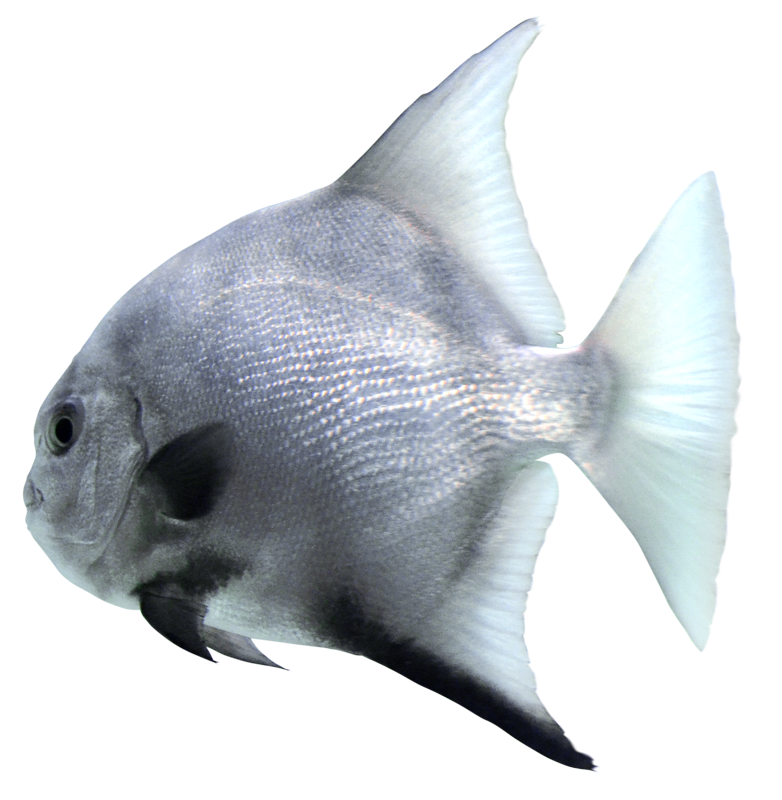
Chaetodipterus faber (Broussonet, 1782)
生息域で体格が異なるスペードフィッシュ
A Spadefish Whose Size Varies Across Its Range
マンジュウダイ科に属する魚で、アメリカ東海岸のマサチューセッツ州南部からバミューダ諸島、カリブ海、メキシコ湾を経てブラジル南東部までの西大西洋に広く分布します。体高の高い円盤状の体を持ち、その輪郭がトランプのスペードに似ていることが英名の由来です。最大で全長90cmほどに達し、マンジュウダイ科の中でも大型の種として知られています。
銀白色の体には4〜6本の黒い横帯が入り、遠くからでもよく目立ちます。ただし、この模様は成長とともに薄くなり、不明瞭になることがあります。幼魚は浅い沿岸域や河口周辺で暮らし、濃い褐色から黒色の体色をしています。さらに体を傾けながらゆっくり泳ぐ行動が見られ、水面を漂う枯葉に擬態して捕食者の目を欺いていると考えられています。一方、成魚は岩礁や人工構造物の周辺に集まり、ときには数百匹にも及ぶ大きな群れを形成します。
雑食性で、動物質から植物質まで幅広い餌を利用します。地域によっては食用にされることもありますが、体内に蓄積された毒素によってシグアテラ中毒を引き起こす可能性があるため、商業的な重要性は高くありません。その一方で、強い引きを見せることからスポーツフィッシングの対象魚として人気があります。また、大型で美しい群泳を見せるため水族館でもよく展示されます。アメリカのノースカロライナ水族館では長年にわたり飼育・繁殖に取り組み、本種は同館を象徴する魚としても知られています。
同属には東太平洋に分布するスペードフィッシュ(Chaetodipterus zonatus)や、西アフリカ沿岸に生息するスペードフィッシュ(Chaetodipterus lippei)が知られています。いずれもよく似た体形と縞模様を持ちますが、大きさには大きな違いがあります。東太平洋種は最大約60cm、西アフリカ種は約30cmほどであるのに対し、本種は90cm近くまで成長します。同じ祖先から分かれた近縁種でありながら、それぞれの海域に適応する過程で体格に差が生じたと考えられています。大西洋の広大な沿岸域で大型化した本種は、地域ごとの環境が生物の姿をどのように変化させるのかを示す興味深い例です。
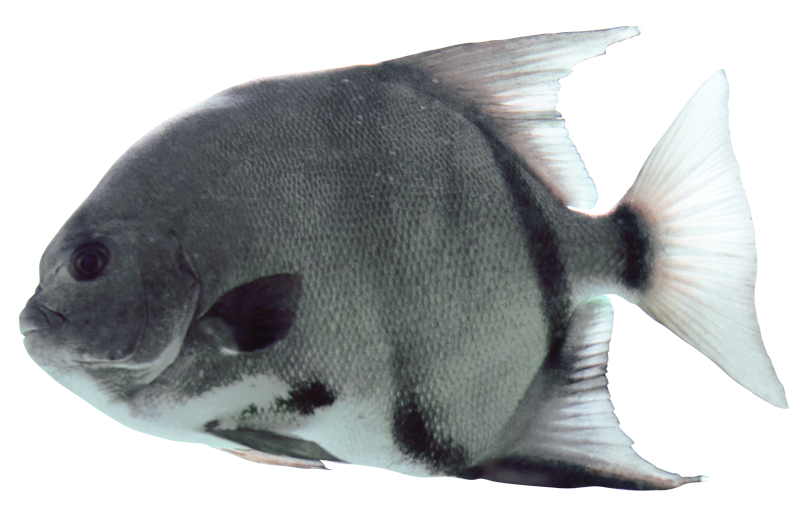
The Atlantic Spadefish is a member of the family Ephippidae and is widely distributed throughout the western Atlantic, from the southern coast of Massachusetts in the United States to Bermuda, the Caribbean Sea, the Gulf of Mexico, and southeastern Brazil. Its common name derives from its deep, disk-shaped body, whose outline resembles the spade symbol found on playing cards. Reaching a maximum length of about 90 cm, it is one of the largest members of its family.
Its silvery body is marked with four to six dark vertical bands that make the fish easy to recognize. These markings, however, often fade and become less distinct as the fish grows. Juveniles inhabit shallow coastal waters and estuaries, where their dark brown to black coloration helps them blend into their surroundings. They are also known to swim at an angle, mimicking drifting leaves and reducing the risk of predation. Adults gather around reefs, wrecks, piers, and other underwater structures, sometimes forming schools numbering in the hundreds.
An omnivorous species, the Atlantic Spadefish feeds on a wide variety of both animal and plant material. Although it is occasionally consumed locally, it has limited commercial value because it may accumulate toxins capable of causing ciguatera fish poisoning. In contrast, its size and strong fighting ability have made it a highly regarded sport fish. It is also a popular aquarium exhibit due to its impressive appearance and schooling behavior. The North Carolina Aquariums in the United States have maintained and bred large numbers of Atlantic Spadefish for many years, and the species has become one of the institution’s best-known symbols.
The genus Chaetodipterus also includes the Pacific Spadefish (Chaetodipterus zonatus) of the eastern Pacific and the West African Spadefish (Chaetodipterus lippei) of the eastern Atlantic coast of Africa. Although these species share a similar body shape and striped pattern, they differ greatly in size. The Pacific species reaches about 60 cm in length, while the West African species grows to around 30 cm, compared with nearly 90 cm in the Atlantic Spadefish. Despite their close evolutionary relationship and shared ancestry, these species appear to have developed different body sizes as they adapted to different marine environments. As the largest member of its genus, the Atlantic Spadefish provides an intriguing example of how regional environments can shape the evolution of animal form.
参考文献
“Chaetodipterus faber (Broussonet, 1782) Atlantic spadefish” FishBase. 2025年2月8日閲覧
“Atlantic Spadefish” Discover Fishes, Florida Museum. 2025年2月8日閲覧
“Spadefish” (2023, February 10), Animal of the Month, North Corolina Aquarium. 2025年2月8日閲覧
“Chaetodipterus zonatus (Girard, 1858) Pacific spadefish” FishBase. 2025年2月8日閲覧
“Chaetodipterus lippei Steindachner, 1895 West African spadefish” FishBase. 2025年2月8日閲覧